Reflections 9th August
The walls that failed
There are boundaries in nature. There are rivers, forests, escarpments, ravines and mountain ranges; there are cellulose walls. But these boundaries are in fact areas of transaction, semi-permeable membranes. The notion that a perimeter should be impenetrable is a human contrivance alone.
Nick Hayes, The Book of Trespass: Crossing the Lines that Divide Us
On the fifth of August, Dutch company Accell filed for a suspension of payments. On the same day, Raleigh, a British company founded in Nottingham in 1887, that provided the bikes of my youth, filed notice that it intended to appoint administrators.
Four weeks earlier the German competition authority had cleared the sale of Accell’s brands, Raleigh among them, to a Singapore group called Dutech. So the name is going somewhere. The company that carried it, and the people inside that company, are going nowhere.
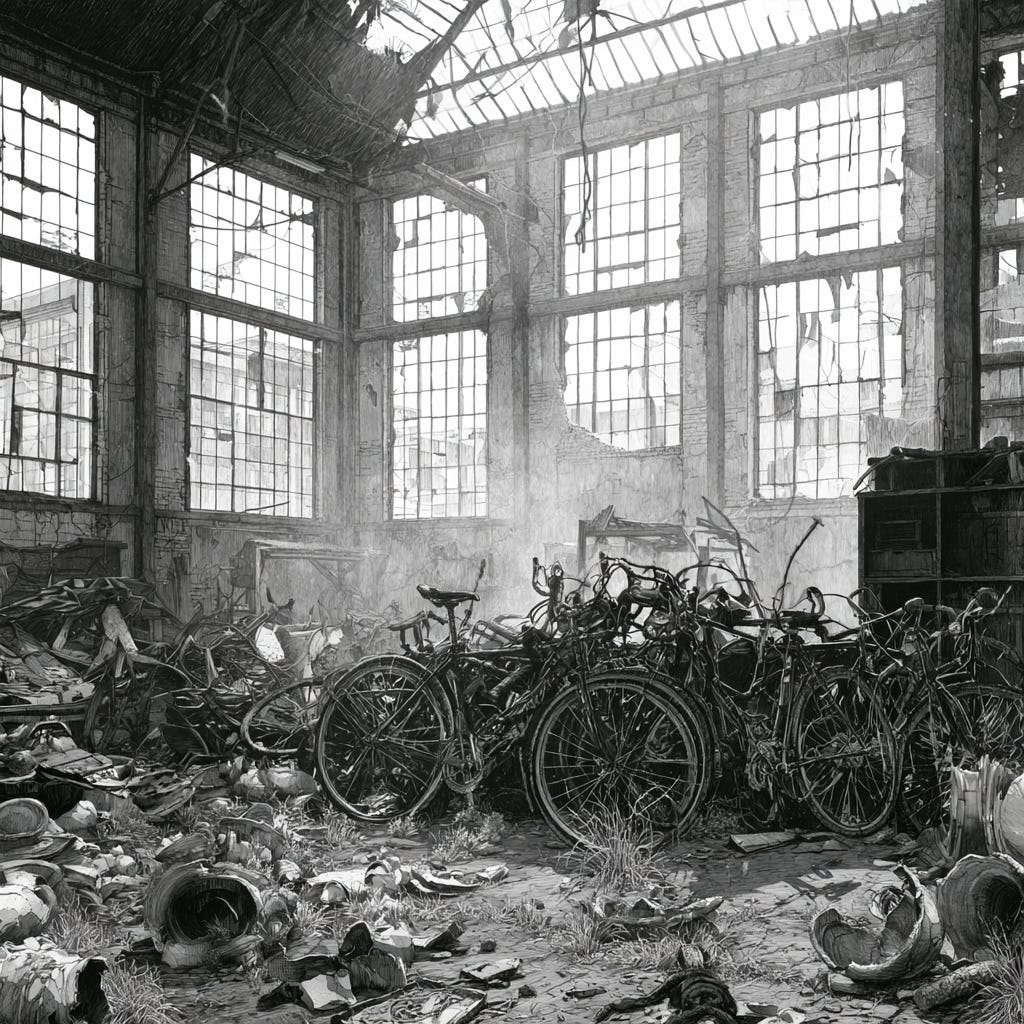
Raleigh built its walls. The name, as with Denby will survive somewhere as a shadow of ifself.
What the walls could not do was protect those sheltering inside it.
Most organisations begin by building bridges. The energy goes into inventing, testing, and connecting a new capability to a market that did not know it wanted one. Then growth arrives, brings complexity, and complexity asks for coordination, standards, control, and some measure of certainty. That is what allows a good idea to become a going concern. It becomes a mistake when the measures become an end in themselves.
It is the point at which the safeguards stop supporting the work and become the work, and investment shifts from what might be made next to the defence of what has already been established. Larry Greiner called the resulting condition a crisis of red tape, the fourth of his phases, arriving when the systems built to coordinate growth begin to obstruct it. It is a hardening of the creative arteries, and arrives unseen, because every individual control seemed justified at the time it was introduced.
Charles Goodhart’s law is usually quoted in Marilyn Strathern’s wording: when a measure becomes a target, it ceases to be a good measure. Goodhart’s own version was drier and more useful: that any observed statistical regularity will tend to collapse once pressure is placed upon it for control purposes.
Inside a firm the effect is the same either way. The numbers that once described whether the work was going well become what the work is for, and the creative clarity that built the business is quietly submerged.
At which point the organisation starts to become worth more taken apart than kept together.
The dismantling has a shape. This summer you can watch all three parts of it here in the UK. They are not the same mechanism; the differences are the interesting part.
The acquisition.
On the seventh of August easyJet’s board agreed a takeover by Apollo Global Management at around £5.7 billion, Castlelake having withdrawn from the contest the same day. EasyJet is not a failing airline. Its third-quarter profit fell by about seventy per cent, to £85 million from £286 million, largely on a fuel bill that rose by £105 million. That is a bad quarter in a cyclical industry with an oil price problem. The airline is being bought because it is cheap. What happens afterwards is a matter for prediction rather than record. EasyJet is now a business with a hundred and sixty million passengers a year that has just acquired a set of owners whose horizon is measured in quarters rather than decades, and will find itself one blip away from following Raleigh, Denby and others.
The leverage.
KKR and Teslin took Accel private in 2022 and put in one point three billion euros of equity against a seven hundred million euro term loan. Equity was about two thirds of the financing, which by the standards of the trade is a great deal of the buyer’s own money. Leverage at closing was five and a half times earnings, and ratings agencies called the outlook stable.
Europe was going to buy an enormous number of electric bicycles.
Europe did not. The pandemic order books turned into warehouses full of stock nobody wanted, the industry discounted, and interest rates went up while the volumes came down. KKR and Teslin lent the company another three hundred million euros as it deteriorated. A restructuring cut the debt by forty per cent, from one point four billion to eight hundred million, with fresh money from both the lenders and the shareholders. In February the shareholders wrote off their equity, upwards of one point one billion euros, and handed the keys to the lenders. In August the lenders wrote off something in the order of eight hundred and fifty million of their own.
Nobody stripped this company. There was no dividend, no recapitalisation, no sale of the freehold to a related party. Every party in the queue lost (Except, of course, The Advisors).
What went wrong is duller and more general than villainy. A debt load calibrated to pandemic demand does not shrink when the demand does, and five and a half times earnings leaves no room to have a bad year.
Raleigh survived the collapse from thirteen thousand employees. It survived being sold, repeatedly, but it did not survive three years of interest on the burden it took on to finance its own acquisition.
The remains. Denby appointed administrators in March. By late April no buyer had been found, manufacturing ended at the site the company had occupied since 1809, and another forty-nine people were made redundant. Denby had been in the hands of Hilco Capital since 2009, a firm that specialises in distressed assets rather than in leveraged buyouts. The mechanism differs again. The ending does not.
Wealth, or at least survival, for a few. Disorientation and disillusion in the rubble for the communities that lived inside the walls that failed.
Although extraction was not the cause of failure at Accel, it is real elsewhere.
KKR had been in business since 1976, the junk bond machinery was working well before 1988. What the RJR Nabisco episode did was make it visible: twenty-five billion dollars, and a book read by people who do not read business books: Barbarians at the Gate.
The name stuck because it was accurate.
Since then the technique has moved steadily down the food chain. The large public company was always a difficult target, defended by scale, scrutiny and the sheer cost of the assault. The consolidator is a different proposition. Buy chains of opticians, or pharmacies, or veterinary practices, and none of the purchases are individually large enough to attract attention. You have assembled market power one small transaction at a time.
The Competition and Markets Authority finished its investigation into veterinary services this year and found consumer harm in a sector reshaped by exactly that pattern. Serial acquisition is now a recognised subject for competition authorities on both sides of the Atlantic, which is a polite way of saying that the regulators arrived after the walls had been breached.
So there are two things going on that undermine the walls. One is deliberate, as the CMA eventually recognised. The other needs nobody’s bad intentions at all; it only needs a firm to be carrying debt raised on the assumption that next year resembles last year.
The second is the more common, and I have come to think it is the more dangerous, because there is nobody in it to blame and therefore nobody to stop.
There is a version of this post that ends with private equity as the barbarian and the rest of us inside the walls. I do not believe it.
What the three cases have in common is not a villain. It is that each firm had, at the moment the bad year arrived, no slack. EasyJet had a fuel bill it could not pass on fast enough. Accell had an interest bill calibrated to a demand curve that failed to show up. Denby had neither the volume nor the margin to absorb one more shock. Slack is the thing that gets optimised away first, because on any given day it looks exactly like waste, and yet it is only visible as insurance in the year you need it and do not have it.
That is what the walls were doing all along. Not keeping the world out, which they never manage for long, but holding a reserve inside: people who knew things that were not written down, a bit of spare capacity, a margin that had not yet been promised to anybody. The financial engineering did not breach the wall. It found the slack and mortgaged it, and then the weather did the rest.
Hayes is right that the impermeable perimeter is a human invention. What he does not say, because he is writing about land and not about firms, is that the invention was always a bargain. The wall kept things out, and in return it told the people inside where they stood, what was their business and what was not, and when they had done enough to go home.
That second half is what private capital destroys first. The walls are still standing at Denby and at Raleigh; the Brands remain.
There is just nobody home.
Appendix: sources
The three cases
Historic Nottinghamshire bike firm Raleigh set for administration, ITV News Central, 6 August 2026, and Accell Group begins insolvency proceedings, Bicycle Retailer, 6 August 2026.
On the financing of the 2022 buyout: Accell Group’s new debt offering secures credit ratings, SGB Media. The €1.3bn equity contribution, the €700m term loan B, and leverage of 5.3 to 5.6 times are from the ratings agencies’ opening assessments.
On the unwinding: KKR cedes Accell Group to lenders after €1.1bn equity write-off, Transacted; Accell Group moves forward with agreement to cut €600 million debt, Cycling Industry News; KKR steps back from Accell Group as lenders take ownership, February 2026.
On the trading position: Accell Group says its recovery on track following €390 million loss; Accell Group revenue falls 22% in 2024.
On the sale of the brands: Bundeskartellamt clears Dutech Group’s takeover of Accell Group.
Apollo Global agrees takeover of easyJet as Castlelake withdraws, 7 August 2026; Apollo trumps Castlelake with £5.7 billion easyJet bid, RTÉ, 10 July 2026; easyJet’s third-quarter results.
Denby to appoint administrators, 13 March 2026; No buyer for Denby Pottery: manufacturing ends, 22 April 2026.
Consolidation and competition
Competition and Markets Authority, veterinary services market investigation, final report 2026. Summary for practitioners.
When small deals add up: antitrust scrutiny of serial acquisitions in veterinary and dentistry, Proskauer Rose.
From my bookshelf
Charles Goodhart, “Problems of monetary management: the UK experience” (1975), for the original formulation; Marilyn Strathern, “Improving ratings: audit in the British university system”, European Review 5:3 (1997), for the wording everyone quotes.
Larry E. Greiner, “Evolution and revolution as organizations grow”, Harvard Business Review (1972, reprinted 1998). The red-tape crisis is the fourth phase.
Bryan Burrough and John Helyar, Barbarians at the Gate: The Fall of RJR Nabisco (1989).
Nick Hayes, The Book of Trespass: Crossing the Lines that Divide Us (2020).


