Reflections 8th March
When the Process Becomes the Point.
We fail, not because we play the game badly, but because we become so absorbed in the game we are playing that we cannot see the larger game it is part of.
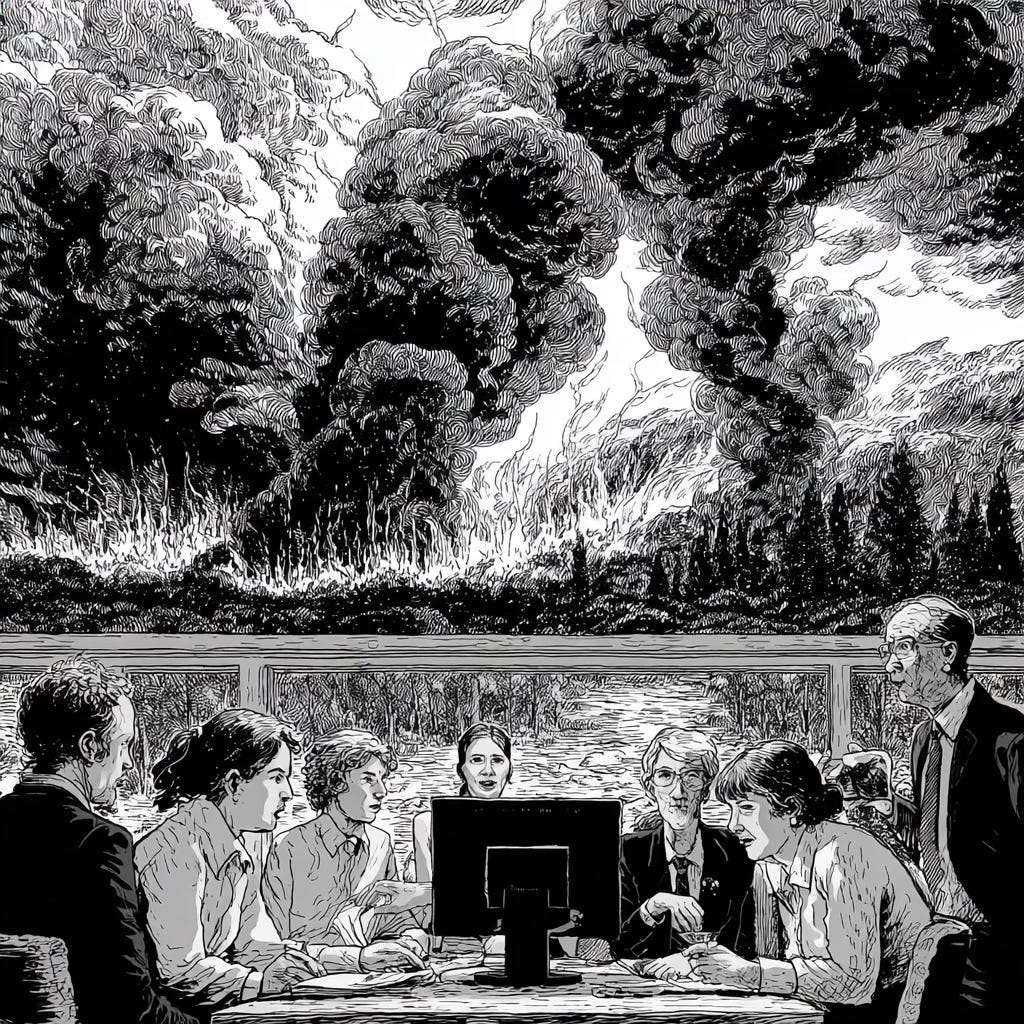
I am sure I am not alone in finding the current situation surreal; in having the sense that we are already on the slope towards a number of epic fails. An epic fail is not simply losing; it is the progressive collapse of possibility to a single, inescapable outcome, while those involved continue acting as though it has not happened. The dread we feel is not about the outcome itself. It is about the widening gap between the possibility we envisaged and the solidifying reality as we watch companies, governments, and even countries making moves in a game that has already been decided.
Companies cutting workforces on assumptions about what AI will do for them, whilst not knowing how, but afraid to be seen not following the herd. Governments capitulating to populists who offer nothing but blame. Countries squandering decades of reputation and goodwill through an apparently studied indifference to consequence.
What, I have been wondering this week, is the mechanism that produces this feeling of terrible inevitability?
The philosopher C. Thi Nguyen offers the sharpest tool I have found for understanding it. In his book Games: Agency as Art, he draws a distinction between two fundamentally different orientations to purposeful activity.
In achievement play, the goal is the point. You play to win, and winning is the whole of what you are after. The goal organises your activity, and once reached, the activity is complete. In striving play, the relationship is inverted. You adopt the goal of winning not because you value the win, but because without a goal the struggle has no shape. The win is the scaffold that gives the pursuit its form. What you actually value is the quality of the engagement: the full presence of your capacities against a resistant and unpredictable world.
The distinction matters because striving play is irreducibly process-oriented in the right sense. Strip away the quality of genuine engagement with the world, and you have not preserved something cheaper. You have destroyed the thing itself.
Nguyen calls what happens next value capture. The scaffold becomes the building, and the metric designed to point to something real begins to substitute for it. Our values, he points out, are rich but hard to express, and resonate with my thinking on craft and mētis; on who we are more than what we do.
The sharp, explicit format of measurable targets has a competitive advantage in institutional life. Adopt the metric, and your efforts gain the clarity and motivational pull of a game. All you have to do is peg your values to a number. The cost is the progressive displacement of the richer, harder-to-articulate judgment the number was originally meant to approximate. It is paid slowly, and mostly off the books.
This is what I mean by the process becoming the point. Goals serve a purpose, but when we make them an end in themselves, when we give power to metrics over meaning, the process becomes its own justification, and we become blind to the larger game. We are watching tactical players winning brilliantly in a war they have defined for themselves: every metric green, every target hit, the dashboard untroubled by doubt, even as the larger game makes the win meaningless.
The second condition that makes this drift so dangerous is structural distance from consequence.
Taleb was right about having skin in the game. Those who bear the consequences of decisions have a better understanding of reality because reality, whether measured in lives affected or livelihoods lost, corrects their errors. Remove that skin, and the feedback loop floats free. The tactician who will not be on the ground when the policy plays out. The engineer who will not be on the aircraft. The statistical modeller who will not be in the neighbourhood when the mortgage fails.
The distance is not moral failure. It is the structural logic of scale, which progressively concentrates authority in the people furthest from consequence and removes it from those closest. The people with genuine skin in the game, the clinician in the room, the teacher who cannot hide behind a dashboard, the engineer who knows what the structure is telling them, are precisely those whose knowledge and judgement the process has been trained to subordinate to metrics.
Every time we prioritise metrics over mētis, we lose connection to reality, because there are no metrics on the future. Mētis, the practical wisdom earned through experience rather than study, the kind of knowing that lives in your hands, your instincts, and your judgement rather than in any book or manual, just might give you a glimpse. It cannot be taught directly, transferred easily, or replicated by an algorithm. It is forged only in the doing, over time, under real consequences, which is precisely why it matters more now, not less. Mētis is what connects the map to the territory.
And it is in the territory that the failure occurs.
The quiet disillusion. The realisation that others understand the map but not the territory, formulaic action matters more than local culture, and that they fail to be motivated by what you thought they should be. The realisation that small mistakes and misunderstandings compound, and define the next game in the sequence, the ones that they are not yet aware of.
A quick glance at our record of official enquiries over the last decade gives a measure of what this costs. In 2015 there were ten official inquiries in the United Kingdom, taking an average of two and a half years and costing £40 million. By 2025 there were twenty-seven, taking nearly five years, at a cost of £250 million. What we miss costs us dearly. Data may give us a map, but it is the territory that calls the shots. Learning in retrospect is an expensive business.
The impending tragedy in this is the evaporation of agency, as unaccountability becomes a design feature of large organisations. The audience, those outside the institution, those living with its decisions, can feel what those running it cannot: the tiny details, the loss of familiarity and connection, and the accelerating erosion of trust.
Trust, like possibility, is never based on logic alone. When trust disappears, the window of possibility through which new ideas and futures can be seen closes, and the blinds are drawn. The immediate future is then on rails, and process is in charge of the locomotive.
Despite all the hype and noise, this is not AI’s fault. AI accelerates what we were already doing. It makes achievement, measured in performance metrics, faster and more confident. It deepens our insulation from where decisions affect people, promoted to an emissary between leadership and reality. And it makes the process more self-contained and self-referential than any purely human system could be, because it optimises at speed and scale exactly what it has been told to optimise for, with no access to the situated, relational, risk-bearing judgement that might notice the larger game. This is not an AI problem; it is a people problem.
What I have termed the Artisanal Gap, the critical space that mētis occupies, is where the surprises, both positive and negative, will arise. Try as we might, people will not be programmed at scale. It may have seemed an act of perfect logic to arm convenient rebels when the Russians occupied Afghanistan, yet it enabled the Taliban, which has not worked out so well. We might want to reflect on whether what we are doing with AI is quite as different from that as we would like to believe.
This pattern is not new and not accidental. It is what happens in every epochal transition. William Ophuls captures it with uncomfortable precision:
Civilisations are undone not by their failures but by their successes. The very scale, complexity, and resource consumption that mark a civilisation’s greatness generate the structural conditions of its eventual collapse. Each solution adds a layer of complexity that costs more to maintain than the last. Each innovation produces unforeseen consequences that accumulate faster than institutions can manage. The system becomes simultaneously too complex to reform, too indebted to its own momentum to change course, and too captured by entrenched interests to act in its long-term interest. Collapse is not a failure of will or virtue. It is the bill presented by immoderate greatness itself.
Every severance, though, has a corresponding restoration.
The restoration of striving play requires the recovery of genuine orientation: the willingness to remain in contact with the world as it actually is, rather than as the process represents it. The restoration of skin in the game requires redistributing genuine authority to the people closest to the consequences, not redesigning dashboards, but giving the clinician, the engineer, and the teacher the power to act on what they know.
The restoration of meta-game awareness cannot be institutionalised by procedure. It requires the capacity to stand outside the game being played and ask what game contains it, to hold open the possibility space that process culture systematically closes. In a world dominated by metrics, mētis becomes a luxury good, and like all genuine luxury, it cannot be scaled. It is a function of having skin in the game: not just accountability, but relationships and purpose, a sense of belonging, and a willingness to care for others and for what comes next.
This is, in the end, a form of meta-game awareness: knowing there is a larger game than the one we are in, and having, even without a full understanding of its rules, some instinct for its shape.
We do not know how the present moment will resolve, other than that it will. But the work of beginning, one step at a time, with those who still have both the mētis and the willingness to use it, is not nothing. It may, in fact, be the only thing that matters.
It is this work we are exploring at The Athanor. The alchemical metaphor is deliberate - what we are exploring is not science, or logic; it is more fundamental, and aligned to what process cannot discover.


There things we do not see, or choose to not see.
Maybe it is a small, but crucial part of the system that is failing. Maybe we can fix it.
If it is something larger than what we see, do we assume that the way we know things is the way things should be.
One of those assumptions is the hierarchical nature of organizational systems.
Virtually all my conversations are revealing not just failure of hierarchy, but the inability to see how it can be saved.
When a company terminates the employment of 30,000 workers, what does this say about how the processes of the systems have operated and managed.
I’ve been talking with academics who have lost their teaching jobs. What are the conditions upstream that contributed to these decisions. And when these teachers are required to sign a NDA in order to receive their severance, it is reflection of the hierarchy not wanting to been scrutinized like they did faculty members.
So, if the change we see is larger rather than smaller, how do we respond when the hierarchy is closed to conversation?
The upside is that I find greater engagement with these questions.
It really is a fascinating moment.