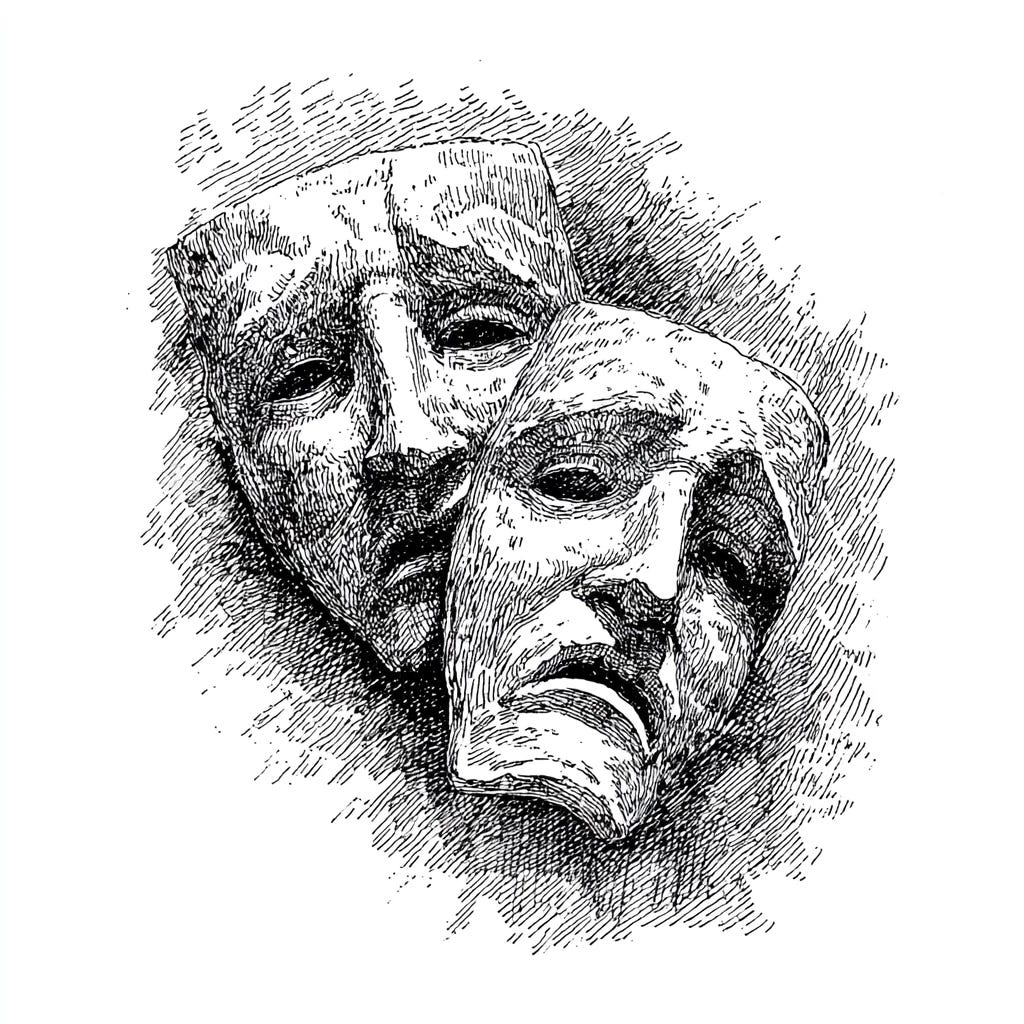
Reflections 7th December.
Time to change the story
The end of a year is a natural time for reflection.
Short days, the Winter Solstice as the world turns, accompanied by celebrations, pagan and faith-based, and the stories that accompany them. And of course, here in the UK, the tradition of pantomime, originating in ancient Greece and Rome as a form of expressive mimicry, which then resurfaced through Italian commedia dell’arte before evolving into the British Christmas tradition we know today. It has become a communal ritual that blends satire, archetypes, and audience participation, which is why we now use “pantomime” as shorthand for any public drama that feels more performative than serious.
It now seems destined to be privatised by FIFA and other pedlars of spectacular but otherwise meaningless gladiatorial entertainment.
My friend
introduced me to Baudrillard and his “Spectacle of the Real”, where the world feels increasingly shaped by images of itself. When we spend more time with representations than with the things they are meant to represent, and slowly, the copy starts to feel more real than the original. Politics becomes performance, work becomes more metrics than meaning, and even our own lives are edited for digital audiences we do not see.It is a strange inversion. The messiness and substance of experience retreat into the background while a brighter, tidier version takes centre stage. This spectacle of the real has become so normal that we barely notice it, yet it quietly alters how we think, act and judge what matters. When our news headlines are dominated by a drama of Netflix and Warner Bros, and when a pantomime villain publishes a foreign policy grounded in his own delusional and self-interested story, maybe the end of the year is a time to consider different stories.
The uneasy space between the real and the almost real
I came across the idea of ‘uncanny valley’ years ago, as a facet of games technology that describes the discomfort we feel when something artificial comes close to looking human but does not quite make it. It is the slight recoil we experience with lifelike robots, digital avatars, or faces edited to perfection. They are almost real, and that is the problem. Our senses know something is off even when we cannot explain why.
The idea becomes more interesting when we set it alongside Baudrillard’s view of a world dominated by polished representations. If the spectacle of the real encourages us to accept the copy as the original, the uncanny valley reminds us that our bodies often resist. We encounter stories, images and public performances that are beautifully presented, confident and emotionally tuned, yet they carry a strange aftertaste. They look right on the surface but feel wrong underneath. Something in the proportions does not add up.
We can see it in the way organisations tell their stories. The message is expensively and persuasively crafted, the visuals are warm, and the language is reassuring. Everything signals competence and calm. Yet, even as we are subjected to a torrent of persuasion, we often feel the opposite. Politicians whose hand movements have been coached, but which do not connect to the scripted words coming out of their mouths. We know instinctively that we are being invited into a world constructed for effect rather than insight.
It is where Baudrillard and the uncanny valley meet. As representations become more produced, remote and superficially convincing, they do not always become more trustworthy. The closer they get to our own sense of reality, the more we sense the gaps we find it challenging to articulate other than through anger and frustration.
Rather than dismiss that discomfort and succumb to fear, we should treat it as an early warning. The uncanny valley is a signal that something has been polished past the point of authenticity; it tells us that a story has been tuned for effect rather than grounded in experience and that a leader has begun to act a part. It tells us that a system has chosen surface artificial coherence over the messier honesty that the leadership of real change requires. It is, as the old joke goes, a matter of mind over matter. They don’t mind, and we don’t matter…
In a world increasingly shaped by simulations of competence and care, our unease is not a flaw. It is a guide. It draws us back towards spaces where experience has not been edited and where conversations have not been rehearsed. In my work, those spaces are the small groups and quiet workshops which I write about here, at New Artisans , and the Community of Practice we are slowly building at The Athanor; places where simulated anaesthesia gives way to the uncomfortable real, and where the instinctive recoil at the uncanny valley can relax into the generative furnace of genuine human connection.
The question becomes how we step back across the threshold of the uncertain into something more grounded. We will not outcompete the spectacle on its own terms, and we do not need to.
What we can do is return our attention to the places where the real still insists on being felt. Craft, in its broadest sense, remains wonderfully immune to simulation. It requires contact, patience and a willingness to risk failure in full view of others. Those qualities draw us out of passive spectatorship and back into participation. They offer small acts of agency that do not depend on permission, and they create spaces where collaboration feels natural rather than choreographed. When we come together to work on something tangible, no matter how modest, a different kind of story begins to form, one that does not need polishing to carry meaning.
It is not a retreat. I suspect that many of us share a quiet anger at what is happening and the stories we are being peddled by the morally challenged. Rutger Bregman is articulating it effectively in the current Reith Lectures, made perhaps more potent by the fact that the BBC, whose founder Lord Reith saw it as an organ for speaking truth to power, has sheltered behind the advice of its lawyers and edited his text so as not to upset the Spectacle of the Real currently coming out of Washington.
We have to work closer to home, doing what we can, where we are, with what we’ve got- to paraphrase an American President of a very different calibre.
The reality is that we all work for ourselves, even where we have a job working for others. It is a matter of perspective. In the spectacle, we are all bit part actors when we work for others, and authors when we work for ourselves. We are a company of one, with our own strategies and networks, and we are responsible for developing our own skills.
And we are not that far from the Real.
Our farmers, who face levels of uncertainty that make organisations doing work of much less moment seem mollycoddled, are first and foremost farmers. Their skills, attitudes and dispositions are their own. They have agency far more than those of us who work for large organisations, where our connection to the entirety of the enterprise is at best tenuous, and their resilience and adaptability command tremendous respect.
There are businesses that command the same respect, often quietly and without spectacle. Family firms, in particular, have a way of grounding themselves in the real that many large organisations have forgotten. They work to rhythms measured in seasons and generations rather than quarters, and they carry a commitment to reputation, legacy, and mutual obligation that does not translate easily into the language of metrics. They often succeed not by competing harder but by choosing work that others overlook, by relying on relationships rather than choreography, and by using resources with a patience born of shared history. Their governance is informal, their knowledge is tacit, and their sense of purpose is rarely scripted for an audience. Like farmers, they live close to their craft. They make decisions with skin in the game and a clear view of the consequences. In a world addicted to polished stories, there is something refreshingly unvarnished about enterprises that know how to win without fighting, simply by being themselves.
2026. Taking Ourselves More Seriously
One of the most challenging aspects of change is recognising what we need to let go. It is often what has shaped us, from which we have derived our status, and where we feel comfortable. Leaving it is a challenge. And so it is, I believe, with seeing organisations as somewhere where we develop our careers and ourselves.
There are great organisations out there, but they’re rarely the ones offering us the spectacular money, peddling the spectacle of the real. These are organisations run by those who resemble Tolkien’s Ringwraiths, so consumed have they become by the spectacle rather than the real. In those organisations, we are disposable “human resources”.
The Real is different: It is where first-hand experience takes precedence over second-hand commentary; where practice matters as much as performance, where relationships with small groups matter more than peddling stories to an anonymous mass audience. It is where we value quality over metrics and relationships over reach. The work is less scalable but far more real. It is not about impressing a crowd; it’s about improving craft over time, and that paradoxically, is where meaning and value regenerate.
It can be easy to think this is just whistling in the dark. I don’t think it is. I think the spectacle is beginning to wear thin. Beyond the froth of whether or not AI is a bubble, are discussions with rather more substance. Rather than repeat them here, I’m putting some links at the end of this post that you might like to read and form your own conclusion.
2026 is a year to take ourselves more seriously. To think more like farmers, and less like fantasists. To choose the people we want to work with over time, doing things that matter. To shape our lives and careers independent of organisations as arbiters. Technology is giving us more options than perhaps we have had in the last hundred years. It would be a shame not to take them.
This is what we are exploring during 2026 at the Athanor. Working together at the edge of what is fraying to find out what is beyond it, and work with it.
Posts to Ponder
On The Limitations of LLM’s On The Siren’s Call blinding us to the complexity of our work On the changing character of Leadership On Organisational Physics and Moral Gravity (heavy title, brilliant Article)Cory Doctorow on Working with AI, or for AI….


Thank you, Richard. A couple additional thoughts. Juhani Pallasmaa in his book, The Eyes of the Skin: Architecture and the Senses, makes the point that our sense of sight is the least dependable sense for connecting with reality. He says our skin, our sense of touch, is. This suggests that physical reality is separate from image-based representations. We can easily be fooled by what shows up on our screens. I saw a comparison recently of two AI created images. The first generation version was sparkling. The second gen looked like something I’d take with phone. This leads us to need to develop a positive agnosticism about the presentations we receive. I am interested in what changes over-and-above what it means. Show me the tangible difference that it makes in how someone lives. This is what The Spectacle of the Real cannot produce.