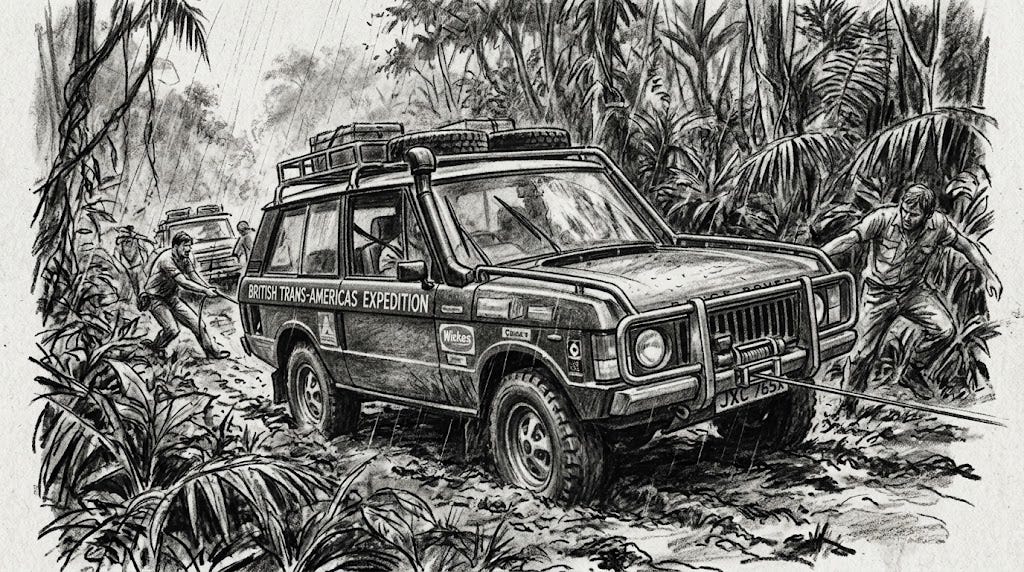
I’m sorry this is a day late. Object lesson over the weekend on resilience, as a garden that had been starved of rain for close on three months reacted to a week’s worth of it, and tried to turn itself into the Darién Gap I write about below
Sometimes, we can look at the data for as long we like and still not find the answer to the incomplete question we are pursuing, as, in many cases, the question itself morphs as we chase the answer.
I suspect that, in part, it is because we have become so obsessed with data and its management that, on a day-to-day basis, we discount what holds the data together.
This morning, as we look at the thousands of jobs that will be displaced at Jaguar Land Rover, the reasons that are being rolled out are the obvious ones. The tariffs in America, which are clearly going to be true, and the cyber attack, which is also true. These are within the bounds of normal business risks, not outliers, and a strategy failure with the staff rather than shareholders paying the price.
What we don’t talk about is what Jaguar Land Rover has become. We look at it sentimentally, as though it is still an integrated business with a clear identity. It no longer is. It went through a series of restructures before being sold off to a multinational domiciled outside the UK, and we watched as, gradually and then suddenly, its identity became eroded to a point where it is no more than a manufacturing unit with a synthetic brand, following the data to the extent that in the same week as the job cuts are being advanced, it launches an electric Range Rover.
Personally, I cannot imagine anything more ridiculous than an electric Range Rover.
In 1971–72, two early Range Rovers undertook the British Trans-Americas Expedition, travelling from Alaska to Tierra del Fuego in a dramatic demonstration of the new vehicle’s capability. Its defining challenge was the Darién Gap; the roadless, rainforest-and-swamp barrier between Panama and Colombia, where a British Army-led team spent 96 days forcing the heavily laden vehicles through terrain that often permitted progress of only a mile a day. The crossing demanded trail cutting, improvised bridges and rafts, winching, mechanical repairs and a rethink after oversized swamp tyres and heavy loads damaged the vehicles’ differentials. Emerging into Colombia in 1972, the expedition became a foundational episode in Range Rover history: less a conventional drive than an extraordinary feat of engineering, logistics, persistence and courageous people that helped establish the model’s enduring reputation for go-anywhere durability. It was an astonishing feat that set the Range Rover’s identity for decades.
Its successor will not be able to make a journey from London to Edinburgh without a stop on A roads or motorways for electricity, and unlike petrol, you can’t carry electricity with you. It is a remarkable triumph of marketing over substance, designed for an audience where image is everything. With a price starting at £150,000 for the basic model rising to £225,000, Range Rover is now a classic Veblen good, where demand is negatively elastic to become more attractive the more expensive it is, hoping to survive in a market where cars have more in common with white goods as they become, in effect, washing machines with wheels.
The Erosion of Care
This is what measurement does when it is left unexamined. Efficiency is not a thing, it is a ratio, that requires three decisions: a numerator, a denominator, and a timescale. The first two get argued about. An owner who cares about their what their business will look like in twenty five years thinks and measures differently from a manager on a three-year posting, and both think differently differently from an investor planning an exit in five. They are not disagreeing about the facts. They are using different clocks. One cares about the business, one about their career, and one about the money.
Consider the Darién Gap crossing. Ninety-six days to cover a distance that could have been done in a helicopter after a leisurely breakfast and arrive before lunch. Why all the trail cutting, improvised rafts, winching, differentials wrecked by tyres that turned out to be the wrong answer, with a full rethink halfway through? By any measure it was a catastrophe for productivity. What it did produce, though, was not the film footage , the advertising or even the story. It produced knowledge held inside particular people about the soul of Land Rover, and where it might go next. At that time, Range Rover was a risk, and what it produced was metis; the situated knowledge that comes from exposure to challenging conditions and which no amount of data can capture.
Mētis is expensive to acquire and cheap to destroy. Acquiring it requires years of people caring enough about something to pursue it while things go wrong, until they uncover the secrets about what they are working with. It is slow, painful and largely unbillable. Destroying it requires only a cost saving exercise, or ceasing to care beyond short term returns. The asymmetry is why it gets sidelined. The case against it is always in the data. The case for it never is.
It why the word craft has become marketing decoration, a font choice, applied to area where process long ago eroded the craft ethic. When we want to create something important, rather than a shallow, highly processed sequel to something we already know how to do, the outcome is not predetermined by a plan; it remains continuously at risk in the hands of those creating it, and depends on their judgement in the moment.
Care is not a sentiment attached to skill, and is part of its makeup, not an optional extra. A craft practised without it is a different is no longer a craft, it is a soulless process boundaried by data. I can think of no better description of a £200,000 vehicle designed to be looked at rather than used.
English is an unhelpfully generous language when it comes to the word “care”. On one hand, it can be a care package, sold as an option, or somewhere we put old people to be monetised by venture capital, or it can be the engine of what teachers, doctors, explorers and others for whom what they do is calling more than “work”. The moment care becomes data it becomes a process movable between suppliers, with every improvement recorded as data while leaving core to rot away.
Something similar happens to identity. When we turn it into data, identity becomes a brand that can be bought, licensed, relocated to a different jurisdiction and managed by people who do not care. What cannot be relocated is what built the brand . Jaguar Land Rover kept the noun, whilst the verb was restructured out of existence somewhere between the third reorganisation and the fourth.
It matters. A surgical checklist of nineteen items was introduced across eight hospitals by the team who did the surgery driven by care as a reaction to adverse data, and was followed by a halving of thirty-day mortality.
It was, understandably, adopted everywhere, but when adoption was later mandated across a hundred hospitals in Ontario, with self-reported compliance above ninety per cent, there was no significant change in mortality, complications, length of stay or readmissions. The same nineteen items. One result driven by care and a sense of identity; the other by compliance to a mandated process.
Several things could explain it, but the difference I think is authorship. In the first case the practitioners were pivotal in design and implementation. In the second they received it. The difference is agency, between a standard we have authored and a training programme.
Efficiency programmes are not wrong, but they are partial. There is always substantial ground to be won in administration, duplication, coordination and handovers, and most of the credible gains of the last thirty years have come from exactly there. It is where AI can have real impact, and more power to its digital elbow.
What no process, AI included, can do is manufacture the attention driven by care. Where organisations have created space for attention at the expense of short term efficiency, the results have been awkward for the management orthodoxy: better nurse-to-patient ratios producing lower mortality and costs avoided at more than twice the cost of the staffing; as well as district nursing teams running at a third of the industry’s overhead with better outcomes. Care of that kind is not a cost the system carries despite its need for efficiency. It is the means by which we discover what is happening to it in time to act.
The part of any craft we can delegate to technology is the process is the support act. We have always been able to delegate it to other people; it is where apprenticeship came from.
Now, when we can delegate to a technology that will perform in seconds what used to take hours, and which improves recursively on the data it generates but leaves no space for care. The early findings are consistent and should give us pause for thought; where we treat AI like an apprentice, our work gets faster and measurably better. Where we assume competence, we check less, accept more, and do not improve our own skills over the course of the work, while the ones worked with an “apprentice” stayed sceptical and got sharper.
It is a care gap. Judgement is formed by our exposure to consequence in real time. Treating an apprentice as a master good enough to be trusted removes the exposure while leaving the consequence invisible because it becomes remote, and beyond our care boundary. We record the apparent gain, whilst the cost lands on the erosion of judgement over time.
So where does the line actually fall? Perhaps between execution and answerability. It started with scientific management, and grew through process by stretching the gap between those who do the work and those who receive end product or service, with management as shock absorber for failure.
Two components of care do not delegate. First, attentiveness, because it cannot be subcontracted, and secondly, answerability in being the one who is responsible.
That gives a usable test. The question to ask of any delegation we make, to a supplier, a subsidiary, an outsourcer or a machine, is not whether the output is good enough. It is whether the delegation has removed an opportunity to learn something that data cannot record.
Which returns me to the thousands of people who will leave Jaguar Land Rover over the coming months. The headcount will be reported, because it is data. What the company loses beyond data will not. It is the difference between using the Darién Gap as marketing collaterlal, and being there to understand what a new car would and would not do. That sort of knowledge is expensive, acquired one particular situation at a time, and is about to be removed at the stroke of a pen by people using a three-year time horizon.
The Darién Gap was crossed by people who could be identified by name, in vehicles they had to keep repairing themselves, in a place where nobody could take the consequence off them. That is what set the identity on which a brand was built.. The successor to those vehicles is a beautifully executed but sterile object, usable only in places where a car costing a quarter of the price would be equally functional, and whose whose fragile identity is the impression it makes on arrival.
It’s a logical conclusion to what happens when we prioritise data over care.
The next step feels inevitable. Countless brands built by those who care have found themselves acquired by those who do not have a founders care, and find the identity and brand eviscerated by those who want to extract value measured in one very particular dimension.
It is easy to see Jaguar Land Rover following Aston Martin, Lotus, Morgan, Bristol, and a whole variety of other businesses, including manufacturing ones like Denby recently, into a place where the brand sits as a line item on the intellectual property register somewhere rather than a living, vibrant entity; something that like an ageing celebrity depends on sequels and prequels of work previously done, rather than doing something original.
It doesn’t make me angry so much as sad. These brands deserved better end-of-life care. The people in them who do the work deserve a better organisation.
Sources
McHugh et al., “Effects of nurse-to-patient ratio legislation on nurse staffing and patient mortality, readmissions, and length of stay,” *The Lancet* 397 (2021): 1905–1913. Aiken et al., “Hospital Nurse Staffing and Patient Mortality,” *JAMA* 288 (2002): 1987–1993.
KPMG International, *Value Walks* (2016), on Buurtzorg; Rasmussen et al., scoping review (2024), on transferability.
Haynes et al., *NEJM* 360 (2009): 491–499; Urbach et al., *NEJM* 370 (2014): 1029–1038.
Tronto, *Moral Boundaries* (1993) and *Caring Democracy* (2013); Hochschild, *The Managed Heart* (1983); Hülsheger and Schewe, *Journal of Occupational Health Psychology* 16 (2011): 361–389.
Dell’Acqua et al., “Navigating the Jagged Technological Frontier,” HBS 24-013 (2023); Dell’Acqua, “Falling Asleep at the Wheel” (working paper, 2022); Lee et al., CHI 2025; Stanford Digital Economy Lab, on apprenticeships.