Reflections 5th July
When Gaps Appear
So much is shifting at once that I find it hard to know where to stand, let alone where to start. Gaps everywhere.
John Muir saw the difficulty more than a century ago, walking the Sierra:
When we try to pick out anything by itself, he wrote, we find it hitched to everything else in the universe.
Pull on one thread and the whole fabric moves.
So the task becomes simpler and more uncomfortable at the same time: pick a gap.
Any one will do. Find one that holds your attention, and from there work your way toward the one that matters now.
I have never found much to hold me in the gaps we make for ourselves. The gap in a market, in a strategy, or in the politics of the week; these are shallow things, drawn in data and coloured by opinion, and they close about as quickly as they open.
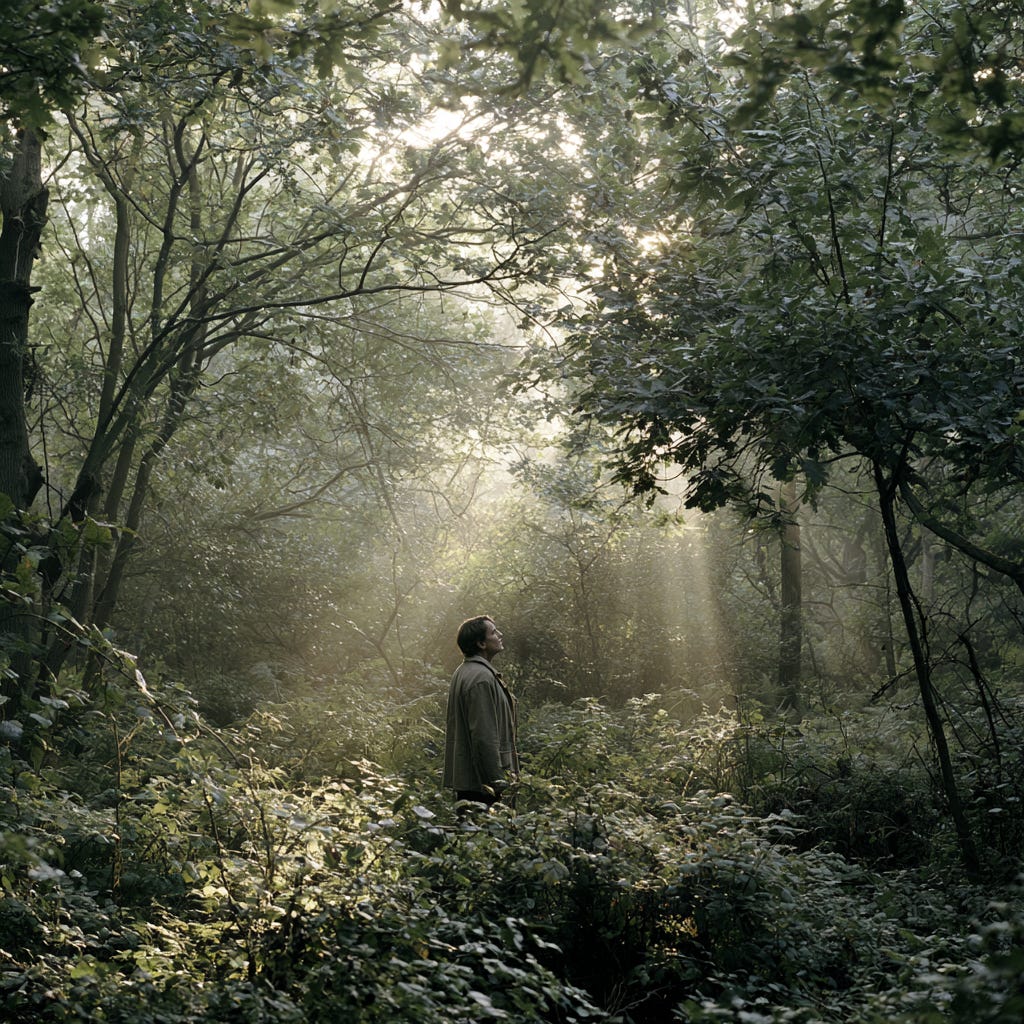
Nature keeps deeper examples, so I have gone back to a metaphor I have used previously, the gap that opens in a forest canopy when an old tree fails and falls, and to the under-storey beneath it, that patient tangle of established but under-resourced growth waiting on the forest floor.
When a canopy tree comes down, the fastest gaps to close are not filled by anything new. Most small openings shut again within a season or two, closed from the side as the neighbouring trees extend their crowns into the light; nothing is replaced, and the incumbents simply grow larger. Only when a gap is too wide for the surrounding crowns to reach across does the question of what rises from below arise at all. The first quality that governs how a gap closes, then, is simply its size; and the first thing the forest tells us is that the scale of a failure decides who occupies the space. A modest firm goes down and its rivals absorb the space sideways before anything emergent gets near it. It takes a collapse large enough to open vertical room, room the incumbents cannot lean into, before the understorey gets its chance.
And when it does, what happens next is set less by what arrives after the gap opens than by what was already standing in the shade before it did. Foresters have a name for it: “advance regeneration”. Shade-tolerant saplings established years earlier, holding at knee or waist height, a stem and a root system already in place with almost nothing above ground to show for the patience. When the canopy breaks they are released; that word belongs to the foresters, but it feels right to me for where we find ourselves,
They climb fast because they are not starting; they are resuming.
A gap with a deep bank of that suppressed growth beneath it closes quickly. A gap with no such bank, one that must wait for a seed to blow in, settle on bare ground and begin from nothing, closes slowly, uncertainly, unpredictably, and often to a thinner and more restless set of occupants.
This is the lesson I most want to carry across: uncertainty does not create the thing that fills the gap. It releases what is already there in us.
There is another lesson underneath that one. What gets released is not always what we would have chosen. An opening can go to bramble as readily as to oak, and the bramble does not merely arrive; it holds. Whoever covers the ground first can keep it covered, shading out the slower, taller thing that would, given time, have made the better wood. Ecologists who study this call it inhibition. The fastest coloniser of a gap is rarely the one that would crown it in fifty years, and it can stop that crown ever forming. Speed into the opening is one thing. Fitness to hold it for a lifetime is quite another; and so what thrives in the wreck of an old order is often no heir to it at all. It is something that could only ever have grown in the wreckage: a form suited to disturbance, to bare ground and open sun, to the short window before the canopy closes over again.
At this point the metaphor has done its work for me; I will not push it further because I know people who have forgotten more about forests than I will ever have time to learn, and I would rather stop at the edge of what I am beginning to understand than infer a competence I lack.
And so to the gaps of our own moment, the ones opening now in the made world of markets and firms and work as a new technology moves through them. It is opening gaps quickly, many of them wide; in tasks, professions and trades, and in whole categories of employment.
The forest gives us better questions to ask of them than the ones usually on offer.
The usual question is who will build the next thing, and what must we learn as though the gap will be filled by whatever proves cleverest at starting from nothing once the light arrives. The forest suggests otherwise. It says look to what is already standing in the shade. The order that follows a large failure is rarely invented in the opening; it is drawn up into it, released from whatever was established, suppressed and waiting while the canopy still held. So the question is not what we will build after the gaps appear. It is what we are quietly building now, in the shade, while the old canopy still stands and still pays.
What have we let root, almost unnoticed, with little above ground to show for it, that could be released when the light comes?
There is more to a falling tree than the light it lets in. When a tree dies it stops drawing on the soil, and for a while the ground beneath it is unclaimed; water, nutrients, and the space where roots can run. That below-ground opening is invisible from above, and it closes faster than the hole in the canopy, because the surrounding trees push their roots into the freed soil long before anything moves toward the canopy. A seedling can stand in full light and still starve. In the world of firms the light is the visible part, the released demand, and the customers suddenly looking for somewhere to go. The soil is everything underneath: the capital, distribution, specialised people, data and the trusting relationships a new venture actually needs. The survivors reach those first. Whilst a logical, carefully argued proposition can look appealing, it can lack the root structure it needs.
Set beside all this, some of the confident forecasts look questionable. We are told to expect the single-person company grown to enormous value, the one-person unicorn; a great crown thrown up fast on the strength of the technology. Perhaps. But a crown is not a root system, and the forest is unsentimental about the difference. Height gained quickly, without the slow underground architecture that anchors a tree and feeds it through drought, is height held only until the first real storm. The question I would put to any such venture is not how high it has grown but what holds it down: what relationships, what tacit knowledge, what feel for the subject, what reason to endure past the season it happened to be fashionable.
A firm can be all canopy. It does not usually stay standing.
And I also have to rethink my earlier argument, because I described the bramble up as the thing that smothers, but the forest will not let me leave it there. I had the bramble as the coloniser that takes the open ground and holds it, shading out the slower tree that would have made the better wood.
It can be that. But in grazed country it is as often the reverse. The oak does not establish in the open, where the deer and the rabbit find it; it establishes down inside the thorns, hidden and defended, and grows up through the bramble that sheltered it until it overtops and shades out the very cover that saved it. The country legend for this is older than the science that confirms it:
“The thorn is the mother of the oak”
Which turns the question round. Perhaps the fast, thorny technology moving into the gaps is not the thing that smothers the slow-rooted work but the thing that shelters it through the years it could not survive in the open, and is outgrown, in the end, by what it nurtures.
AI can support relationships, but is unlikely to last without them.
The same thorn shelters one seedling and smothers another, and the difference lies in how the two grow together. Kasparov, having lost to the machine, drew the lesson the rest of us are still catching up with: a modest player working well with a computer will beat both the grandmaster alone and the computer alone. He called the good version the centaur, human and engine grown into one animal with the human still holding the reins. There is a poor version too, the reverse-centaur, where the person is yoked to the machine and set to keep its pace and carry out its judgement. The technology makes one or the other of us according to how the work is arranged, which is to say the arrangement is now both craft, and personal discipline.
A real one, a new one, and there is no manual for it. There was no handbook for living with steam, and none for electricity; the mills and the households worked it out as they went, badly at first, over a generation or more.
We are early in the same kind of working-out, and the surest way to end up yoked to the thing is to pretend otherwise, that it is simple, or that the working-out is already behind us, and that there are experts who know.
This is close to what I find myself saying to the artisans I work with: that learning to work well with these tools is itself a piece of craft, to be served the way any craft is served, by doing it, getting it wrong, and doing it again. And that in the end each of us is understorey.
Despite its hubris, the current business canopy is fragile, desperate for nourishment without any certainty as to the fruit that nutrition will give rise to.
We are the growth on the floor, established but under-resourced, and the light we depend on is one we can neither govern nor predict. So the question I am left holding is not how to win the gap when it opens. It is gentler than that.
What is the quality of the connections I am putting down now, in the shade, while there is nothing above ground to show for them? Whose thorns am I sheltering inside, ready for the day the canopy breaks and the light comes down?
Because it will.


