Reflections 5th April.
Finding the ideas that are lying around
“Walls look like order; but more often than not, a wall stands at the precise fulcrum of an imbalance in society. Most walls are only necessary as a means of defending the resources of those who have them from those who lack them. In this way, though they present themselves as mechanisms of security, they are in fact tools of oppression.”
Nick Hayes, The Book of Trespass: Crossing the Lines that Divide Us
Walls, like borders, are only stories.
There is nothing to stop us from crossing a line or climbing a wall other than the story we tell ourselves about it. The system that says what’s behind the wall is mine, whilst I remain perfectly free to access what is on your side, has been given a veneer of respectability by the idea of a rules-based order, even though access to that order has always been a matter of privilege.
And then, around every ten generations or so, somebody comes along and rearranges the walls. Energetic beginnings harden into complex, affluent systems. Elites consolidate, and once credible institutions lose legitimacy. The system becomes unable to respond creatively to new pressures, and moral entropy goes unnoticed until the brute fact of decay imposes itself, personified by openly corrupt leaders. It feels very much as though we are at the end of the latest experiment.
The question becomes who is going to do the rearranging. Not, one suspects, those currently exercising the outer limits of their power and discovering its futility. When power is built on wealth predicated on a story of perpetual growth, and the growth falters, all that is left is the substance of the cultures we have built.
“Only a crisis -- actual or perceived -- produces real change. When that crisis occurs, the actions that are taken depend on the ideas that are lying around.” Milton Friedman
The Ideas Lying Around
The broad question collapses into the same local one: what do we actually do on Monday morning? Where do the ideas come from, and who is tending them?
I have spent the last week working with people whose work matters, and is not measured in quarterly profit but in impact over time. Their stock in trade is relationships, ideas, collaboration, and a win-win perspective. They find themselves operating in a world the obverse of their own values, where rules-based approaches seem to be treated as quaint options, and they find themselves deep in wicked problems initiated by wicked people, which morph in real time into any solution applied to them.
We don’t need to look far to see others like them: teachers, doctors, aid workers, and others for whom the work they do can be measured in love but is valued in money by those with different values and who are a long, comfortable way from the reality on the ground.
The people on the ground are where the ideas we need are lying, even if we cannot see them because those who have them are run ragged by those who only see numbers, and are unwilling to do the hard work of growing and creating when they can just take the results.
The ideas we need will be generative rather than efficient, and unlikely to be seen as productive when viewed through the lens of metrics.
“When a measure becomes a target, it ceases to be a good measure.” Goodhart’s Law
Getting to the ideas we need means excavating beneath the frantic obsession with short-term returns.
For a while, measured in financial terms, the relentless pursuit of scale and efficiency seems like a triumph, until it runs out of road. We have become extremely good at squeezing every last ounce of value from existing ideas, and so busy extracting the returns that we forget to grow new ones. And the cognitive muscles we need to do that; reflection, critical thinking, art, philosophy, dialogue and patience, are precisely the ones we have been quietly encouraged to set aside.
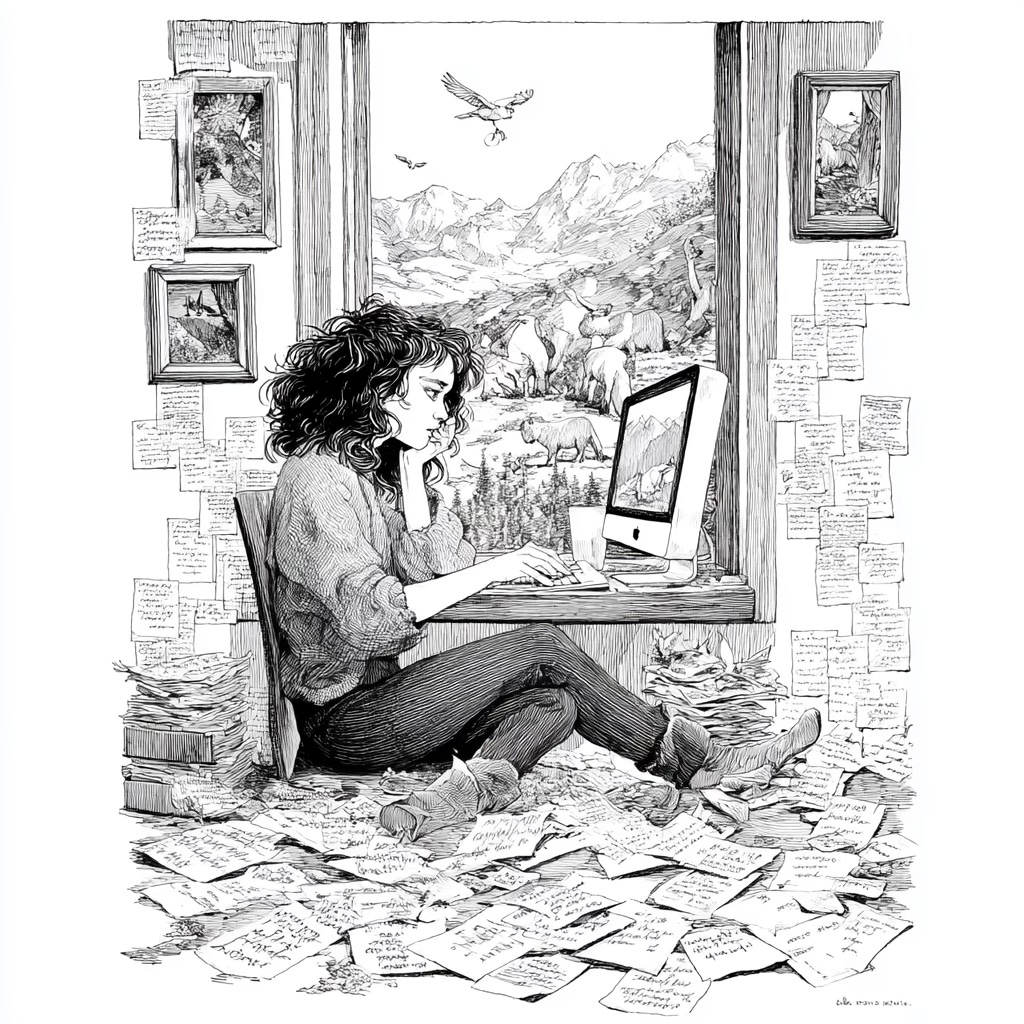
We leave fragments of ideas lying around all the time: an insight here, a scribbled thought there, a highlight in a book somewhere else. Creative people tend towards productive untidiness. Diversity improves perspective, and the friction of encountering something or someone unfamiliar takes us down routes of the adjacent possible. I am not sure whether any research has been done on the amount of wasted insight left lying around in tidy, process-driven, carefully measured environments, but if there were, I am confident it would be significant.
And just as God laughs at our plans, so has technology given us tools we can use in ways they were not designed for. It is turning out that AI models built for productivity, efficiency, and cost-cutting, if used thoughtfully, are at least as good at helping us excavate the ideas we need as individuals, as they are at rescuing the tired models of organisations. Not because of what they can generate at scale, but because of what they can surface in small, specific, well-considered conversations.
“I wonder if a single thought that has helped forward the human spirit has ever been conceived or written down in an enormous room.” Kenneth Clark, Civilisation, 1966
I can now gather the highlights I have made across thousands of books and articles, and work with them in ways that are specific to the case in hand, not some generalised case. The abstractions of sector and demographic give way to the specifics of location and context.
AI is like having a kaleidoscope of all the ideas I have ever encountered. A tiny twist of the lens and they fall into a different order, with different connections.
And now I can talk with other people doing the same, enabling half-formed ideas to find their partner, a little like those old films where people identified their contact through the other half of a torn banknote.
The ancient Greeks distinguished three modes of knowledge that map well onto our current predicament. Episteme is the knowledge of universal truths: systematic, demonstrable, transferable; the things you can write in a textbook or encode in a formula. Technē is craft knowledge, the competence of the physician or the carpenter: more situated than episteme, bound to materials and purposes, but still teachable through instruction and imitation. Mētis is the hardest to pin down, and for good reason. It is the embodied intelligence of the sailor reading the wind, the facilitator reading the room, or the firefighter sensing that something is wrong before they can say what. It is knowledge that lives in the body, in accumulated experience, a deep curiosity of their subject, and in pattern recognition below the threshold of articulation. You cannot transmit it cleanly; only cultivate the conditions in which it might develop.
The distinction matters because most of what we call AI capability operates in the register of episteme and the more procedural reaches of technē. It becomes conspicuously thin precisely where mētis begins.
When episteme has become effectively free, and the more routine parts of technē can be outsourced, we have little excuse not to invest our human capabilities in the craft, the creativity, and the connection that grow the mētis that feeds meaningful progress.
“The times are urgent; let us slow down.” African proverb
The deep, reflective, thinking work we need is incompatible with urgency. The problem we often face is that what should be deep work becomes shallow work, done in good enough form to keep the metrics happy, producing ever greater volumes of mediocrity while we wonder why we are not making progress.
I have written here before about the groups that formed during Covid as a short-term space and sanctuary to consider what was going on. They proved so valuable that they are still going and growing. Sometimes I think of it as rewilding the imagination: not deciding what to grow there, but letting what grows naturally emerge and connect.
Whilst metrics-driven organisations are using AI to scrape the bottom of the barrel of existing business processes, we can look for the ideas that are lying around, connect them, and grow them together. It means finding the space and the sanctuary to do so, which, whilst it can be difficult, has never been more necessary.
When you slow down and talk to other people doing the same, it is surprising what appears.
“The best way to find out things, if you come to think of it, is not to ask questions at all. If you fire off a question, it is like firing off a gun; bang it goes, and everything takes flight and runs for shelter. But if you sit quite still and pretend not to be looking, all the little facts will come and peck round your feet, situations will venture forth from thickets and intentions will creep out and sun themselves on a stone; and if you are very patient, you will see and understand a great deal more than a man with a gun.”
Elspeth Huxley, The Flame Trees of Thika
The people who got us here are not the people who will get us to where we want to go. To build the organisations we deserve, we will need to do the work. It is no time to cling to fading organisations better off hospiced.
The current experiment is ending. We need to let it go, and grow new experiments from the ideas we can find lying around.
We can only do it if we find the time to look.


