Reflections 4th January
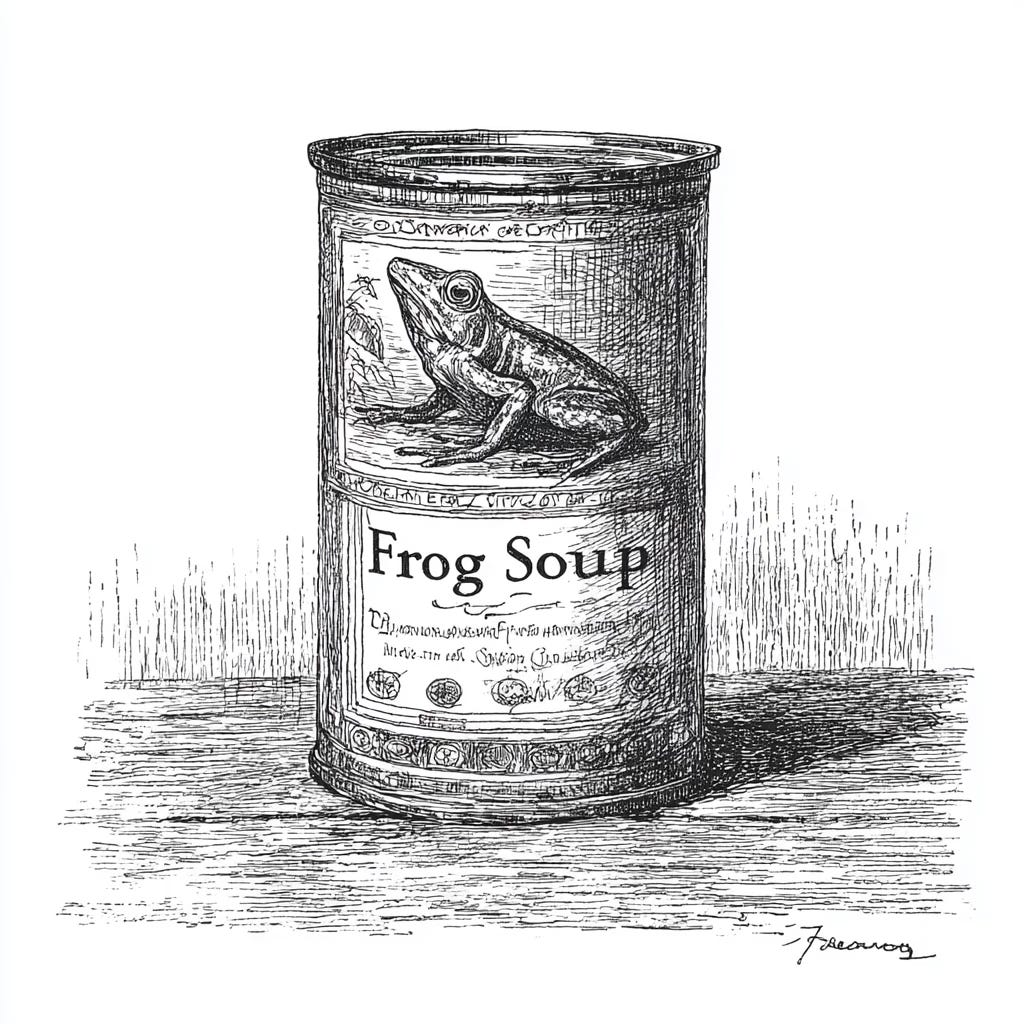
Frog Soup
This is later than I intended. I had a perfectly good post prepared for today, but yesterday’s events made it feel like turning up at a fancy dress party, where the host has spiked the drinks, wearing a dinner suit, during Dry January. Wrong post, wrong place.
Something about what is happening reminds me of the apocryphal story of the “boiling frog”. You know the one: put a frog in boiling water and it will jump out; leave it in cold water and bring it to the boil, and the frog will let itself be boiled to death. It is one of those stories created for metaphor, and it is wrong on so many levels. Leaving ethics aside, the story is based on 19th-century experiments by Friedrich Goltz, who worked with decerebrated frogs whose brains had been damaged or removed; under those conditions, the frogs did not jump.
Healthy frogs always jump, sensitive to even the slightest change in temperature. The boiling frog story endures because it offers comfort, making it socially acceptable to enter the soup phase of our existence: it’s not our fault; we thought it was a hot tub, and nobody told us the water was starting to boil.
We fall for the story, not the feeling. We tell ourselves that “No one could have seen this coming.”
It frames our awareness as binary: either total ignorance or catastrophic realisation, and it enables us, post hoc, to pathologise those who remain as stupid, passive, or asleep at the wheel.
And not only is the water hot, but the pan is also coming apart. The stories that created it are failing, as the decerebrated frogs in the White House pursue whatever strategy will keep them in the headlines, and those in the pan focused on consuming rather than noticing: fiction as digital fentanyl delivered over Truth Social.
It looks different from Outside the Walls. The stories can be seen for the destructive fantasies they are, and those of us who have left, or are in the process of leaping, recognise the inevitability of embracing uncertainty, even if we don’t like it. Uncertainty feels more constructive than becoming soup.
The story says the frog does not notice the water warming. Biology tells us otherwise; the frog notices immediately, and what changes is not perception, but the threshold at which action becomes possible. This is closer to the emerging experience Inside the Walls. We feel the heat long before we name it, and the danger is not unconsciousness, but isolation.
In a recent post, I looked at stages of conversation. I identified two of the critical stages as “private disquiet”, where we notice but keep it to ourselves, and “shared naming”, where we realise it’s not just us and look for places to make our views known, with others seeing something similar.
Not yet a place for action, but for orientation: looking, knowing we are going to have to leap soon if we do not want to become soup.
What, I wondered, makes us so amenable to becoming soup? Our politicians, vital as they are, are easily distracted by the complexity they face, the allure of power, and, normally, both. They find themselves more focused on keeping the pot from falling apart than on the well-being of the frogs. Reviewing what is happening in the Americas does not need a careful collection and appraisal of the facts. It’s fucking wrong, at any level of civilisation.
Examined from a healthy distance, we can see everything as a cycle, from conversations to organisations and civilisations, with technology as a catalyst. It’s just the timescales that differ.
Today, for us frogs, it’s the technology loop that interests me, and looking at it from the standpoint of iatrogenesis, the catchy term for the harm, illness, or adverse effects caused by medical treatment, diagnosis, or advice. What, I wondered, are the iatrogenic impacts of technology, rather than medicine?
It starts with the obvious: a remedy to a problem, or a gain in capability. Fire, the wheel, the lever and on up to AI. We experience it as liberation, and come not just to accept it, but become dependent on it until it disappears from our consciousness altogether. Those who question it are outsiders, odd, heretics.
But as Kevin Kelly told us in “The Inevitable” over a decade ago, technology has a momentum of its own. Technology is not something we ever finish learning; it is something we are permanently apprenticed to. We are not in search of utopia when it comes to technology, we are in protopia, a state of perpetual change where we are always learning, updating and adapting, never arriving. Because we never master it, we remain subject to it, in much the same ways as the mysteries of religion, but without the socially useful parts.
And like religion, it becomes a source of power. Access becomes gated; expertise is defined, measured, and judged by a priesthood less interested in solving problems that matter than in becoming indispensable on their own terms.
Which is where the iatrogenic effects appear: a loss of individual autonomy, rising inequality, deskilling, monocultures, overreach, and monopoly. We have only to ask ourselves where power accumulates, whether what we become dependent on is reversible on our own terms and who carries the downside risk of failure.
Which brings me back to conversations, the space we need to express the disquiet we sense, and name it for what it is doing to us, individually and collectively. When the harms we sense are described as anomalies that will be eliminated and blamed on our lack of ability or adaptability, we can feel the water temperature rising.
This, for us, is a point of reorientation, a period of discernment and recontextualization. When we question what we’re told and no longer treat technology as inevitable, neutral, or total. Instead, we ask, where does it genuinely help? Where does it narrow judgment? And what must remain human? Why do we make it optional rather than mandatory?
It is a point where we name what we sense anyway. Most technology innovations fail not because they lack intelligence or capability, but because we lose the capacity to talk honestly about what no longer fits.
In “The Fate of Empires and the Search for Survival”, John Bagot Glubb identified the cycle of thirteen different civilisations and their commonalities. It is the last two that I think interest us right now. The penultimate one before collapse is the “Age of Intellect”. Knowledge proliferates. Explanation replaces experience, debate replaces judgement, and cleverness outruns responsibility. It is an age of analysis without consequence.
It leads into the “Age of Decadence”, where confidence collapses into cynicism, meaning is replaced by spectacle, rights are detached from duties, and systems exist to preserve comfort, not purpose. It is an age of maintenance without conviction.
When you think about it, AI is a perfect technology of late intellect. It excels at abstraction, pattern recognition, synthesis, and fluency without belief. When the Age of Intellect values explanation over action, AI produces explanation at scale. When it comes to sliding into decadence, AI is a wonderful substitute for judgment, a buffer against uncertainty, and an excellent managerial substitute for courage, because decadence seeks convenience over character, reassurance over truth, and control over meaning.
Which is why what is happening now matters. Whether it’s an AI-produced strategy or the endless stream of bullshit justifying imaginary situations to exercise power without responsibility, if we can’t feel the water boiling and the pan collapsing, then we’re destined to be soup.
We cannot deal with what is being generated at scale using the same approach as those generating it. Turning private disquiet into shared naming is a much more intimate activity in small groups. Naming the bullshit, looking at how it affects us, and how we might adapt on our own terms. That’s why the Athanor exists - not to act as some sort of central hub, but to be a space for those who want to create their own groups, who want to name their own bullshit, and look after their own communities. If you are feeling uncomfortable and want to name it with others, have a look.


Very wise and good.
Let's oversimplify for a moment.
Let's divide humanity into two types.
There are ones who respond and ones who initiate.
If we are living in the Age of Decadence and not of the Intellect, then the means of communication is seduction rather than logic.
As a result, every aspect of culture is different kinds of porn, seducing us to believe that we are what the seducers are suggesting that we are.
Of course, they never celebrate our independence or agency as human beings.
We are living in a hostage-like situation, where the hostages believe that are making rational choices to allow the seduction lead them.
For all the initiators, some see this reality and begin to mimic the seducers, thinking that this is how to win in the mimetic rivalry of modern culture.
The rest of the initiators may see that there is nothing for them in a culture of seduction. They cut themselves off from these cultures of seduction.
But this is an option that capitulates to the seducers, rather than offering an alternative or even a reversal to a time where the traditions of community and conversation are the foundations of society.
So, we need to ask ourselves this one question.
Am I a consumer or am I a creator?
As a consumer, we allow ourselves to be seduced.
As a creator, we create new ways for us live in community.
It is our choice.