Reflections 31st May
Building Wider Bridges...
Five miles east of me, eight metres below the surface of a Derby street, runs a brick-arched Victorian sewer that has been carrying the contents of those houses since the 1860s. A small number of engineers can tell you, with reasonable accuracy, what condition it is in. None of them sits in the rooms where decisions are taken about how much money it might receive over the next thirty years.
Those rooms are in Toronto, Sydney, Riyadh, and the City of London. The people in them have never seen the sewer, and will never see it because the sewer exists for them as a row of figures on the regulated asset base of a privatised utility. Between the engineer who knows the pipe and the analyst who allocates the money, the formal apparatus of British water provision runs sixteen separate companies, a sequence of regulators that is shortly to be merged into one, an investment cycle that turns on five-year price reviews, and a debt structure that the National Audit Office has not yet finished mapping.
As complexity chokes communication, somewhere along that chain, the necessary stops being reachable from the possible.
This is not a story about water alone; it is one of the clearest visible cases of a wider predicament. Indy Johar posted a powerful graphic on his blog, that mapped the issue beautifully:
The water sector is the gap made tangible. The necessary is uncontested and physical; clean water and functioning sewerage for seventy million people, infrastructure renewed at a rate that keeps up with climate stress, and rivers that can sustain the life forms native to them. The perceived possible is contested but visible; more debt loading by the current owners, bills rising thirty per cent over five years, a regulatory reset that may or may not be substantive, and an industry stumbling between insolvencies.
The easy temptation in a moment like this is to name the missing pieces and demand more of them. The public narrative names money, regulation, and technology. Bills must rise so the money is available; the regulator must be replaced so the rules are enforced, and new technology must be deployed so the leaks are fixed. All three of these are true; but none of them, by themselves, will close the gap.
A river of money has flowed through this sector for thirty-five years. Roughly one hundred and ninety billion pounds of capital expenditure since privatisation; eighty-three billion in dividends; and sector debt at nearly seventy billion against an asset base of similar order. The copious flow has not produced the renewal it was supposed to. Regulation has been re-engineered repeatedly, and is being re-engineered again, with Ofwat now being merged into a new super-regulator on the recommendation of Sir Jon Cunliffe’s recent review. Each iteration has reconfigured the apparatus and left the substantive problem largely where it was.
Deckchairs and Titanic spring to mind.
Technology is more advanced and more widely deployed than at any point in the sector’s history, and yet the sewage discharges into the our rivers and elsewhere continue to rise, as people in Kent long for something as basic as a shower.
The gap between necessary and possible is not where the public discourse looks for it. It is somewhere else.
✦
A pipe in the ground is a piece of physical knowledge, just as a pension fund is a piece of financial knowledge. A river ecology is a piece of biological knowledge, a regulator is a piece of legal and administrative knowledge, and a community living beside an outfall is a piece of social and political knowledge.
These five registers cannot be added together by any formal apparatus; they are not commensurable. The work of holding them in productive relationship is interstitial; it sits between the registers rather than inside any of them, and it cannot be done by an institution. It can only be done by a person or small group of people, formed and motivated by something more than money, in such a way that they can hold the interface and translate across it.
Stewarding is not a job title; it is a sense of social responsibility. Stewards already exist in the water sector, in small numbers: the river warden who has read both the catchment and the financial accounts of the company discharging into it; the engineer who has done a decade with the operator and now sits across the table from the regulator; and the campaigner who has learned the regulated asset base inside out. Each of these is holding an interface no institution can hold, and without them, the sector’s formal apparatus runs on uncorrected error. With them, even imperfect apparatus carries more than it would otherwise.
The work of holding contradictory registers in productive relationship cannot be done by an institution. It can only be done by a people, formed in such a way that they can hold the interface and translate across it.
The gap between necessary and possible is, in part, the gap between the number of Stewards the sector has and the number it needs. It is a structural observation, not a sentimental one.
The mathematics of networks is unambiguous. In any network under stress, the binding constraint is rarely the count of available connections; it is the width of the bridges across the gaps that the connections nominally span. A narrow bridge will carry facts; only a wide bridge will carry trust, behaviour, complex coordination, the kind of work that allows a difficult decision to land and stick. Bridges are widened by people, by the trust those people engender, and by the time they have spent holding the same interface across the same gap. There is no apparatus shortcut.
Set out in those terms, it sounds like a bad thing, and it would be, except for one thing. The thing that has just changed.
✦
A small group of people with AI can hold interfaces that previously required institutional scale, and is a structural observation about communication complexity. Most of what an institution does is coordinate, and most of the cost of coordination is in the carriage of context across the institution’s boundaries. AI now carries an order of magnitude more of that context, per unit of human attention, than was possible five years ago. Institutions remain necessary; they remain the vessels in which most work is held, but they are aged and brittle, relying on those steeped in a world of status and privilege. What has changed is that small groups, close to the reality of the sector and working at the interfaces that institutions cannot see, can now do work at a scale and quality that was previously closed to them.
Consider what this means concretely for a Steward working in the water sector. Last year, a single person could read perhaps three regulatory submissions in depth in the time it took to brief a board. This year, the same person can read all eighty-eight Cunliffe recommendations against the operating accounts of three companies and the discharge data for five catchments, and present the synthesis in the same meeting. The marginal cost of holding a wider bridge has fallen sharply, whilst the marginal value of holding it has risen, because the wider the bridge, the more of the necessary it can carry across.
The water sector already contains early versions of what this looks like. Citizen-science groups have been mapping pollution events in real time, with data quality that has begun to be admissible in regulatory proceedings. River trusts have been holding the interface between catchment ecology and the planning system in ways that the formal regulator could not, and small advisory firms have been carrying the interface between long-horizon capital and the engineering of the underlying assets, brokering positions that the conventional advisory market is not configured to support.
None of these is large in headcount; yet each of them is a bridge far wider than its size would predict. With AI, that disproportion is about to become structural rather than exceptional. The river trust that could brief a minister last year can brief a select committee, an investor consortium, and a regional planning authority this year, on the same morning, with the same depth.
A small group of people with AI can hold interfaces that previously required institutional scale.
What is true of water is, in less visible form, true elsewhere. The same pattern appears in social care, the prison estate, primary care, local journalism, food systems, and regional energy. In each case, the formal apparatus has run for a long time on uncorrected error by those who see numbers and reports but not reality. The binding constraint we face is the supply of Stewards; as the new asymmetry between small groups and large institutions is rebalancing in the small group’s favour. The water sector is, for the moment, the sector where this is most clearly legible, because the consequences of the uncorrected error reach the reader of the morning newspaper.
The headlines are still about money, regulation, and technology. The headlines will catch up. What is visible to anyone willing to look is that the most consequential work in a number of stressed sectors is now being done by small groups who would, under the old asymmetry, have been unable to carry it.
✦
Indy Johar’s graphic describes the gap, and the volatility inside it accurately. Its catalytic response is the set of seven elements that would, in combination, build an arc from the necessary to the possible. The map is right about the components. Seven elements cannot reach each other across the holes between them. They can only be carried into productive relationship by people who hold the interfaces those holes contain, working in small groups, supported by the bridge-widening that AI now provides.
The current moment is not the moment of resignation that the volatility section of the map might suggest. It is the first moment in modern industrial history in which the binding constraint on closing the gap has become amenable to deliberate work at the scale at which the work is needed by those doing it.
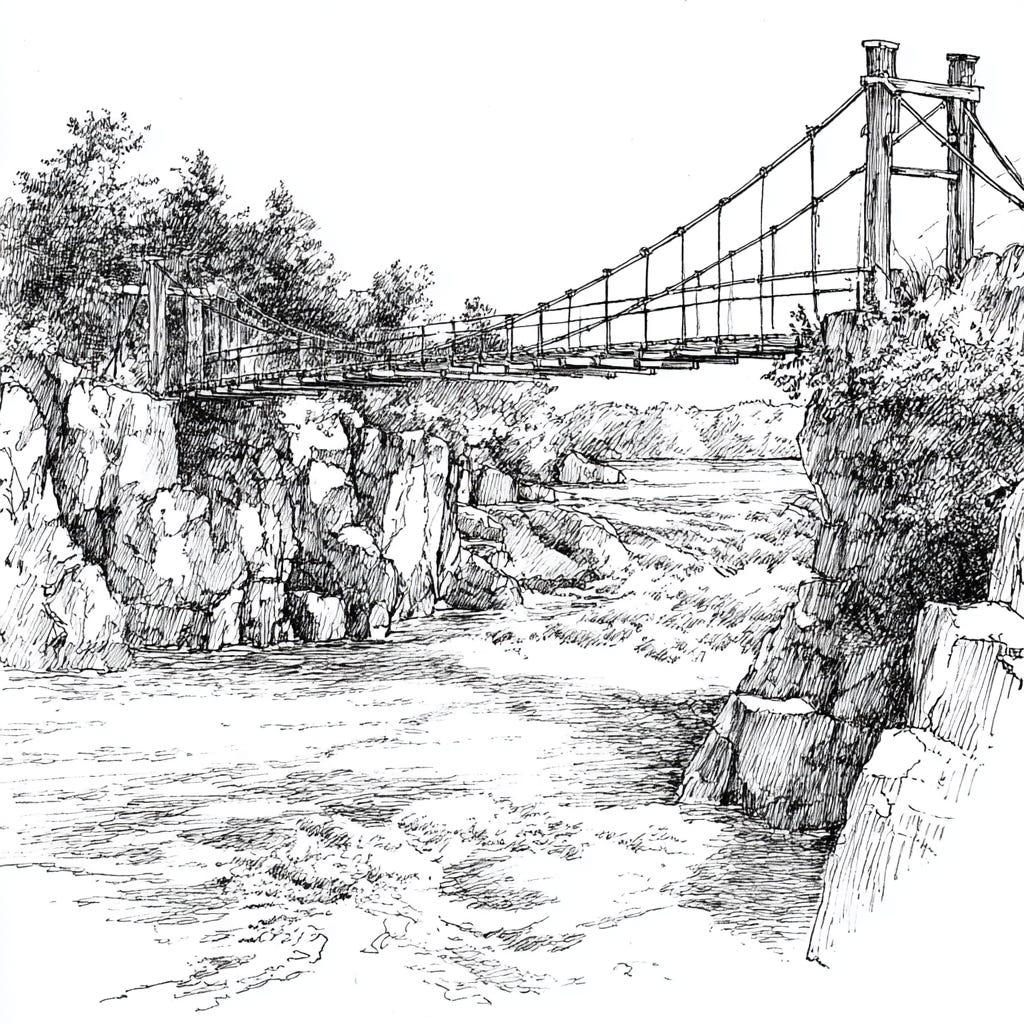
Money is downstream of bridge width. So is regulation. So is technology. The bridge is the thing.
The water sector will, over the next five years, be one of the visible tests of whether the deliberate work of widening bridges happens at the pace the necessary requires. Whether it happens depends, in turn, on whether enough small groups recognise what they are now equipped to do, and act on the recognition.
And what is true for water is true for just about every institution. We can only hope that we can have organisations run by those who understand those they serve, rather than those who understand only money.


