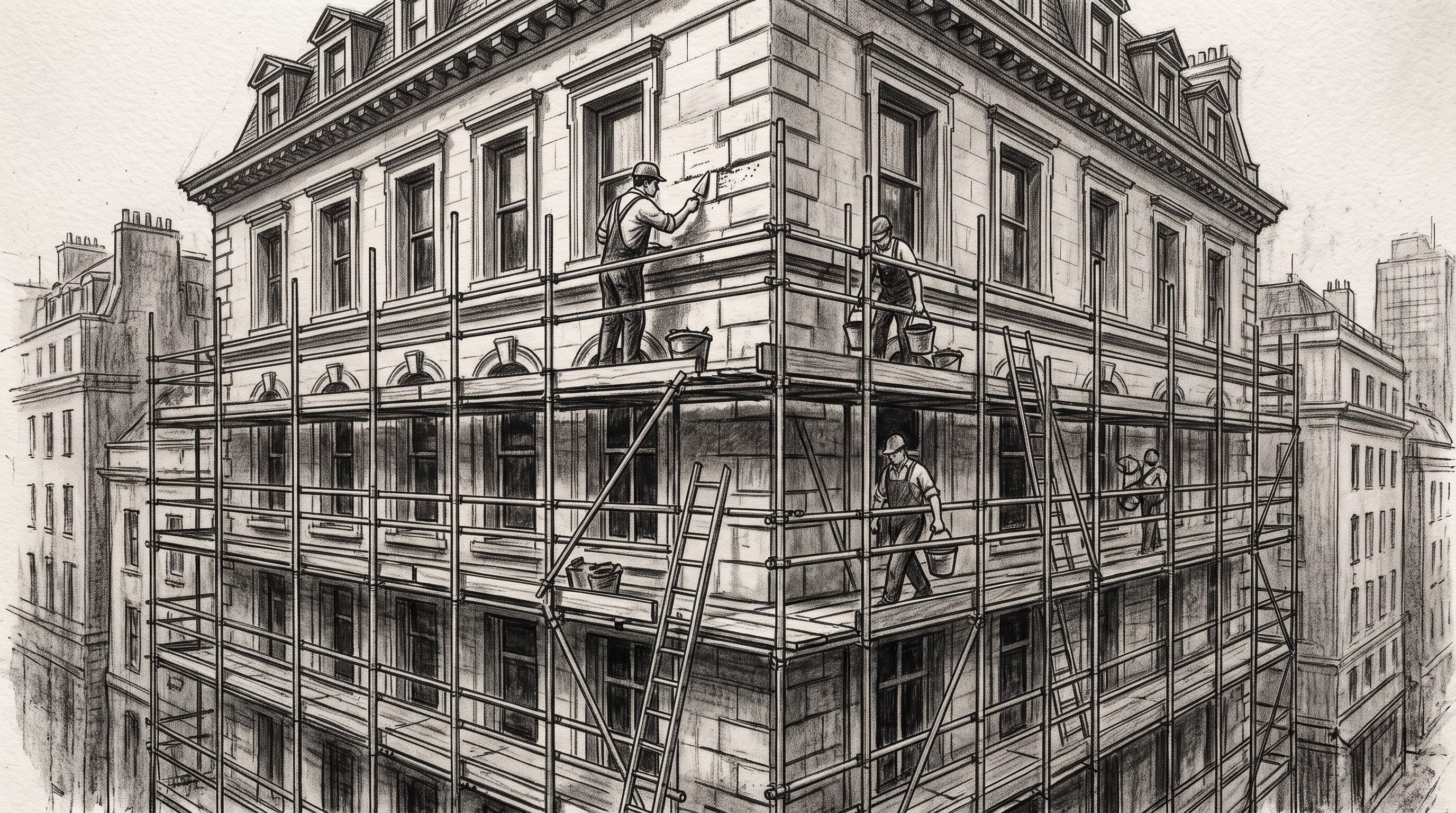
I have written often about what I notice happening as the ground shifts beneath us and the cracks begin to appear: the growing reluctance of employers to put up with the economic waste of our human idiosyncrasies as the price of accessing the parts of us that are periodically useful to them. They appear to believe technology will now make that usefulness available on demand, without having to allow for holidays, sickness, or the social life we need.
I have also written about the people who act as the mortar that keeps the walls standing. Those people who keep things together because of who they are, their love of their job, or a simple humanity that makes people laugh at points when what they really want to do is scream. It is the sort of passive, quiet usefulness that escapes the silicon-based analysis that measures a very limited set of actively useful financial, productivity and efficiency parameters.
Mixing mortar is a skill. I live in an old house, built for a world in which walls moved a little, got wet, dried out, and were repaired over time. Its lime mortar is not intended to be stronger than the brick or stone around it. It is softer and more permeable: it accommodates small movements, lets moisture escape, and acts as a sacrificial material, taking the strain so that the structure does not have to.
Cement mortar can look like the obvious modern improvement. It sets quickly, is hard, and can appear cheaper at the outset. But in an old wall its very hardness can be the problem. It does not readily accommodate movement or moisture, so stress and damp are transferred into the older masonry; the part of the wall that is hardest and most expensive to replace.
There is a metaphor here for how we design short-term work architectures. The strongest-looking system is not always the most resilient one. Organisations need interfaces that can flex, channels through which information and pressure can escape, and routines that are easier to renew than the people, relationships, and capabilities they are meant to protect.
Cement mortar is cheaper, readily available, and can be mixed and used by those with basic training. It is the stuff of process, recipes, technology, and global sourcing. Lime mortar, on the other hand is the stuff of craft, character, experience, communities, adaptation to local soil conditions and the very human qualities that allow organisations to flex under pressure.
As we rush to replace old ways of working with efficient modern processes, we are making ourselves increasingly vulnerable to the complex and increasingly unpredictable changes we are experiencing as the ground moves beneath us. At some point, as with old houses where cement mortar has been carelessly used by inexperienced, poorly trained (or cynical) builders to replace lime mortar as a matter of cost and convenience, it will need to be ground out and replaced if the building is to stay healthy. There are many organisations out there right now whose equivalent of lime mortar is being replaced by the cement mortar of technology and temporary gig workers, and the cracks are already beginning to appear.
Reuters reports that Meta’s 2026 Project OT (”Organisation Transformation”) explored making the company “AI-native,” including scenarios that would shrink some teams by up to 60% through layoffs, redeployments and AI-supported “pods.” In the end, though, rather than replacing 60% of the whole workforce, Meta went ahead with a roughly 10% workforce reduction in May, and Zuckerberg cancelled planning for a larger second restructuring wave, previously envisaged for November, only hours before that second round was due to begin. The reported drivers were employee backlash and weak or disruptive operational results from AI-assisted workflows. We have seen recent parallels at Klarna, Commonwealth Bank of Australia (CBA) and, in a softer form, Duolingo, with each moving from a public or operational “AI-first” posture toward restoring human roles, reframing AI as augmentation, or withdrawing coercive implementation rules. I suspect we will see a returning demand for the human equivalent of lime mortar. Experience, judgement, craft, commitment and above all a respect for the people who do the work.
It carries a cautionary tale. AI, in its many varieties, represents transformational technology easy to think of as somehow automatic, yet it needs to be used with skill and craft. Embracing it mindlessly for the sake of a quick hit to the profit and loss will carry a price as organisational structures built on it start to show the cracks. And it is people, not technology, that will have to do the repointing.
After the best part of a century spent gradually removing people from making judgements within the workflow, perhaps we’re going to have to return to them. I have written elsewhere about the gradual erosion of judgement in the workplace as we went through the algorithmic processes from scientific management through total quality management and on to business process re-engineering, Agile and Scrum. All of these have helped us make real progress in efficiency and productivity, but not in considering what is emerging, what comes next, or what needs to be left behind. The cement mortar of process works well in some structures, but less so in ones that have to adapt to the land moving beneath them.
As we are often told, planning is essential; plans quickly become pointless, and we have no idea, at the levels that matter, of how AI, in its many manifestations, will affect our work. I’m curious about the generalities and the abstractions, yet for each of us, as individuals at this moment in this place, it is more difficult to see. Difficult to plan, but that should not stop us planning. The skills and experience we have that do not get recorded in the algorithms of process are the difference between cement mortar and lime mortar, as the cracks begin to appear in the idealistic plans of those who would replace people with technology on a generalised basis.
So what do we do? I think the answer, in part at least, lies in the very technologies we’re wary of. Where we can use it to automate, where the processes are clear enough and well tested enough, we will end up doing it because it makes sense. Where we choose to delegate to it but retain responsibility for the outcomes, and where we use it to sharpen our thinking, that is something different. We need to become familiar with its textures and idiosyncrasies, its strengths and weaknesses. We can only do that as individuals, because often the people we work for are only really interested in our productivity, not our creativity and curiosity. It’s something that is very difficult to be trained in because what we would do is pick up somebody else’s view of how to use it rather than develop our own. To bring back the metaphor, we need to learn how to mix our own particular lime mortar. Experience, craft, perspective, commitment, and all the other things that the data does not capture.
It will be needed. Precisely when, where, and how, it is too early to say. But now is a good time to recover the innate skills we have in critical thinking and judgement and craft that process has worn away.
Finding ways to do that is what we’re focusing on at the Athanor. We will share what we’re finding there on a regular basis, as well as running workshops with groups of individuals and businesses, focused on what makes each of them different.


I see what you see. I describe it this way.
"There is a persistent, residual culture of values that persists because it resides in the people."
I said this to an executive assistant for a SVP for a large, in-trouble, global corporate giant. I also said to her, "the company that people know and love is because of you and others like you. You are long-termers. The people above you are short-termers and are there to extract value. You increase it."
Her response was a visceral change of her physicality. Her thought, I suspect,
"Finding someone noticed what we all know."
I sat in a local restaurant a couple of months ago just happening to talk to the guy sitting next to me. Turns out he is the president of a manufacturing company. I asked him,
"How is your company using AI?"
His answer. This really was it.
"We are trimming our workforce to free up money for new projects."
There you go. This is how the machine fails to learn.