Reflections 29th March
Navigating Shifting Borders
And what is a border, if not a story? It is never simply a line, a marker, a wall, an edge. First, it is an idea. An idea that is then presented as a reality. James Crawford, The Edge of the Plain
Crawford is right, and not just about the lines drawn between nations. The maps we make of our economies, our organisations, and our technologies are stories we have chosen to tell, presented as though they were simply descriptions of what is.
I have been spending time lately with James Cheshire’s wonderful “The Library of Lost Maps”. It is one of those books you keep nearby, not to read straight through but to open when you need to think. It is full of wonderful passages, including this one from Beryl Markham, writing in 1942:
“Here is your map. Unfold it, follow it, then throw it away if you will. It is only paper, it is only paper and ink but if you think a little, if you pause a moment, you will see that these two things have seldom joined to make a document so modest and yet so full with histories of hope or sagas of conquest.”
One of the maps in Cheshire’s book is of Hiroshima, completed just weeks before the atomic bomb fell. It is a poignant reminder that we can spend years making a map and moments making it irrelevant. Maps, like our stories, are beautiful, fragile things.
Like the maps we make of our economies. Drawn up on convenient assumptions, plotted in data that captures only a fraction of what actually makes them work. The models we use as compasses rely on a kind of economic magnetic north assembled from what can be measured, while ignoring the true north that data cannot reach: whether people feel seen, heard, and aligned in the pursuit of something that means more than money.
Our geopolitical maps are in no better shape. Wars built on self-serving rhetoric are reshaping the world in ways nobody anticipated, not just where the fighting happens but in the erosion of trust that spreads outward from it. Organisations built to operate at scale are discovering that the borders they need to cross to make that scale work are closing. The story of invincibility is meeting the reality of the territory.
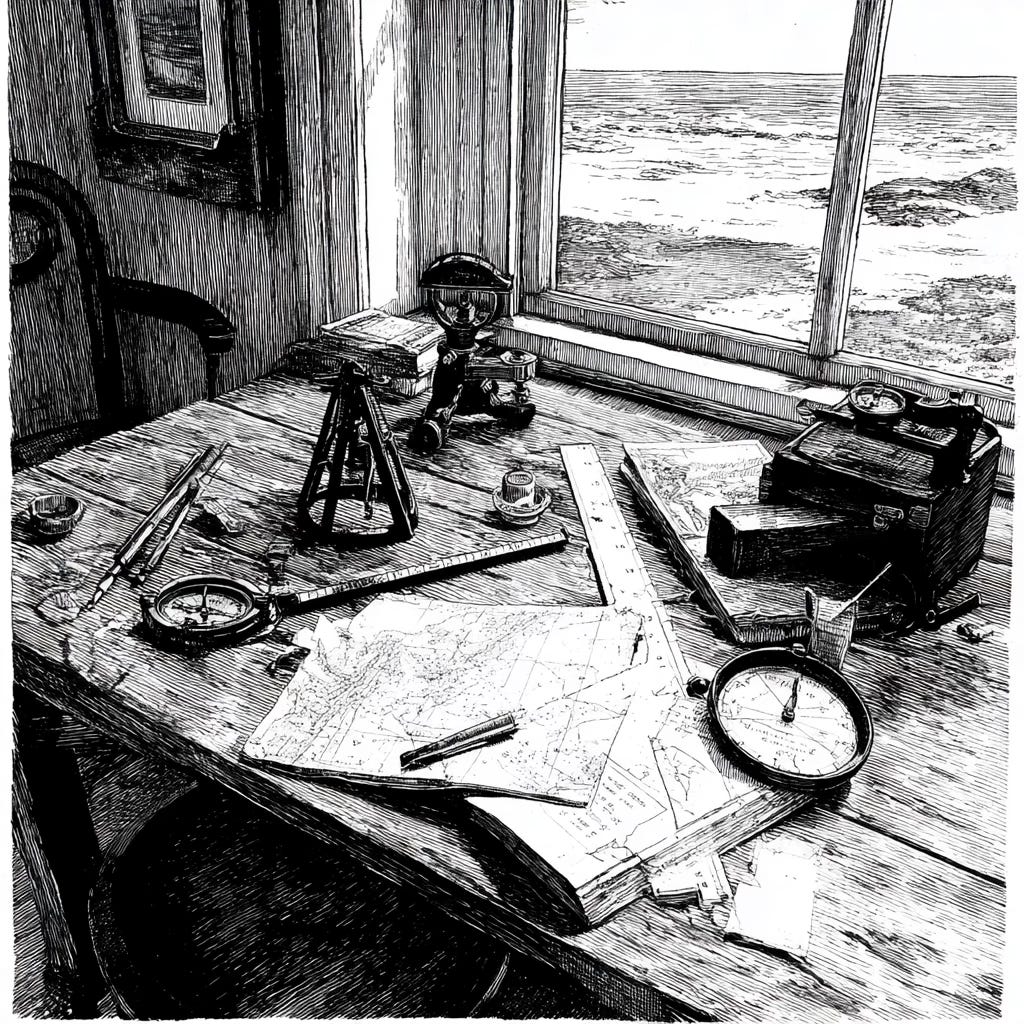
I am old enough to have learned to navigate with a sextant, a compass, a chronograph, and parallel rulers. I learned to use tide tables and the basics of astral navigation, and learned these things even though I didn’t need them at the time. We learned them just in case we did, when everything else failed.
That, I think, is the lesson available to us now. The AI story being told at the moment carries such a weight of investment expectation that it has become largely self-serving. The claims have drifted a long way from the territory they are supposed to describe. The reality is probably closer to what Ed Zitron argues: that the whole edifice is built on investment stories that have decoupled almost entirely from physical fact.
None of which will stop the story.
When AI comes looking for you, as it will, the question worth asking is not what tools you know how to operate but what you actually know how to do. Mistakes will be made, and as Joe Procoppio has observed, AI might not replace your job but it won’t stop someone selling your boss the idea that it will.
When that day comes, you will find yourself falling back on older instruments: human creativity, connection, imagination and the kind of judgment that no map, however finely drawn, can substitute for.
It is a good time to dust them off.
If the question of what those older instruments actually are interests you, it is one I explore more fully over at The Athanor — a space for thinking about the deeper currents that maps tend to miss.


