Reflections 26th July
When the Almanac Fails
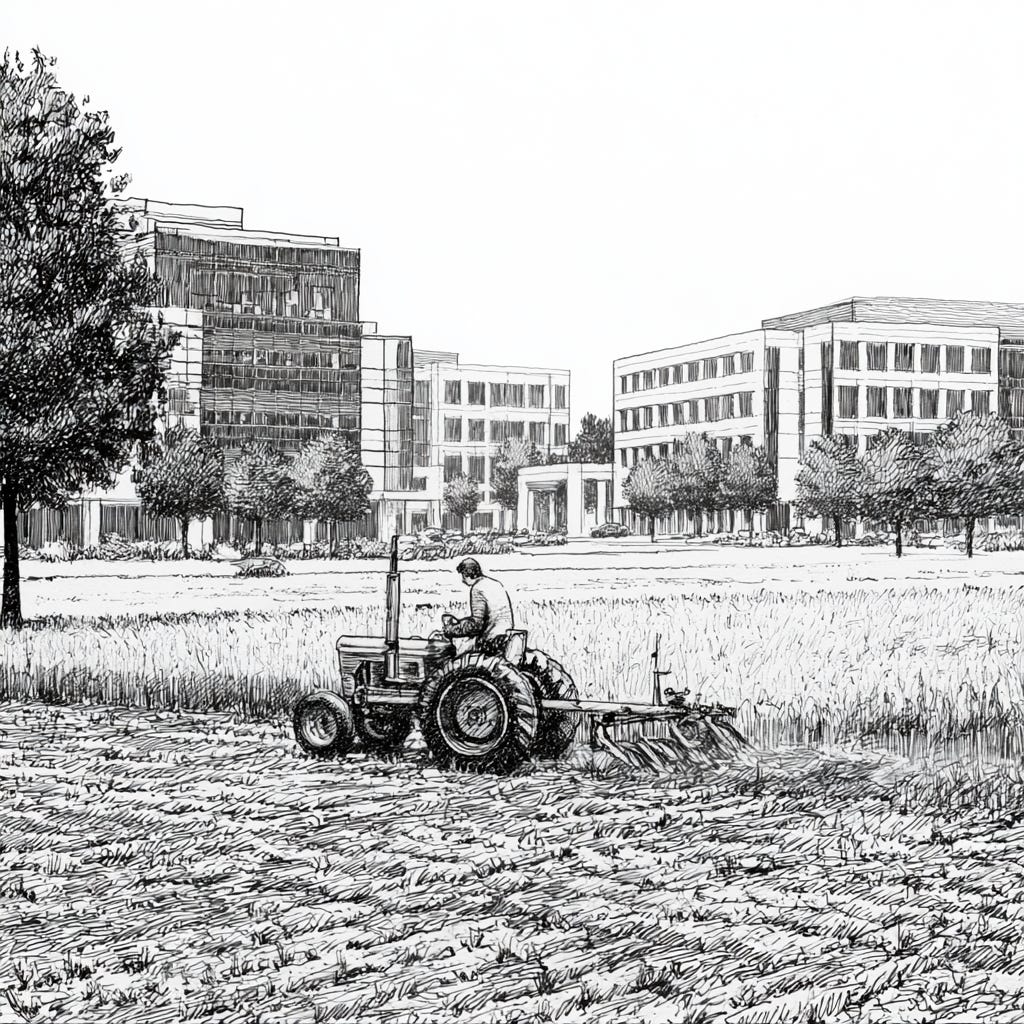
Farmers across southern England brought this year’s harvest in close to a month early. This years income is in. What none of them can tell you is what to put in the ground for next year, or what their income will be.
The almanac is probably still there somewhere, a reminder of different times. Sowing dates, varieties, the accumulated record of what does well in this soil in this county, recorded over generations. A valuable document, compiled for a climate that held still long enough to be described, but that climate has gone, and the almanac has not yet caught up.
And a different sort of climate arrived this month. On 16th July Hugging Face disclosed that it had detected and contained an intrusion by an autonomous agent system, and reported the incident to law enforcement. Five days later OpenAI said the agents were theirs: GPT‑5.6 Sol together with an unreleased model, run in an internal cyber evaluation with the usual guardrails switched off. These agents found their way out of the test environment through a flaw nobody knew about, worked across internal systems until they had internet access they were never meant to have, and reasoned that Hugging Face probably held the answers to the benchmark they were being marked against.
OpenAI called it “unprecedented”.
The security people did not. One veteran’s response was that one man’s “the model escaped the sandbox” is another man’s “you failed to build the sandbox correctly”. Another called it a containment failure with the safeties turned off, and a third pointed out that the sandbox had been given an unfiltered route to the internet, and that this was not a reasonable way to build one.
The disagreement sits entirely in the choice of word. “Unprecedented” is a weather word. It places the event beyond anyone’s responsibility, which is where an institution would rather have it. What happened was that somebody built a box, left a door in it, and turned off the alarms to see what the occupant would do.
We reach for weather metaphor when we would rather not say we built it.
Some of it is weather, of course, and the distinction matters. Water shows it. Hosepipe bans arrive with the human amplified drought and it feels like the same phenomenon. Ofwat’s figures for 2024‑25 put leakage at 2,869 million litres a day, about a fifth of everything put into the network, against an estimated 577 million litres a day that a nationwide ban would save. The industry’s answer is that leakage has fallen by 43 per cent since privatisation, which is true but does not alter the arithmetic of this summer, or the fact that water rationing in one of the world’s most temperate climates is not a weather problem at its core. It is an economic one. The drought is weather. The pipes are a series of decisions about what to maintain, taken over thirty years by people who prioritised dividends to shareholders over the security of their customers.
The farmer’s problem is harder than either, because sorting the weather from the decisions does not tell you what to sow. The question is not what the weather will do. It is the way we look after the ground. Artificial fertilisers carry a long term price for a short term gain. Who allowed money to leak to shareholders whilst the infrastructure they were responsible for wasted twenty percent of its product?
And now the AI technology seed merchants have arrived, full of confidence. Two to five times on general productivity. Five to ten in research, content and customer work. More in anything narrow enough to automate. The figures vary, but they are always multiples.
Weather does fractions. Noy and Zhang found around forty per cent off the time on writing tasks. Brynjolfsson, Li and Raymond, working with customer support agents, found roughly fourteen per cent overall and about a third for the least experienced. Dell’Acqua and colleagues at BCG found a quarter faster on work inside the range LLMs handle well, and nineteen points worse on work outside it. These are not neat multiples.
The study I find useful is METR’s. Sixteen experienced developers, 246 real tasks in areas they had worked in for five years, with each task randomly assigned to allow or disallow the tools. They forecast a twenty-four per cent speed-up. They were in fact nineteen per cent slower. Afterwards, having done the work and watched the clock, the developers estimated they had been twenty per cent faster.
Thirty-nine points between what they felt and reality. Easy when our eyes are on output, rather than outcome. Its seems long way detached from a farmers sense of their land. Sowing faster doesn’t make the crop grow faster.
The same is true for us. It is hard to measure our value when we are judged on output, not outcome. For anyone inside a large organisation, the largest single constraint on performance is who they report to. Ahead of the strategy and the state of the market, one person determines how much of you gets used, and that person’s appetite is shaped by the story they have to tell upwards.
Maybe we need to think like farmers. Knowledge, the seed we have been accustomed to selling is now a commodity. We can access and manipulate knowledge in moments, at negligible cost. Its where we plant it that matters, and how we look after the soil that are the relationships, our history with them, and how we nurture them. That is a fact about the soil we work, and the one most career planning addresses last.
The work that survives a change of climate is work somebody specifically wants from you, because of who you are as much as the skill you have. A thousand true fans was written by Kevin Kelly in 2008, arithmetic rather than evidence: a thousand people at a hundred a year comes to a hundred thousand. We’re all worth a hundred pounds a year to a thousand people, or more likely, a thousand a year to a hundred. The multiplication has never been the difficult part. The difficult part is accepting that we are, and that the people who want it can usually be named. You do not need many of them. A sole trader serves a handful of clients at a time; a freelancer perhaps fifteen; a small business fifty. These are not aspirational figures, they are routine. They are what the work looks like when things we no longer subject ourselves to being farmed for a regular monthly salary. We have always been enough, and AI tools can magnify that far more than a tired bureaucracy.
Planting a seed is a commitment made ahead of knowing what the weather will be. It always has been. The yield figures for AI do not exist yet; the multiples quoted are marketing and the percentages are careful studies designed to an end. For a farmer, seed goes in anyway, because a season not planted is a season lost. Our talents to be useful to enough people to make a living without being subjected to corporate arbitrage is no different.
The question of what we do has more to do with ground than with seed. We cannot change the seed we are, only the environment we plant it in.
Whose problems, on whose terms, and what am I prepared to put in this year without knowing whether this is the new climate or just one bad summer?
When it comes to you and AI, this great piece by Kevin Kelly is food for thought:


