Reflections 24th May
Being Ready for Suddenly
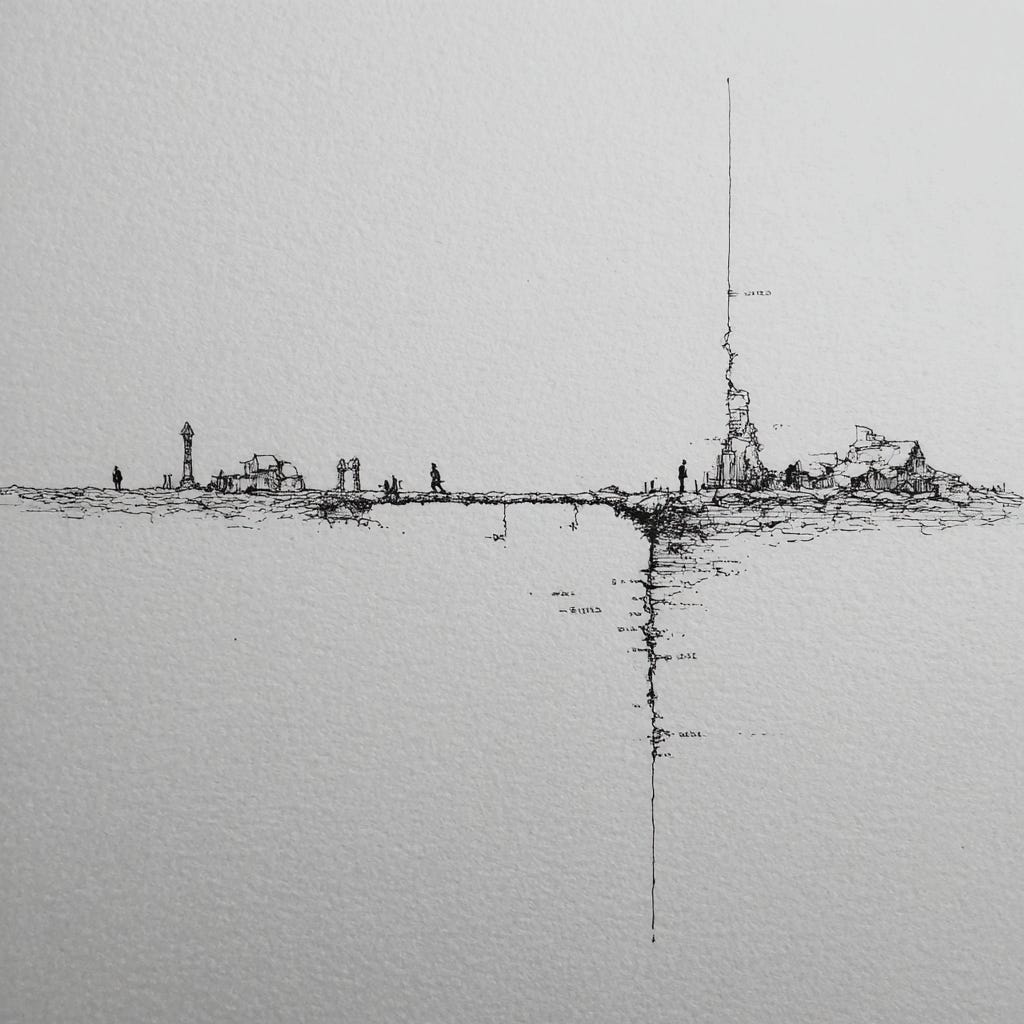
In The Sun Also Rises, Hemingway has one of his characters asked how he went bankrupt. His answer?: Gradually, then suddenly.
The line has been repeated often enough to have worn a little smooth, and become so familiar it is easy to dismiss, but the structure that underlies it remains fresh, because change does not pause. It is how most large changes arrive: an accumulation of small shifts that go uncounted because each one is small, followed by a moment in which the cumulative weight becomes undeniable.
By the time the suddenly arrives, it’s normally a done deal; we have to accept it and move on rather than fight it. Like grief, it’s a hard road to travel.
We are surrounded at the moment by suddenlies of different sizes and at different scales. Some are personal. We get older knowing perfectly well what is coming, and we still find ourselves avoiding the discussions that would help those affected, as well as us.
People in mid-career are discovering that careers, as their parents understood the word, have quietly become an obsolete category; as the companies that once carried the relationship are no longer prepared to do so, and people approaching retirement are finding that the arithmetic of retirement has changed, incurring a set of intergenerational obligations that the next generation is, understandably, getting tired of carrying.
The cycles run wider still. Britain spent something like a century and a half stumbling toward Empire, which then was catalysed by the Industrial Revolution around 1800, had its purple patch through the nineteenth century, before meeting its own suddenly somewhere in the middle of the twentieth. We are, by most measures, still in denial about that arrival, a point leveraged by populists for their own ends.
America sits perhaps three quarters of a century behind on the same curve, and historians a generation from now may well read the “suddenly” as the rebalancing with China as the hinge between its hubristic gradually and its inevitable suddenly.
Gradually is such a comforting place to be, until suddenly arrives.
“In times of change, learners inherit the earth, while the learned find themselves beautifully equipped to deal with a world that no longer exists.”
―Eric Hoffer
Hoffer’s is a good line, and like all good lines it carries a sting. The sting, on closer reading, is that being learned was not the mistake. The mistake was the assumption that learning, having been done once, had been done. The learned are punished for the posture of knowing. It is the part of the predicament that gets less attention than it deserves. It is one thing to recognise that the world is changing; it is another to notice that one’s own equipment, the hard-won set of frames and instincts that have carried a career, is itself a piece of the world that is changing.
The frames were built for a particular set of conditions at a particular time, and rewarded inside them; they became reliable because the world held still long enough for them to become so. And when the world stops holding still, the same frames continue to deliver outputs to the wilfully blind. They feel as confident as they always did, even whilst they are, quietly, no longer adequate to deal with what they claim to address.
Being ready for suddenly therefore has little to do with prediction, the refuge of consultants, which is mostly what the learned reach for when they have run out of frames. It has little more to do with planning, in the sense the word usually carries; plans assume a stable enough relationship between present and future for the plan to mean something when the future arrives.
Readiness, in conditions of recursive change, is a disposition rather than a forecast. It is closer to a craft than to a discipline of foresight.
A craftsman’s workshop has a particular quality that distinguishes it from a shop. In a shop, or a consulting practice, or a bank, things are arranged for the customer; in a workshop, things are arranged for the work. There are finished pieces, certainly, but there are also half-finished ones on the bench, abandoned experiments in the corner, tools worn smooth with use, and reference books with broken spines. Learning in demonstrable action.
The whole space implies a process, a practitioner who knows things you do not yet know, and a relationship to the material that is ongoing rather than concluded. The craftsman is better prepared for suddenly than the shopkeeper not because they have predicted it, but because their working disposition already assumes the material will not behave exactly as expected, and that part of the work, every time, is to read what is actually in front of them rather than what they were planning to find.
It is what the Greeks called mētis, and what every serious practitioner recognises under one name or another. It is the intelligence that operates in the particular case, that judges when the rule should bend, that reads a room before it reads a report. Mētis is what expertise becomes when it has been held lightly enough, for long enough, to remain open to the case in front of it.
Our challenge, collectively, is that the conditions under which mētis forms have become harder to find. The institutional environments that once produced it through long apprenticeship, sustained exposure to consequence, and the slow accumulation of judgement under stakes have largely organised themselves out of the practice. Dashboards have replaced the noticing; methodologies have replaced judgement; and somewhere along the way the question of whether the frame still fits has stopped being asked at all.
There is a paradox in this. The systems that were built to make work more reliable have, by their reliability, hollowed out the very capacity that would allow the work to remain adequate when reliability stops being the point.
Being ready for suddenly, in practice, is not a frame of mind one decides to adopt on a Sunday evening. It is the slow, deliberate cultivation of a working disposition: a “workshop mind” kept open rather than tidied away into certificates, questions kept live rather than answered too quickly, and a frame held loosely enough to be examined when the case demands it.
It is uncomfortable to sustain, and the reward for sustaining it is slower and less legible than the reward for the posture of knowing. It is also the posture that has the better chance of holding when suddenly arrives.
Somewhere between an awareness that signals change and the workshop where transformation actually happens, there is a notion of craft: where a practitioner does the unending work of staying capable of being surprised. Exploration, and risk is necessary; without it, suddenly finds us unprepared. The workshop, untidy and experimental is necessary; without it, nothing changes in any deep way and is the part of the practice that determines whether the practitioner can still be of use when the world has moved on from what they were taught.
Recognition will not save you if the workshop has been closed. Companies are no longer safe havens. We are all equally exposed to an increase “suddenlies” that will most likely continue for a few generations until we have moved out of this cycle and into the maturity of the next.
The question, then, is not whether suddenly is coming. It is what condition one’s workshop is in. What is on the bench, half-finished. What has been left in the corner because it did not work. Which of the frames have been used so often that they have become invisible, and might no longer be doing the work one assumes they are.
Only a crisis, actual or perceived, produces real change; when that crisis occurs, the actions that are taken depend on the ideas that are lying around
Milton Friedman
We do not know which ideas might work. That though is secondary. What comes first is generating ideas. That is the readiness that matters. The other kind, the kind built out of confidence in the frames one already has, is what the learned have always relied on. Learning is more of an expedition, exploration in unfamiliar territory.
AI will only tell us what we already know, in ways we have not be able to do before, but that is not enough. It will not rescue us from the impact of suddenly.
That’s our, very human, job.


