Reflections 22nd February
"Before the Rain, Before the Rain"
I refer to a number of sources in this piece, and rather than break up the flow with links, I’ve put them all at the end.
This has been a week of “suddenly”. None of it should have been a surprise, but inevitably it was. That is the nature of gradually; it is rarely dramatic, and we push it into the background while we get on with the stuff that is in front of us. But where there is gradual, there is always going to be a suddenly.
Whether it is the Royal Family in the UK, the apparent “Divine Right of Presidents” in the US to determine acceptable law, or the realisation that just as software was eating the world, so AI is now eating software. If you are in tech, it is beginning to feel much like the weavers felt during the industrial revolution, as they were replaced by machines and children. And as it is in tech, so it is becoming everywhere else as technology develops at a dizzying pace.
We can see it in recruitment, which is becoming more akin to the “Call-on”; the central event of a docker’s day at the beginning of the last century. Hundreds of men would gather at the dock gates where a foreman would stand on a high point and literally pick out the strongest-looking men for that shift’s work. Then came “The Scramble”; the term for the physical fight that often broke out as men pushed, shoved, and climbed over one another to get their tallies, or hiring tokens, from the foreman. Along the way, HR has become increasingly about resources and less about the human, more trading floor and less a profession. It is not hard to see the parallel.
We can see it in the passive acceptance of inequality as a fact of life rather than a societal disease, and in the fraying of basic courtesies and considerations as corporations detach themselves from the communities they were once part of, but now see themselves as superior to.
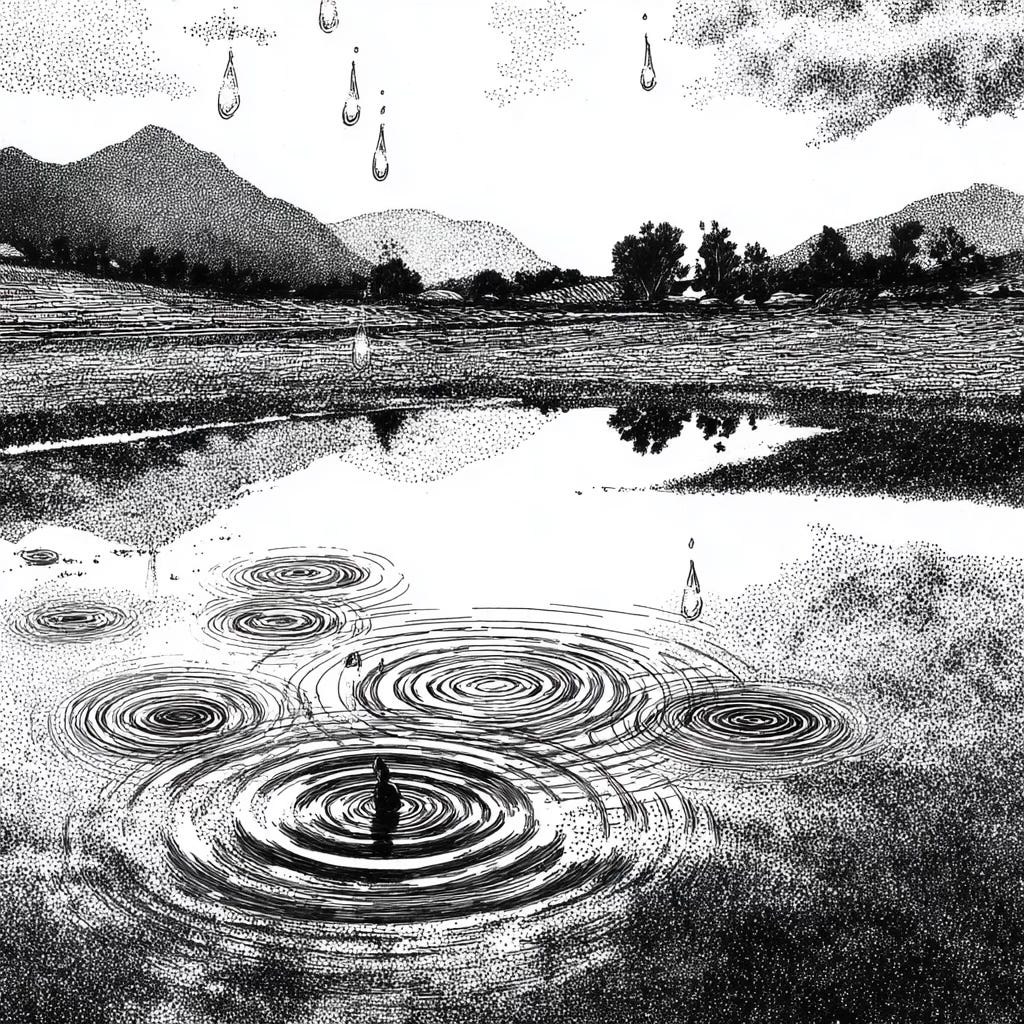
Change rarely arrives as single raindrops into a still pond. If it did, we could simply watch the rings expand and fade. Instead, life feels like a squall across the surface all at once. The ripples do not just grow; they collide, and where the arcs meet, the water does not flatten; it peaks into jagged, unpredictable crests. This is the interference pattern of modern life: a chaotic geometry where one shift crashes into the next before we have even found our footing from the first.
When that happens, for a period, nobody is in control. Those who think they are, by entitlement, job role, or title, do their best to frame what is going on as a temporary situation that will return to the normal they are comfortable with. Those who are subject to control find themselves dislocated and disoriented.
And then there are those for whom it is not a surprise.
“When did Noah build the ark? Before the rain. Before the rain.”
Nathan Muir in Spy Game. 2001. Director: Tony Scott; Universal Pictures.
From Observation to Practice
Last week, I said I needed to stop describing and start proving. Less elaboration, more evidence. This week, something happened that made that shift feel less like a resolution and more like an encounter.
A good storm clears the air, and there can be little doubt that we are at the beginning of a real one. We are experiencing those heavy little raindrops that signal what is coming, and I experienced one of them this week.
What I do involves a lot of reading, mostly for pleasure, partly for the work I do. I still find reading as input and journaling as output one of the best ways to make sense of what I am noticing around me. Stafford Beer noted that spending too much time in the black box of complexity that exists between input and output is a sure route to insanity. Better to concentrate on the nature of the inputs and the qualities of the outputs, and notice what changes. Leave the black box alone. It will take care of itself and is not listening anyway.
I was considering how better to capture the essence and insights of what I was reading, and had come across a Substack that outlined Aristotle’s Trivium: the routine of writing down what we remember from what we have read, the questions it generates for us, and our answers to those questions. It is an elegant way of minimising the overwhelm that can come from a heavy reading schedule. I have been trying it, and I like it a lot; it forces me to take a break in the reading to evaluate what I am reading.
That led me to a thought: would it not be great to do that in company, to get multiple perspectives on a piece? Something like a reading club, but accessible in the moment?
So I took the article, fed it to Claude, and asked it to create a tool that would allow me to specify other people, or personas, I wanted to read a piece and follow the Trivium process, and then have others do the same. I asked it to format it so I could do my own Trivium reflection first, and only then offer its perspective, so I could do a side-by-side comparison.
What happened next left me staring at the screen, half inspired, half seriously alarmed.
It took me, as a complete novice, around two hours, including the faffing around of someone who could not quite believe they could just describe in plain, clear language what they were trying to do, and off it went, muttering to itself in language I do not understand, and then presenting me with a finished product. I ended up with a working tool after three iterations, and what it does is impressive. Yes, it is a bit mechanical, but as a sparring partner for my own observations, it is valuable.
What This Means
Of course, it is just scratching the surface. But for me, conceptually, it is a game-changer. This is not an app I would aim to make public. It is a personal assistant that I can tailor and fine-tune to very specific client needs, to make our conversations richer. And if I can do it with the Trivium, I can develop other tools, from strategy to uncertainty modelling, that avoid the inevitable shallow generics of the scaled models required to sell in volume. It will help me explore ideas and offer original rather than recycled thinking.
When ripples combine, each situation is unique to the client and context. What this enables me to do is harness my experience, knowledge, and creativity not to provide a solution, but to help the client identify one for themselves, that they “own”, because they are the authors. It is a very focused, specific exercise that breaks new ground and is the antithesis of the generic slide deck of the corporate consultant.
And I think there is a craft to this. AI is a tool, and there is a skill to using it. It is a very different mindset to AI as “super Google”, or a provider of answers. It feels to me far more like a sculptor’s hammer and chisel that we use to chip away at the challenge until what we are looking for reveals itself.
I am aware that there are those with deep technical experience who would look at this and find it unremarkable. They are not who I am thinking of here. I am thinking of those who, like me, have a wealth of non-technical experience that we can now harness with technology. People whose relationship with the challenges they face is less as problems to be solved, and more as puzzles, or games to be enjoyed. Where the satisfaction is as much about the journey, and what we learn, as it is about the solution.
Something Alchemical
That half-inspired, half-alarmed feeling of staring at the screen was, I think, a small dissolution. An assumption I had carried for years, that building tools required a technical education I did not have, simply fell away. Not because I have become a technologist, but because what I know, the experiential knowledge that comes from decades of navigating uncertainty with real people in real organisations, turned out to be the more important ingredient. The technology was the vessel. The knowledge was the material being transformed.
On that basis, this is more alchemy than science. The nigredo, the breaking down of old assumptions about what we can and cannot do. The beginning of something being revealed that was always there, waiting for the right conditions.
That is how I want to explore it over at The Athanor. I will share my work there, for paid subscribers, warts and all. Not as an expert, but as an explorer.
A New Language
I think we are doing ourselves a disservice by allowing “artificial intelligence” to become part of the language. It is neither artificial, nor intelligent. It is something else, something that deserves a more descriptive name than a technical one. Perhaps a Loom, not a mind, weaving existing threads into new patterns. The threads are ours. The patterns can be surprising, even beautiful, but the loom does not understand the tapestry.
And the opposite of artificial is not natural; it is authentic. That is the real question these tools raise. They are built from authentic human output. The knowledge is not artificial. The pattern-matching is not artificial. What is missing is commitment, and Metis, the embodied, practical wisdom the Greeks distinguished from abstract knowledge. These are the qualities that make a craftsperson’s knowledge different from a database.
If we are not to allow the tool to take charge, we must recover our belief in our own qualities as authors, rather than sub-editors.
Names matter; first we create our tools, and then our tools create us.
The Pareto Revealed
Work has always been a compromise, with thinking materialised by effective execution. A natural Pareto: 20% thinking, 80% delivery. Technology is changing that balance, and the implications run deeper than efficiency.
AI does not change the nature of work. It reveals it. By absorbing so much of the delivery that has consumed us, it strips away the noise and shows us what was always true: that the thinking was always the real work, we just could not see it because we were so busy doing the other thing. The question is not how to deliver more efficiently. The machine has that covered. The question is whether we can tolerate the discomfort of genuine thought: sitting with ambiguity, questioning premises, reading the grain rather than just working the saw. Most of us, and most of our organisations, are woefully underprepared for that shift, because everything we have built, our systems, our metrics, our very professional identities, has been optimised for the 80% that is disappearing, not the 20% that remains. And that 20% is where all the value always was.
Where the Ripples Meet
Where the ripples meet is where the opportunities lie. Technology, climate change, economic models, meaning and purpose. Things that matter beyond the shallowness of the short-term obsession with “performance” and the belief we can make money from money without the effort of creating things of real value.
We have the ideas, we have the need, we have the tools, and the time is now.
Links:
The Score: How to Stop Playing Someone Else’s Game by C. Thi Nguyen
The Trivium: The Liberal Arts of Logic, Grammar, and Rhetoric by Sister Miriam Joseph, Marguerite McGlinn


Noah was responding “to the voice of God.” He listened, observed, and made sense of the whole. Your black box of complexity exists to inhibit these steps you’ve described. The challenge is not knowing what to do. The challenge is believing that “this too shall pass” and things will return to what we are comfortable with. I don’t believe this is realistic. The gutting of the white-collar workforce can be treated as tragic. It is in the short-term. But every one of those human beings RIFed are capable of creating new opportunities. I interviewed one on Friday.
Richard, you have displayed the true value of AI. If Noah represents the seer who sees the storm on the horizon, then what does the ark look like. The question of the future is not about AI. It is designed to devour itself. It is how do we structure the world to utilize human potential.
Whatever happened in Washington this week, it is nothing more than an attempt to hold on to a past that no longer exists. The systems of governance and finance are the black box. They are all outside the ark believing Noah is the fool. In reality, they cannot see that structure of the world is changing after many millennia of being basically the same. The great man/woman who leads is no longer. They are not coming to save us. They can’t even save themselves.
Yet, the future still belongs to the industrious, the resilient, the collaborator, the social catalyst, the seer, the believer, and the adapter. As bad as the storm will be, we will survive to thrive in a new world that has not dawned yet. I am as confident of this as I have been of anything I’ve seen my lifetime.