Reflections 21st June
Between Gradually and Suddenly
Last week I wrote about agency:
“the capacity to act on the world such that the world registers the act, and the feedback comes back to you.”
The action begins with you, and the difference it makes can be traced to you. I want to hold that theme for this post, because an email arrived on Monday that put flesh on the argument in a way I had not quite anticipated.
Parliament is to debate its support for the ceramics industry on 6 July.
It will probably be a short debate.
✦
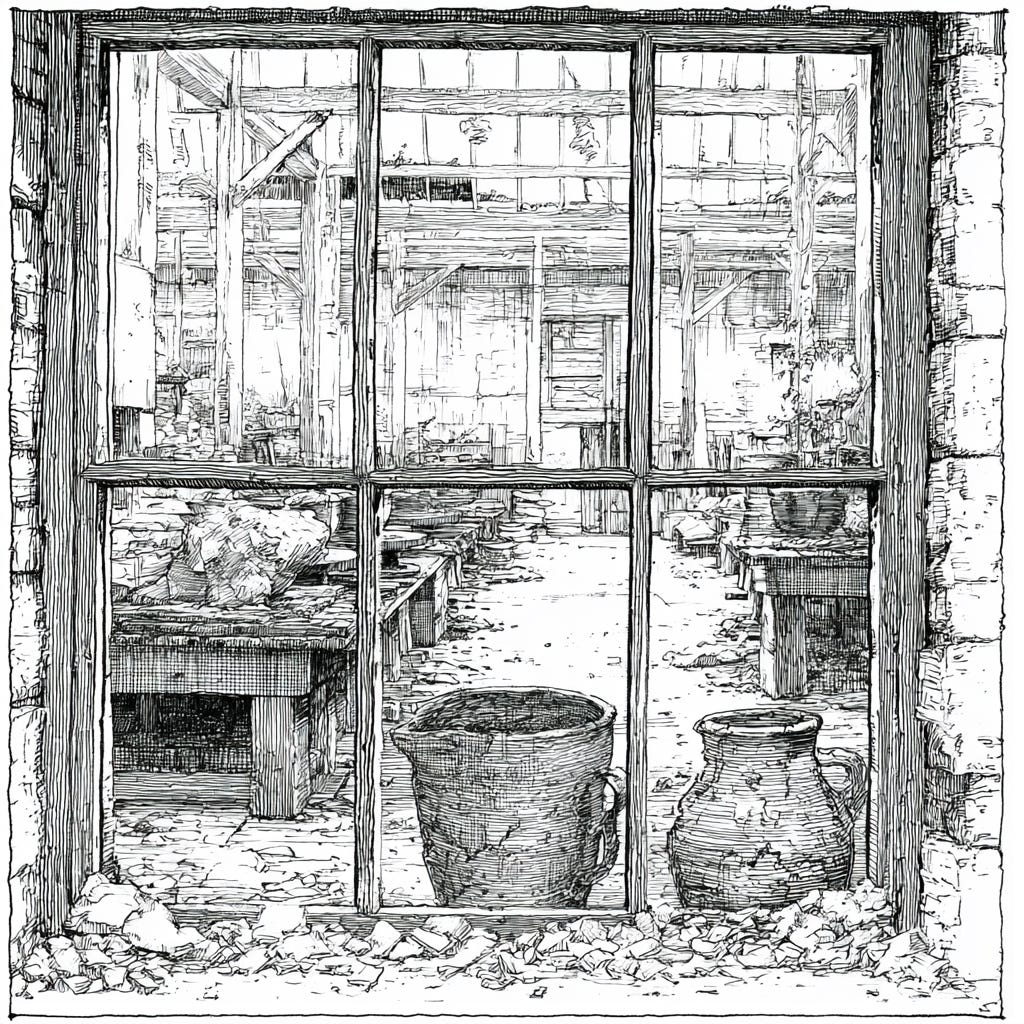
Since the pandemic, the doors have closed at Wade Ceramics, Johnsons Tiles, Royal Stafford, Heraldic Pottery, and most recently Denby Pottery. Moorcroft was bought by the founder’s grandson; the gesture matters, but the general direction of travel does not change. Wedgwood and Portmeirion are teetering. The skills of those who made the goods, and the ethics of the founders who created them, are not available for recycling. Parliament will express regret, then it will probably move on to something more politically exciting.
I think if we look back, we can see a clear pattern. The genesis of value is imagination made tangible. Growing things, creating things, and building things, starting as individual acts that evolve to become community concerns. Agency looms large, and for a while, we can trace what we buy back to its origin. Then the logic of the way we run capitalism makes the origin abstract to become a story to be told by marketers rather than a relationship we feel, the ultimate logic of that, which is that we end up trading not value, but stories. I find it hard to see any agency in ideas like financial engineering, I think that level of abstraction leaves us with the kinds of situations I’ve been describing in Denby and Radley. If I go further back, whole industries built on the energy of founders, from chip manufacturing to computer games, has ended up being captured and traded in acts of agency- free arbitrage. Eventually, the creative energy becomes diluted and exhausted. The enterprise gradually fades until suddenly it disappears.
I want to reflect on what happens in that gap between the fading and closing, between incremental gradually and the catastrophic suddenly, because that gap has become an industry in its own right: the isolation of agency, and the avoidance of responsibility.
✦
The Antithesis of Leadership
There is an enormous apparatus assembled to support those making the decisions, from Presidents and Chief Executives to run-of-the-mill Ministers, and jobbing MPs. An industry created to explain why what happened was not their fault, and that “lessons need to be learned” - by others, of course. Corporate and crisis communications, the home of the expensive consultancies, are paid eye-watering sums to persuade us that those who prioritise extraction over generation are well-meaning souls who were misunderstood, victims of circumstance, or both. Online reputation management has since become a distinct digital practice, there to establish that the software’s failure was nobody’s particular responsibility either; I can only imagine the pitches being made to AI-dependent companies right now. The market for these services is currently valued at somewhere around $105 billion, growing briskly, and all of it tax deductible.
The phrase that irks me is reputation management. Management is the administration of something that exists. You manage an estate, a portfolio, a schedule. What reputation management manages is the gap between what a leader or organisation is and what it wants to be seen as being. The larger that gap, the more creative management it requires.
Reputation Management is accident insurance for inadequate and uncommitted Leaders.
The founders of Moorcroft, or Denby, or Wedgwood did not manage their reputations. They built things. William Moorcroft developed his distinctive slip-trailing techniques over decades of patient refinement; the reputation was the residue of that. What the $105 billion industry sells is the fiction that the residue can be maintained after the practice that generated it has been abandoned or degraded. The brand is preserved; the making is hollowed out; and the gap between appearance and substance requires ever more sophisticated management, funded by cutting the very things that created the reputation in the first place.
For me, it is where the agency argument gains traction. Writing about Bandura last week, I suggested that agency is built almost entirely through mastery, through doing the thing and watching it land, and that the loop between act and consequence is where judgement grows. Remove the feedback and you remove the development. The person who never stays with the consequences of their decisions long enough for those decisions to teach them anything remains, in Bandura’s terms, at low efficacy; their model of their own causal power stays inflated and untested.
This is not primarily a moral observation, though it has moral weight. It is a structural one. The apparatus of reputation management is precisely designed to insert distance between the decision and its cost. The chief executive does not feel the closure of Denby in the way that the person who threw pots there for thirty years feels it. The minister does not feel it at all. What they feel, if anything lands, is reputational exposure; and for that, there are consultancies.
Pye’s distinction is useful here. In the workmanship of risk, the outcome turns on the person doing the work; the material pushes back, the thing might not come off, and the maker learns something true from the resistance. In the workmanship of certainty, the outcome is guaranteed by the process, the risk is designed out, and the maker learns nothing that the process did not already know. What the consultancy sells is the workmanship of certainty applied to consequence: whatever happens, the narrative will be managed, the exposure will be contained, and the person who made the decision will remain, in their own account, a victim of forces beyond anyone’s control.
The result is an organisation full of untestable practitioners: people whose calibration stays permanently soft because they have never been required to stay in contact with their failures long enough for those failures to revise anything.
✦
Perhaps if companies spent a fraction of their PR budget on developing their current reputations, rather than protecting the nostalgic, marketable ones established by people before them, we might do better. The distinction matters.
A current reputation is built forward, through what you are doing now, the choices being made today about materials, people, methods, relationships, and the acceptance of risk. It is accrued through practice and is inseparable from it. The nostalgic reputation is inherited; it sits in archive images, heritage marketing, the founder’s name above the door. It can be leveraged without being added to, and can be spent without replenishment, right up until the moment it cannot.
The ceramics industry is not a special case, though it is a legible one, because the things were made physically, by people with identifiable skills, in buildings you could visit, and the absence of those things is visible and countable. The same dynamic runs through consulting firms that sold their founders’ intellectual reputations for thirty years without producing new thinking, through universities marketing prestige accumulated by scholars two generations dead, through political parties drawing on a legacy of purpose they quietly abandoned. The mechanism is always the same: the gap between substance and appearance widens, the management of that gap becomes the primary activity, and the management cost grows until it exceeds what the residue can bear.
✦
We know how to build a reputation the old way: do good work, over time, in conditions where the consequences come back to you. The craftsman at the wheel, the consultant who stays with a client long enough to see whether the advice held, the politician who has to live in the constituency they represent, the chief executive who cannot exit before the results of their decisions become clear. These are not sentimental examples. They are structural ones. The loop is closed; the person is in it; learning is possible.
The reputation management industry is, at its root, a loop-opening device. It inserts professional distance between act and consequence, and it charges well for doing so. Ejector Seat Economics.
As individuals, though, we do not have that option. Reputation is personal, it is ours, hard won, fragile, and comes more from pursuing more than achieving. It is a measure of how we do what we do.
Circumstance, physiology, and temperament aren’t ours to decide. Pursuit and practice are. The joy of following something as far as one can is enough. Every endeavour is endless. No one ever gets to the bottom of anything.
How to Build Impossible Things. Mark Ellison
If we rely on our employer’s reputation to carry us, and our employer is one of those extractive Corporates, we are exposed in ways no consultancy can fix. We have abrogated our reputation. If we become executives making decisions in a company, whatever we say, we were there.
What shapes a personal reputation is simpler and harder: who you are, the work you do, how you do it, and the company you keep in doing it. The weakest of those will determine the rest.
The paradox is that AI, the bête noire of the moment, may be our most useful tool here. It makes the knowledge required for competence in almost any field practically free. The distance between competence and the excellence that underpins a real reputation is personal, a matter of practice, and remains under our own control. So when we can orient faster than our organisations, and turn our imagination into something tangible that gives us “the capacity to act on the world such that the world registers the act, and the feedback comes back to us.” choices about who we work with becomes a responsibility.
Which is to say: a matter of agency.
Our reputations are ours to shape as we choose, and we are being offered more options in how we earn them. It is not risk free, and that is the point.
Reputations are not built where there is no risk.
Parliament will debate ceramics on 6 July. Some version of “global headwinds” and “challenging trading conditions” will be said. A minister will express concern. We will “learn lessons”. No one will take responsibility. The debate will end, the loop will remain open, and the $105 billion industry will continue to grow.


