

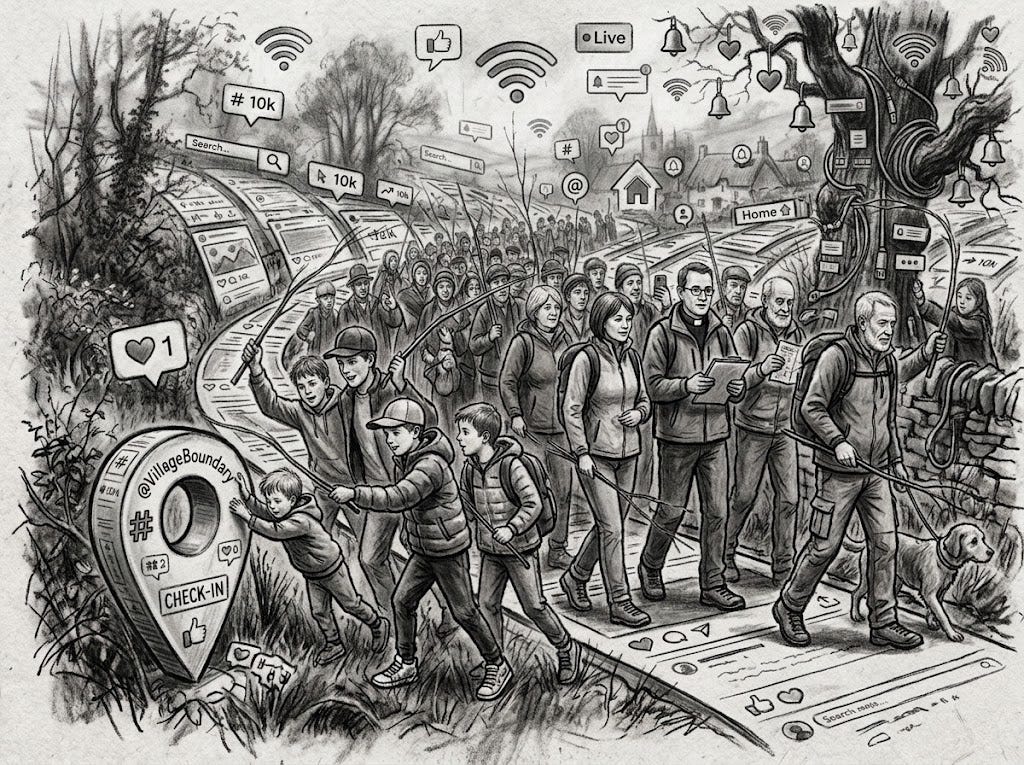
Beating the bounds is an old English custom in which the residents ceremonially walk their Parish boundary, striking or otherwise marking its landmarks. It’s a practical system for preserving local territorial knowledge, involving prayer, seasonal blessings, communal memory, and village community. Although it’s associated with medieval parish life, there are many places where the custom is still maintained. It is a way of making tangible the reaches of the village authority: what’s inside, what’s outside, and maintaining a relationship between them.
I was reminded of it reading a post by Neil Perkin last Friday, itself prompted by one by Johnnie Moore, on agency, or rather, our shrinking sense of it.
It led me to think about the idea of beating the bounds of our attention, because where we place our attention has a direct effect on our reality, as well as our felt sense of agency. There is a big difference between living life on our own terms rather than on those of other people, and it determines the choices we make about what we do. Increasingly, our agency is diluted by business models that find our agency inconvenient, and I have watched with interest as retailers like Sainsbury and Marks & Spencers, Financial Services of every sort, and local government introduce self-service lines ostensibly to help us, but realistically to avoid contact with the customer in a conversation free environment that minimises our sense of agency. Pay and move on please.
The central practical purpose of the medieval rituals was to maintain a shared embodied record of where a parish ended. Residents passed detailed boundary knowledge to younger people to create potential witnesses for disputes over land, rights of way, common land, and other matters.
The practices then wouldn’t pass modern health and safety regulations today. Children would be given unforgettable experiences, such as being dunked in a stream or sent through brambles or held against a wall, in highly memorable experiences that kept in mind the nature of the boundary far more powerful than a map. When I think of it though, that may have been gentle compared to what social media can do to us.
The train of thought took me back to the idea of trespass, of crossing boundaries, Nick Hayes’ wonderful Book of Trespass, and the thought of those who trespass on our attention.
What interests me more is that we accept people who trespass on our attention, and that this way of relating has become a doxa.
“Originating from the Greek δοκεῖν, meaning to seem or to appear, a doxa is a belief so widely held in society that it becomes seemingly self-evident: it requires no explanation and receives no scrutiny.”
― Nick Hayes, The Book of Trespass: Crossing the Lines that Divide Us
In a modern economy, the ultimate unit of currency is our attention.
Unlike our other forms, it cannot be created in spreadsheets or mortgaged in advance. Our attention, individually and collectively, is finite. If we use it on one thing, we cannot use it on another. Switching our attention from one thing to another carries a high cognitive cost, such that we effectively waste much of our attention when it’s moving constantly from one thing to another.
And the indications are, we are losing our ability to focus and concentrate. We have not, it turns out, given much more of our lives to media over the last twenty years; but rather hand the same hours to something entirely different. In 2010 the average Briton watched four hours of scheduled television a day; today it is a little over two, and for those under 25 less than an hour, while our online time has climbed past four and a half hours, three-quarters of it on a phone we check every few minutes. Broadcast, print and the book have given way to feeds that decide for us: social media and video are now the world's largest source of news, half of UK adults get their news from Facebook or its cousins, and the proportion of us who read for pleasure on any given day has fallen by around forty per cent since 2004. Even our attention to a single screen has shrunk, from two and a half minutes in 2004 to forty-seven seconds now. The scarce resource is not time. it is the capacity to stay with something long enough for it to change us.
And we have been trading it away.
It is a poor deal, with none of us immune, and for my own part, I am considering the importance of regularly beating the bounds of my attention in order to be disciplined what I allow to occupy it.
Avoiding the poachers who want us to expend it on trivia exquisitely designed to exploit it, from the shameless content of social media to once respectable news channnels that now feels it must compete using the same tactics.
Most of what is pushed at us we can do little to alter, unlike what we choose to pay attention to. Spending our precious time consuming what we cannot alter is a path to helplessness, whereas making even a small difference to what we can is a path to growth.
Rituals and Ceremonies may change form, but they do not become obsolete.
Our boundaries matter. We would do well to take care of them.