

Observation is hard, really hard.
It’s been a central part of my practice for the last 30 years, and it seems to be getting harder. As we approach the end of the current cycle, and the old normal disappears to be replaced by something we don’t yet know, it seems that everything we look at is both coming apart and reforming at the same time.
Observation, dispassionate, unbiased, and clear has become a skill in itself.
It used to be something we could take time out to do: taking weekends, holidays, or workshops when we could stand back with others and look at what we’re doing before we got back into the thick of it. Now, it feels like we are permanently in the thick of it, and the time and space for observation is getting scarcer.
At the same time, the observation we need to do is more difficult.
When the pressure is on, there is a great temptation to outsource: entire business processes to other companies, all the way to how our organisation works, how we lead, and our strategy to consultants.
We think that we can somehow fix things that in reality don’t need fixing, they are just asking to be recognised as changing and evolving. Outsourcing this carries a huge cost: it may appear to save us money, time, and effort, but it moves us ever further away from the edges where the change is happening. Now, under pressure, we have another temptation: to outsource to AI, and in so doing, insulate ourselves even more from what is really happening.
I am an enthusiast for AI within limits. Its very nature means that it doesn’t do complex but can tempted to think it does by being incredibly good at complicated. It will solve maths proofs that have defied human minds for years, but the whole point of a maths proof is that its challenge lies in its complications. Once it’s proved, it’s proved. It doesn’t go around changing as you look at it.
Unlike the areas that do.
Mark Eddleston published a book this week: The Pigeon Test. I think it’s a really important read: challenging and uncomfortable if you work in the space of advising. I recommend it.
He makes the point, from the perspective of a practitioner, that when we move from observing to recommending and actioning, things start to come apart. No matter how hard we try, we cannot walk in the teams shoes. It is easy to take from them the tasks they have to work out for themselves.
He uses a story from his time at university by his lecturer, Samir Rahani, who drew on a blackboard a sketch of a catapult. He made the point that if you put a stone in a catapult and fire it, you can calculate pretty accurately where it’s going to land. Maths and physics works.
If, on the other hand, you put a pigeon in the catapult, it doesn’t work like that at all. Pigeons have a mind of their own. Consultants, investors, and others who have little skin in the game other than the money they stand to make want to think that the challenges we face are stones, when in reality they are pigeons. They want physics and maths to work with pigeons. It’s a powerful and uncomfortable metaphor.
The stone aspect works well enough in that period of brief normality between business formation and business collapse. “Normal” works well enough for a good while, but likes constancy and rarely keeps up with the changes that are going on around it. Yet it is difficult to challenge normal when so many people are invested in it, particularly where they are tenants rather than owners in the business they’re running, and who find it easy to write off inconvenient truths as anomalies.
During normal, it feels feasible to both observe and orient, yet the challenge we face is that without real discipline, our orientation makes us blind. We see what we’ve planned to see, while the tools we use change faster than the rules we use to govern them (AI being a very current case in point) - and people don’t get fired for following the rules.
When it comes to money versus culture, money wins every time. Culture changes slowly, and will not be instructed. Money is measured in quarters.
So we convince ourselves that the ground we’re standing on is solid and that we understand it, even as the weather changes and rages around us, and yet, even as we know the weather will change the ground we’re on, gradually, and then suddenly, we put it in the “later” bucket.
Which is why I think, as our recent normal frays at the edges, our disciplines need to change. We cannot outsource our orientation to people who have no skin in the game, and have little interest in pointing out to us the inconvenient, and there is a strong argument for partnering with people who will observe what’s happening in our area without judgment, or bias, and tell us the things we do not want to hear.
There is a passage in Roger Kneebone’s book Expert (on page 120) that, I thought, captured this well.
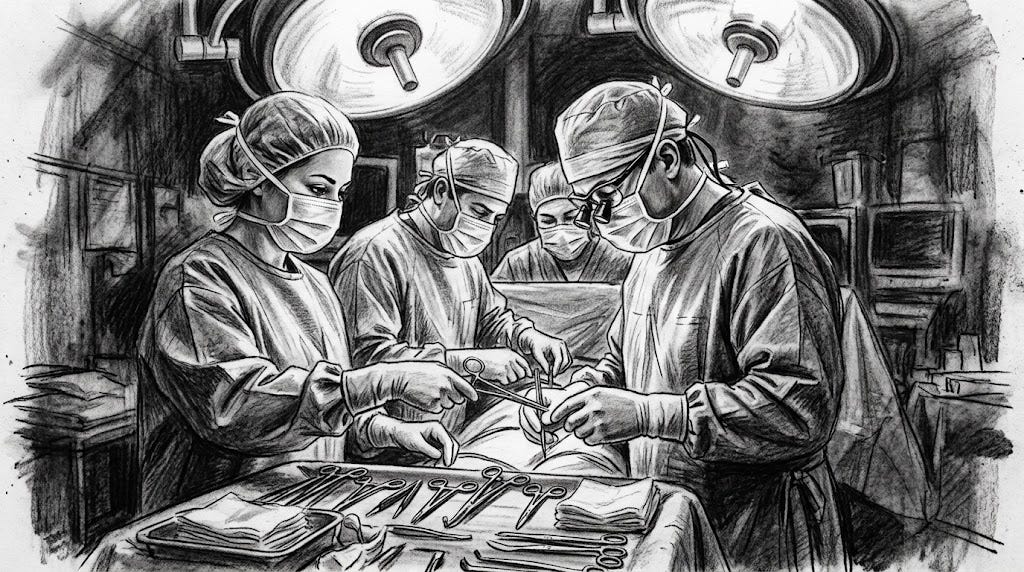
“The scrub nurse is a crucial part of the surgical team, responsible for all the instruments and materials used during an operation. They have to ensure that nothing is left inside a patient after a procedure is completed. Everything has to be counted in and counted out. Working closely with the surgeons, scrub nurses have to be able to lay their hands instantly on whatever instrument is needed and put it back there after use. They have to work within a consistent system that allows a scrub nurse from one theatre to move seamlessly to another. Yet they also customize their “mise en place” (a place for everything and everything im its place) in a way that fits with how they personally like to work. But the role of the scrub nurse goes far beyond handing over instruments and keeping track of them. Expert scrub nurses are constantly vigilant, paying close attention to the procedure and anticipating what will be needed. They can teach others in their team a huge amount. They are a crucial part of the community of practice of the operating theatre, using an unspoken language to communicate which even they are often unaware of.”
He writes further along in the book about an exchange between an experienced surgeon and his scrub nurse, along the lines of: “Sister, don’t give me what I ask for. Give me what I need.
Trust in another’s observation is a powerful thing.
Perhaps, with what’s going on right now, we all need our scrub nurse. People who are not going to advise us or take away our responsibility to do what only we can do, but can make sure that we are noticing what’s important, even when inconvenient, and have the right tools to hand.
Observing effectively is no long a part-time activity (if it ever was). It’s a full-time task and a skill developed over time. People who measure efficiency and productivity find it hard to value it until the time comes when we don’t notice something we should, and by the time we come to act, it’s too late.
Observation, more than ever, is a craft.
Who observes for you?
I had to laugh so hard when I imagined the pigeon sitting in the catapult! That is a really good metaphor.
I agree that observing may become a full-time job, and we should choose wisely how we do it, and what we delegate.
The "scrub nurse" does super valuable observing, but he/she also acts. AIs cannot (yet?) play that role. But what they can do pretty well is the observing part. Certainly never only AI, and never only one. But if we do the observing ourselves, unaided, it IS a full time job, and we'll be stuck in observing 24/7.
AIs have a lot of useful capabilities here: They have pretty much unlimited patience and attention, can follow rules (if we are disciplined to set the right rules), and they have no ego or intention. They do have biases and limitations, of course, but these are discoverable, even if only with rigorous and regular testing. A human may consciously or unconsciously hide them from us. In that sense, AIs are more stone than pigeon. AIs are also incredibly good, if prompted right, at pointing out the things we have overlooked.
In my view, this is not "delegating the observing", but widening our perspective. A periscope, telescope or microscope all have limitations. They help to see some things, and make others invisible. If used right, and if you do not take what you see through them as the complete truth, they can still be immensely valuable. The human still needs to learn how to judge well, how to orient themselves with this input so that they can then decide and act (OODA).
As you say: "AI within limits". The pure observing is complicated, while orientation is where the complexity sits?