Reflections 18th January
On being taken hostage
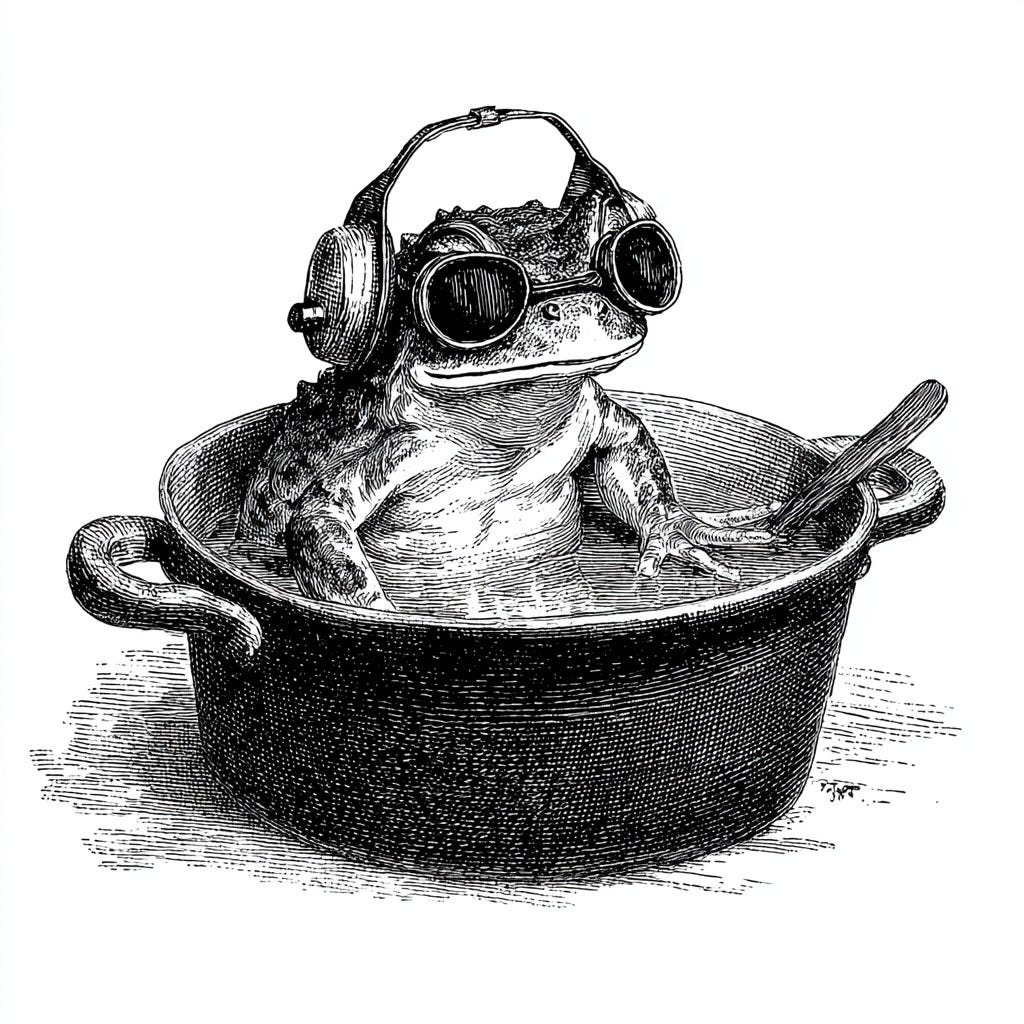
Our frog knows the water is boiling. It has a strategy, a plan, even a landing spot identified. So why doesn’t it jump?
Perhaps because, like us, it wants to think it’s wrong; that the water isn’t really that hot and if we concentrate, maybe we can convince ourselves it’s acceptable compared to the uncertainty involved in our strategy. Maybe the water will stop boiling. Maybe….Maybe…Maybe.
It is easy for us to be taken hostage by our fears. We are about twice as sensitive to threat as to reward, and easily persuaded that the threat of the unknown is worse than the discomfort of the present. The organisations we work for, and the companies that sell to us have a vested interest in keeping us hostage, and armies of lawyers to keep us that way, using non competes, digital rights management, and a host of marketers and others skilled in the use of softer, and persuasive methods that promote a version of Stockholm Syndrome, as we identify with our kidnappers. In many respects, it is more toxic than Stockholm Syndrome, in that we allow the water to become our identity. As Aristotle noted, we are what we repeatedly do.
The brutal economic reality is that whilst we might generate more value with genuine agency, that agency threatens the very systems designed to extract our current value. We’re more profitable as contained energy than as free agents.
The problem for us is that despite the rhetoric, nobody is coming to rescue us. Political and economic governance are so closely intertwined as to be inseparable. They have a joint, vested interest in us becoming frog soup.
We know this, even as we deny it. It is not that our politicians are bad people (there are exceptions, but they prove the rule), most are there working long hours, for little reward, doing the best they can in spite of the stream of hostile commentary from us simmering frogs. Rather than jump, we find it easier to listen to the Boris-Farage-Jenricks of the world explaining how we are victims of those easily labelled, rather than face the reality that we are permitting ourselves to be the feedstock of those who sponsor their rants.
How does this happen?
I think we can learn a lesson from America. Not to vilify it, but because America is a recent invention, a metaphor for corporate capitalism, and offers us a valuable laboratory of what happens to ideas. Not only is America a recent country, but it is also the first to be developed, in itself, as a business proposition. Read Thomas Paine’s “Rights of Man” alongside the Federalist Papers, and you see the conflict of “nation as idea” versus “nation as a going concern”. Paine trusted reason, moral equality, and the innate capacity of people to govern themselves once freed from inherited power. The Federalists, by contrast, assumed human fallibility and built institutions designed to restrain faction, ambition, and disorder. Paine feared concentrated authority more than instability; the Federalists feared instability more than authority. One spoke the language of transformation, the other of settlement.
America was shaped by both, and its political life since has been an uneasy attempt to hold these impulses together, balancing moral aspiration against institutional restraint, and discovering repeatedly that neither can survive for long without the other. America was born out of injustice elsewhere in the world, a place where frogs of every nationality could find refuge if they chose to jump. America in formation was chaotic, but inspirational; less a nation, and more an idea of what a nation could be. It now appears to be in a period where the idea, the reality, and the dream are in close proximity, but not yet sitting comfortably together. When ideas take on form, they acquire responsibilities, and in turn, those responsibilities constrain the dream.
This isn’t unique to America; it’s just more visible there because the documentation is recent and explicit. Britain went through the same transition during enclosure and industrialisation, but we’ve had centuries to forget the violence of turning communal ideas into private property.
In many ways, Britain’s enclosure movement offered a template that America has further developed. E.P. Thompson’s “The Making of the English Working Class” documents how industrialisation didn’t just change what people did for work; it transformed their relationship to time, community, and self-determination.
Artisans and smallholders who once controlled their own rhythms of work became “hands” synchronised to factory bells, their knowledge and craft rendered obsolete by machines they didn’t own. What made this a class formation rather than mere economic change was the systematic stripping away of agency: enclosure removed access to commons, combination laws banned collective organising, and new property relations redefined traditional rights as theft. The violence wasn’t just economic, it was ontological, replacing people who made things with people who sold hours. America’s post-war middle class represented a temporary escape from this logic, a brief period where home ownership, pensions, and workplace protections created genuine agency for millions. But as those protections erode; as gig economy replaces employment, algorithmic management replaces human judgment, and credential inflation replaces accessible skill, Americans are discovering what the English learned two centuries earlier: you don’t become working class by changing jobs, you become working class when your relationship to work strips away your capacity to shape your own life. The trap isn’t poverty; it’s the systematic conversion from agent to resource, from artisan to hand, from frog with options to frog as soup.
For those of us in older countries, we long ago stopped being nation as idea and are struggling with the burden of our past's responsibilities and the constraints they place on our dreams. What seemed like good ideas at the time carry consequences, and as the Iroquois of North America might remind us, we are all the fourth generation, shaped by the three generations behind us, whilst shaping the three that follow us. America has now joined the rest of us, an idea made real, and carrying the responsibilities of that transition.
Like the rest of us, no matter how we dress up and romanticise our past, we cannot go back there. We cannot afford to be held hostage by an idea made real. We need new ideas.
The same is true of our organisations and businesses. It is interesting to watch them as they move from ‘idea energy' to ‘reality energy’. It is a rite of passage, perhaps similar to that from adolescence to adulthood, from unstructured play, through directed play, to the constraints of responsibility to others, and increasingly to those we do not know.
And it is also true of our careers, as ideas and dreams encounter the politics and economics of a reality determined by others. Colin Newlyn writes fluently on it here, and I suspect many of us find his story resonates with our own reality, or prospective reality. Like countries, corporations resist new ideas unless they can control them with the skills they have developed to date; anything beyond that is a threat. This is why so many attempts to acquire ideas developed by others fail. They rely on a corporate image of itself that is at odds with what the acquisition really needs, buried beneath the glamour and money of the deal, like some sort of trophy partner. They may acquire the body, but not the spirit.
When corporations acquire startups, they’re not killing them maliciously; they’re integrating them into systems designed for different purposes. The startup’s “body but not spirit” failure maps directly onto our individual careers: we’re acquired (hired) for our spirit, then systematically converted into deployable bodies.
There is a point after which we join a corporation where the rate of learning slows, and we become that captive energy, available on demand to meet others' needs.
So why don’t we jump?
I think we become what we repeatedly do. Long enough in the corporate world, and we can tell ourselves that we are “expert water temperature negotiators”, or maybe now, all our social bonds are in the pot with us. We can convince ourselves that the situation is temporary, or look at the frogs who jumped earlier, who have made the transition, and tell ourselves it’s too late.
And there is a brutal economic reality: most hostages aren’t worth ransoming. Not because they lack value, but because they have negative option value - releasing them costs more than keeping them. Non-competes, pension vesting, credential requirements, these aren’t just control mechanisms; they’re systems for ensuring the cost of release exceeds the benefit, not just restraints, but temporal traps.
They work by making the future dependent on “not-jumping-now.”
Each year we don’t jump, the cost of jumping next year increases. If the ransom is to be paid, something or someone has to want us more, perhaps a lot more, than the corporation.
Jumping costs. Ideas are seductive, but dangerous. There are no guarantees, and under pressure, the stories we tell ourselves about our dreams are malleable. As the energies that created America solidify, and walls are built around it, the American dream, like the Corporate dream, is shaped by those who own it rather than those who built it.
The cage we find ourselves in operates at three levels. At the surface level we tell ourselves stories (water’s not that hot, it’s temporary, others have already taken the good spots). On a structural level, the economics genuinely don’t work (negative option value, golden handcuffs, credential lock-in). The ransom point is crucial: “something or someone has to want us more than the corporation.” This is rare, not because we lack value, but because the system is designed to make us non-transferable.
And thirdly, on an ontological level. We’ve become people whose capabilities are pot-specific. Our skills don’t translate outside the system that created them. The corporate frog develops capabilities that work brilliantly in corporate water but are useless (or worse, liabilities) outside it.
And, for a long time, we didn’t have to jump; we could find a comfortable corner somewhere in the backwaters until retirement. No longer. The need to maximise earnings, the power of process, and the potential of technology mean there are no more corners.
So, just as our younger selves stood on the edge of the diving board, we find ourselves looking down at the pool seemingly hundreds of feet below. We face that visceral dilemma; we know we should jump, and inside, we want to jump, but we don’t have to.
It’s a liminal space, where time can stand still. We find ourselves in a space between what we know to be collapsing, hoping it won’t before we’re done with it, and exciting but frightening possibilities. This is the moment between recognising the water is boiling and deciding what that recognition means. Not the jump itself, but the clarifying pause before it, when you can finally see both the pot you’re in and the possibilities beyond it without the fog of denial or the panic of emergency.
The alchemists called it Albedo, the quiet, clarifying phase that follows the blackened confusion of the destructive phase of Nigredo. It is not yet completion, but it is a relief. Things begin to separate and make sense again. What was muddied is washed, and what was tangled is gently teased apart. The work here is one of discernment rather than force, of noticing what can now be trusted and what must still be let go. It is the return of proportion, a tentative confidence that something viable is emerging, even if its final form is not yet known.
This is the space we are holding in The Athanor, as private disquiet moves to a shared naming in small groups, until we achieve sufficient clarity to make a decision; to jump, or not to jump.
There is no judgment; both are viable choices, but choiceso to be made with agency, not as hostages.
Work that made me smile this week:
Maria Popova. I love her work, and this really resonated this week.


"from frog with options to frog as soup". That about sums it up! Love it.
A small facet to add: Thankfully, it is not always one big jump one needs to make. Man-world has more layers than frog-in-pot world. More than one jump is *needed*, but on the flipside, one can try small jumps to see how much one can bear at one time. One can experiment with changing habits, with connecting to different people, with opening up. And ideally, some larger opportunities will emerge over time from some of that experimentation.