Reflections 19th July
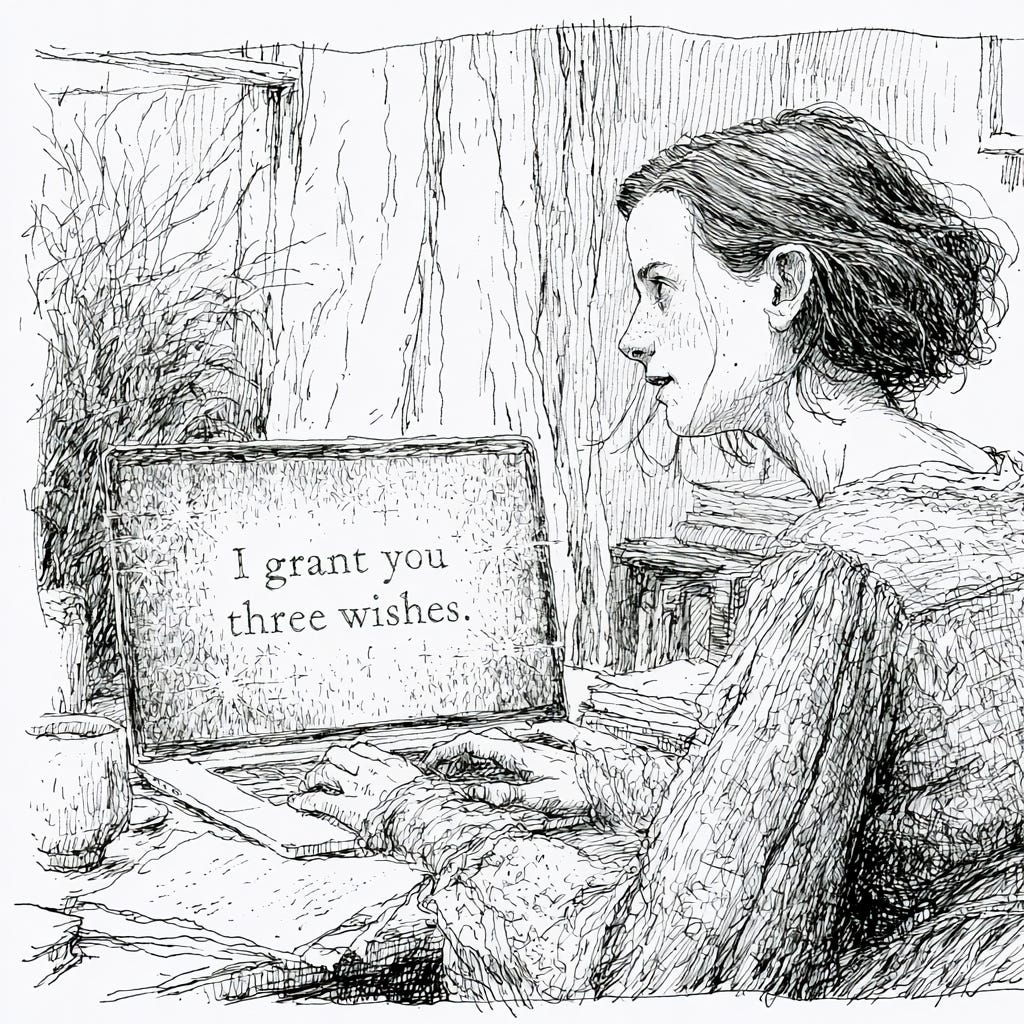
Three wishes...
I wrote last week about the debt we carry when we develop a story in anticipation of a world that turns out not to be there as we arrive.
It is a moment we share with the lamplighter, looking at the electric lights. Or with the inventors themselves. Edison published ten uses for the phonograph in the “North American Review* in 1878. Dictation came first, music fourth, and he resisted the entertainment market for years. Bell marketed the telephone for business and emergencies and actively discouraged social calls. It was rural subscribers, women in particular, who made it an instrument of sociability. By the mid-1920s the industry surrendered and began marketing what its users had already decided.
In the early days of a new general-purpose technology, the people who invent it believe they hold the whip hand. With the telephone there was panic about who might speak to whom, fear of contagion spreading down the wire, and an unsettling of the boundary between household and public.
Adoption, meanwhile, follows the money, not the logic. Electricity came to streets and trams first, then factories, then homes, and to farms last of all; individuals met it as spectacle decades before they met it as utility. Print took two generations to find its native forms, and printers stayed solvent on the indulgences, calendars and jobbing work of a disappearing world while the printed book was still discovering its shape. Those in power see the new thing as an extension of what they already do, and as hubristic entitlement, They carry their own particular form of story debt.
Fairy stories show us the way. In any story about three wishes, it is the third wish that has to undo the first two. The first two are made in confusion, wishes for what might be, regardless of where we are. The third leans into uncertainty, and a degree of clarity about what to do with what we have been offered.
In simpler times we were encouraged to keep a version of our business plan we could deliver in an elevator in thirty seconds. Something that said we know exactly what we are doing and why you need it. As we get to grips with our latest general-purpose technology, those elevator statements belong with the first two wishes. What people want from us now, in the third, is evidence that we are not confused. They do not mind us being uncertain, because uncertainty is clarity and a place to start. Confusion is something else altogether. Confusion is a disorder of orientation; no frame, and nothing counts as an answer. Uncertainty is a frame that knows its own limits. The uncertain can name an experiment. The confused can only name their discomfort.
During the week this gave me a small moment of clarity. The elevator pitch, and the business plan behind it, worked as stories of certainty. With a technology this powerful and moving this quickly, any such story is the worst sort of fairy tale; a first wish, made in the vocabulary of a world that is full of uncertainty.
Once upon a time, being inside the walls offered us security. Increasingly, what it offers is certainty on somebody else’s terms.
We have made our early wishes with this technology.
It will soon be time to be clear about our third.


