Reflections 16th August
Building a Small Space Station
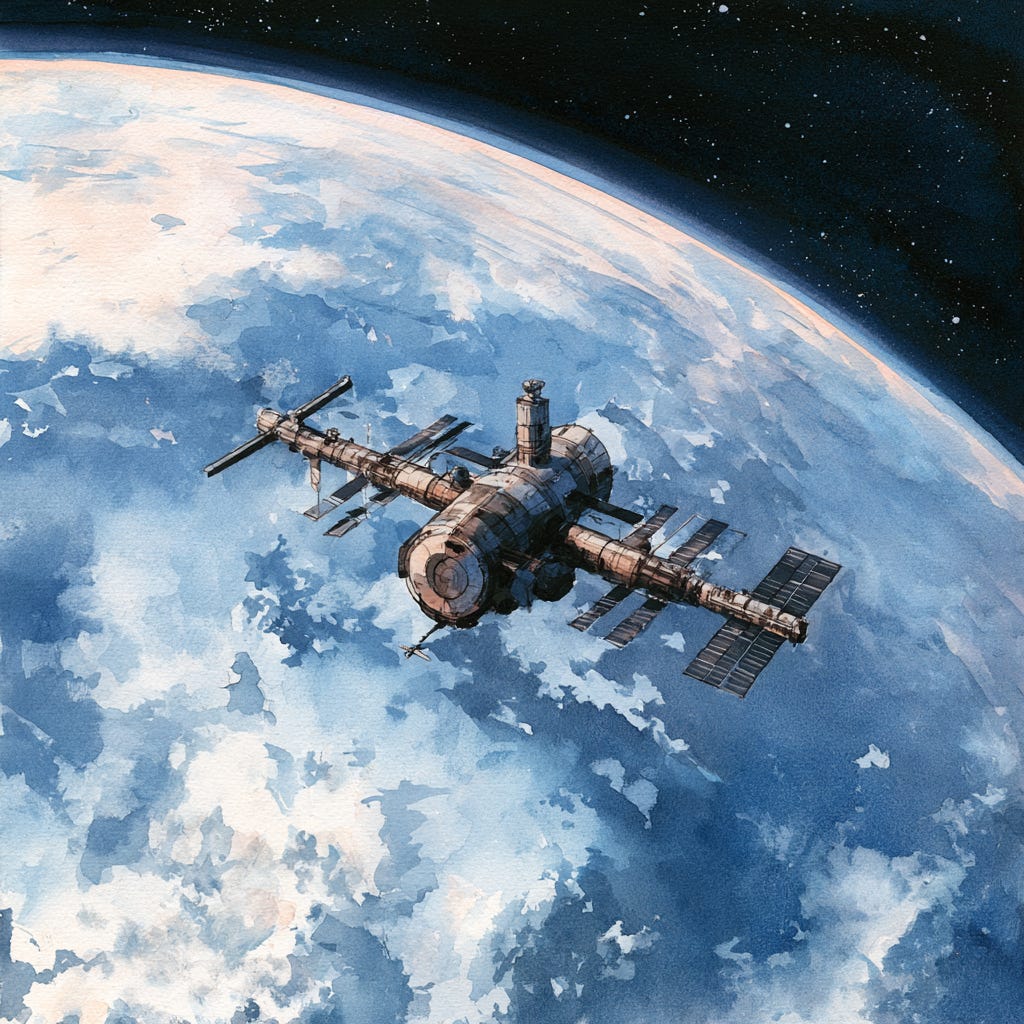
In Samantha Harvey’s Booker Prize-winning novel six astronauts and cosmonauts share the International Space Station for one day. During that time they orbit the Earth sixteen times, watch sixteen sunrises, run their experiments, and think about home. Meanwhile, below them a typhoon is building, and one of them learns, mid-orbit, that her mother has died. The station keeps circling, sixty degrees of latitude at a time, unable to stop for grief and indifferent to the storm.
What the six of them have, that the rest of us normally don’t, is observational distance. Not distance from feeling, but from the gravity that is our constructed reality. Enough distance to see the whole shape: the storm as a weather system rather than as a problem, and the threatened coastline as part of a pattern rather than as a sensational headline.
Harvey’s astronauts are not detached; the novel is at its best when it shows them fully wired to what is happening below. We can learn from that.
Elsewhere on my bookshelf, in “An Astronaut’s View of life on Earth”, Chris Hadfield (who sang ‘Space Oddity” from the Space Station) describes a discipline he practised for years before he ever left the ground: asking himself, of any situation, “what’s the next thing that might kill me?” He’s writing about spacewalks and re-entry, and the discipline itself isn’t about fear; it’s about attention, held with a kind of confidence that comes only from having already prepared.
It may be the best book on coaching I’ve read, maybe because it makes no claim to being one. It describes, patiently and without any talk of “leadership”, what it actually takes to keep your head once the environment becomes unforgiving, and there is nobody to rescue you.
John Boyd would have made a good astronaut. His OODA loop, (observe, orient, decide, act), has been horribly flattened by three decades of management slideware into a simplistic, inaccurate and unhelpful four-step method for making fast decisions, riding on an appetite for misplaced military metaphor as a crutch. His enormous body of research, preceding the current fashion for critical thinking, holds observation is a discipline, with orientation as the shaping act. Being Prepared. Calmness under pressure, where raw observation gets filtered through experience, culture and preparation into something we can use to make the best decision we can with incomplete information.
That’s the discipline the astronauts have, which the rest of us can learn to apply in rather more forgiving environments: that we do not need more information, we need a more grounded orientation to the information we already have.
Each of us needs our own space station; somewhere we can visit to build the picture we need to make sense of our world. A place inhabited by people we trust, whose opinions we respect, who are there to help us observe and orient without judgement.
We tell ourselves we can’t build our own space station because we don’t have the time, even as reality suggests the opposite. We don’t have the time because we don’t have a space station to help us see what matters.
Worldwide, people now spend more than two and a half hours a day on social media; the better part of a full waking day each week, taking in stories built to make somebody else money. Immersing ourselves creates our personal weather, convincing us that every gust is a personal deficiency. Climate change that has been building in plain sight for half a century, technological disruption that is in reality a permanent feature, not a bug, and the felt sudden uselessness of a CV created for a world that has disappeared in an instant.
These are real conditions, and experienced entirely from inside them, at ground level, they can feel like fate rather than weather. Something being done to us rather than something that will change, with its own patterns, that from a distance we could see forming.
We are neither victims, nor helpless, even though the profitable stories told by those who stand to benefit would prefer us to think so.
Media is not our friend. We are a market.
In the book, Harvey’s astronauts try, and mostly fail, to think a new thought up there. There are no new thoughts, one of them tells herself, they’re just old thoughts born into new moments. That’s not defeat, it’s closer to what an orbit can teach us: not novelty, but recognition, seeing an old pattern clearly enough, from far enough back, to know it as a pattern rather than as a crisis unique to us.
We do not need to be billionaires with oversize egos. Building our own space station needs something much smaller and already available to us: a handful of people we trust enough to be open with, or whom we are prepared to learn to trust, met with enough regularity and enough distance from targets, hierarchy and urgency to look at our lives as a whole rather than as this week’s inbox. Not to escape the world of work below, but to see it properly: its patterns, its actual contours, as against whatever story is currently being told about it.
It is a station any of us can build, that nobody else is going to build it on our behalf. Nobody is coming to rescue us, because we do not need rescuing. The orientation we need is in our own gift.
As St Augustine is supposed to have observed; “Hope has two beautiful daughters: anger at the way things are, and courage to see that they do not remain as they are.”
Make the time.
“To me, it’s simple: if you’ve got the time, use it to get ready. What else could you possibly have to do that’s more important?”
Chris Hadfield, An Astronaut’s Guide to Life on Earth
Note: I have disabled AI detection. It tells me that this was 24% Ai generated, It was not. It is perhaps the most pointless use of AI I have come across. Complexity for the sake of it. If we can’t discern what we read for ourselves…
if you want to build your own space station, visit The Athanor.


Two concepts to add.
Know thyself.
Meaning be self-critical about your own prejudices. They blind us to what is right in front of us that we need to see. Why are we blind metaphorically? We are either afraid of the implications of truth, or what I call “consequential reality.” Or, we arrogantly believe we already know what we need to know.
Take time to reflect on what you see.
My friend John Saad (https://johnsaadauthor.com) makes a compelling case for taking time to reflect on what you see. Last year, I took four months off from writing to reflect on questions of time, reality, and generational memory. I took time to read. I read Eliot’s Four Quartets in total three times, the first quartet a dozen times. I read Shakespeare’s Macbeth. And I read William Faulkner’s The Sound and The Fury three times. Absorbing other people’s creative thought, not collecting data, but letting the author’s intent appear to me brought me to a level of awareness that change my focus and direction.
Time is short so take time to reflect on who you are and where you should invest your life for the time you have.