Reflections 15th March
Process as Herd Behaviour.......
Whatever our stance on geopolitics, AI, the jobs market, or what is happening in our particular sector, we will find plenty of evidence to support our view. Very little of it will be objective, and a great deal of it will have involved some form of social proof that strengthens our conviction. Whether we think the world is collapsing or standing on the brink of a new dawn, we can find the company and the evidence to reassure us that we are right.
Going with the herd is easy when we are under pressure. We can take refuge in the idea that we are doing the same as everybody else, so we cannot be entirely wrong. The protection of the herd is reassuring, if illusory.
Sometimes, though, we need to do the hard work of withdrawing to a quiet place, and as dispassionately as we can, observe what is actually happening, and reorient ourselves.
I wrote last week about the challenges we face when we allow process to become the point. I think process is a herd activity, and understanding why tells us something important about the moment we are in.
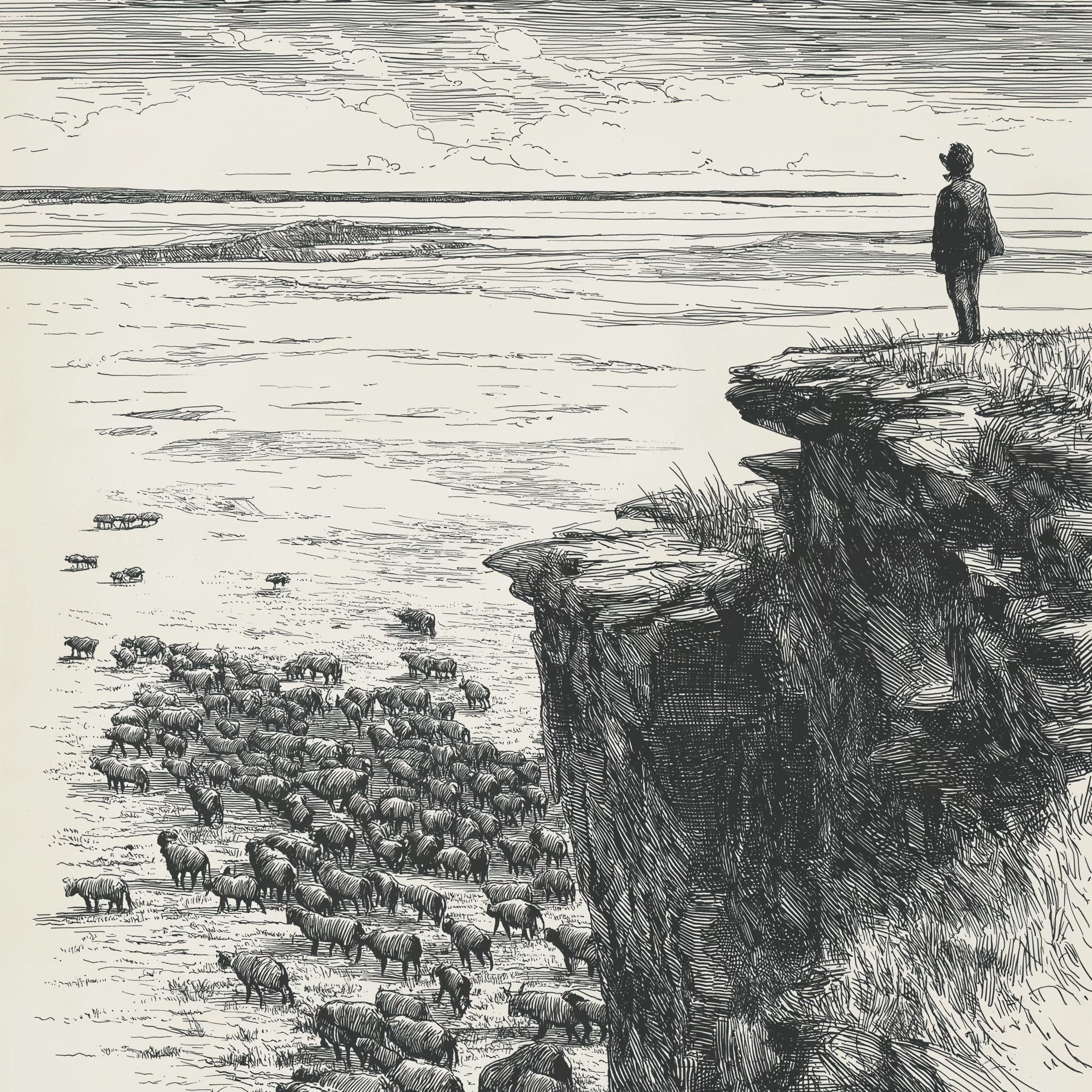
A herd of animals on open ground are not, individually, reading the terrain; they are reading each other. The animal at the edge of the group watches the movement of its neighbours and adjusts accordingly, and what looks like collective intelligence is often something closer to collective attention displacement. The herd moves, and each animal moves with it. The ground itself, with all its actual features, its hollows and its gradients and its threats, recedes from individual awareness.
Process works in the same way. When an organisation develops a procedure for handling a situation, it is, at its best, encoding hard-won experience into a repeatable form and is genuinely useful. The danger comes later, when the procedure outlives the situation it was designed for, and nobody quite notices, because everyone is following the process that has become the terrain.
Following it feels like navigating well, even when it is leading somewhere nobody would have chosen to go.
It is not a failure of intelligence; it is a choice that can easily become subconscious. It is a feature of how human beings manage uncertainty under pressure. When the situation is genuinely unclear, the signals are contradictory, and the stakes feel high, deferring to a shared method is a way of distributing the cognitive load and, crucially, the moral weight of the outcome. If we all followed the process and it still went wrong, then none of us is individually culpable; the process is, and since the process is abstract it cannot be held to account in the way a person can.
Process, like the herd, offers cover.
It is why process accumulates over time and is so rarely pruned. Each layer of procedure that gets added represents someone’s attempt to prevent a previous failure from recurring. Whilst the instinct is sound, the cumulative effect, layer upon layer, year upon year, is an organisation that has progressively less and less of its attention available for the situation it is actually in, because so much of that attention is consumed by the management of its own internal choreography. The herd has grown so large and so dense that it can no longer see the edge of the cliff until it is very nearly there.
A present example sits in the Straits of Hormuz, where, according to Foreign Affairs Magazine, the US Navy has never prioritised mine clearance. As a result, it now finds itself reacting to what amounts to an effective economic cliff edge, created by a small number of players using improvised tools. The process for naval power did not include this terrain, and the terrain did not care.
What makes this particularly acute right now is the information environment we are operating in. The flood of content that arrives in our inboxes, opinionated, AI-assisted, algorithmically curated to confirm whatever we already believe, is itself a herd phenomenon.
The platforms we use to make sense of the world have been engineered to keep us moving with the group. Dissenting signals are not exactly suppressed; they are simply crowded out, drowned in the sheer volume of material that tells us our existing view is correct. Confirmation is frictionless. Reorientation requires effort.
John Boyd, the strategist whose thinking I return to often, described the fundamental challenge of operating effectively in a changing environment as a cycle of observation, orientation, decision, and action. What he understood, and what is easy to miss, is that orientation is the hardest part. It is not simply the act of gathering more information; it is the willingness to allow our existing mental model of the situation to be disrupted by what we are actually seeing, if we take the time to look. The herd makes orientation harder because it keeps offering us a simplified version of the territory that the group has already agreed upon. The process makes it harder still, because it tells us which observations are relevant before we have had a chance to make them.
The result is that many of the people and institutions that appear most confident right now, those with the most assured accounts of what is happening and what should be done, are operating in what Boyd might have called a degenerating orientation. They are not reading the terrain. They are reading the procedure for reading the terrain, and finding that it confirms what they already knew.
The question that matters, then, is not whether to remain within the herd. The animal that simply leaves the herd is not demonstrating independence; it is usually demonstrating panic, and it tends to come off worse than those that stayed.
The more interesting and more difficult challenge is to maintain our own orientation while remaining embedded, to keep one part of our attention on the actual ground, even as we continue to move with the group. Moving to the edge of the herd is more dangerous than sheltering in the centre, but it may allow us to see the cliff edge in time.
It requires a specific kind of discipline, and it is not primarily intellectual; it is perceptual. It means cultivating the habit of noticing when our sense of the situation is coming from direct observation and when it is coming from the movement of the people around us. These feel identical from the inside, which is precisely what makes the distinction so difficult and so important. The herd does not announce itself as a herd. It presents itself as common sense.
One of the most reliable signals that we have stopped reading the terrain and started reading the group is the feeling that the process is, in itself, a sufficient response to the situation. When the answer to any given challenge becomes the invocation of the correct procedure, when doing the thing right has quietly displaced the question of whether we are doing the right thing, the herd has taken over the navigation. We find ourselves moving, possibly quite efficiently, in a direction nobody consciously chose.
The antidote is not contrarianism. Going against the herd for the sake of it is simply another way of letting the herd set our direction, with the sign reversed. It is also, in practice, exhausting and largely futile. The antidote is the kind of attention that James Scott called mētis, the situated, embodied, experiential knowledge of someone who is actually looking at this field, in this season, with these tools, in these conditions. Not the generalised procedure. The specific situation.
We have never been more capable of this, if we choose to be. Strategy has been a large part of my life for the last several decades, and one of my habits has been to regularly record what I am noticing. Not as a statement or a conclusion, just a record. I have kept a journal, made notes on books, tracked observations and areas of developing interest. Over the last six years I have written something approaching three thousand short pieces, and where I used to thumb through them occasionally in a quiet moment to see what I noticed, I can now do something closer to that at scale. I have loaded these records into Claude and given it access to the pattern of my thinking over time. I can ask what I have written before on a subject, what threads connect across years, and where my current thinking contradicts something I argued previously. I can ask what Claude notices about the direction of my thought. It is the nearest thing I have encountered to a working mētis library.
The tools that make this possible are available to all of us now. Whether we use them to confirm what we already think, or to interrogate it, is a matter of attention and habit, not technology.
In a process-driven world, our work rarely defers to our accumulated experience, until, for whatever reason, the wheels come off and the process begins to fail. At that point, the substance of mētis becomes critical. Our value lies not in how efficiently we can operate the machinery, but in what we can see that others cannot.
Sometimes the herd breaks. Acute pressure, a threat that the existing procedure has no answer for, a crisis that moves faster than the process can keep up with, and suddenly the choreography dissolves. In those moments, something more instinctive takes over, and this can be catastrophic, a panic that scatters everything, or it can be the moment when people who have been quietly maintaining their own orientation step forward and navigate. The difference between those two outcomes is almost entirely a function of what people have been doing with their attention in the quieter periods before the break.
This is why the practice matters more than the moment. Boyd’s reorientation is not something we perform in a crisis. It is something we cultivate as a habit, precisely so that when the herd breaks, we have a compass of our own to fall back on.
The quiet place I mentioned at the start of this piece is not a luxury. It is maintenance. It is the regular work of checking whether our map still corresponds to the territory, before the territory changes so dramatically that the mismatch becomes impossible to ignore. The herd will still be there when we return, and will probably not have noticed we were gone. But we will have something it does not: a provisional but honest account of the ground beneath our feet.
“Why do you go away? So that you can come back. So that you can see the place you came from with new eyes and extra colors. And the people there see you differently, too. Coming back to where you started is not the same as never leaving.”
Terry Pratchett, A Hat Full of Sky
Process has its place; it encodes experience, and experience is hard won. But process serves us only as long as we remain capable of questioning it, of asking whether this situation is genuinely the situation the process was designed for, and whether the answer it is producing corresponds to anything real. The moment process becomes self-justifying, the moment following it correctly is taken as evidence that we are thinking well; it has stopped being a tool and started being a substitute for attention.
And if ever there was a time when we needed to pay open minded attention to what is happening around us, it is now.
Taking our old models, our traditional ways of working and trusted processes, examining them and reforming them to create something we can use in the current situation is something akin to alchemy. That is what we’re looking to do in the work at The Athenor. If this is an area that interests you, please come across and have a look.


It is a curious thing that people want the same thing in the same way in the same place all the time. I wonder if this is a product of systems programming or human nature?
I'm presently at my second major family event in ten days. Yesterday we celebrated my cousin's 50th wedding anniversary. A week ago, we celebrated my mother's sister's 99th birthday.
As we talked as a family about the passage of time, we saw that the changes we had all experienced had brought us to a place of gratitude and closeness.
When my cousin retired, he and his wife moved across the street from one of their sons to help care for their grandson, who is autistic. It reminded me that life is what you make it to be, regardless of what you begin with.