Reflections 14th June
Agency, and being seen to be useful
Last week I wrote that we are all beginners now. The thought has stayed with me, and changed shape.
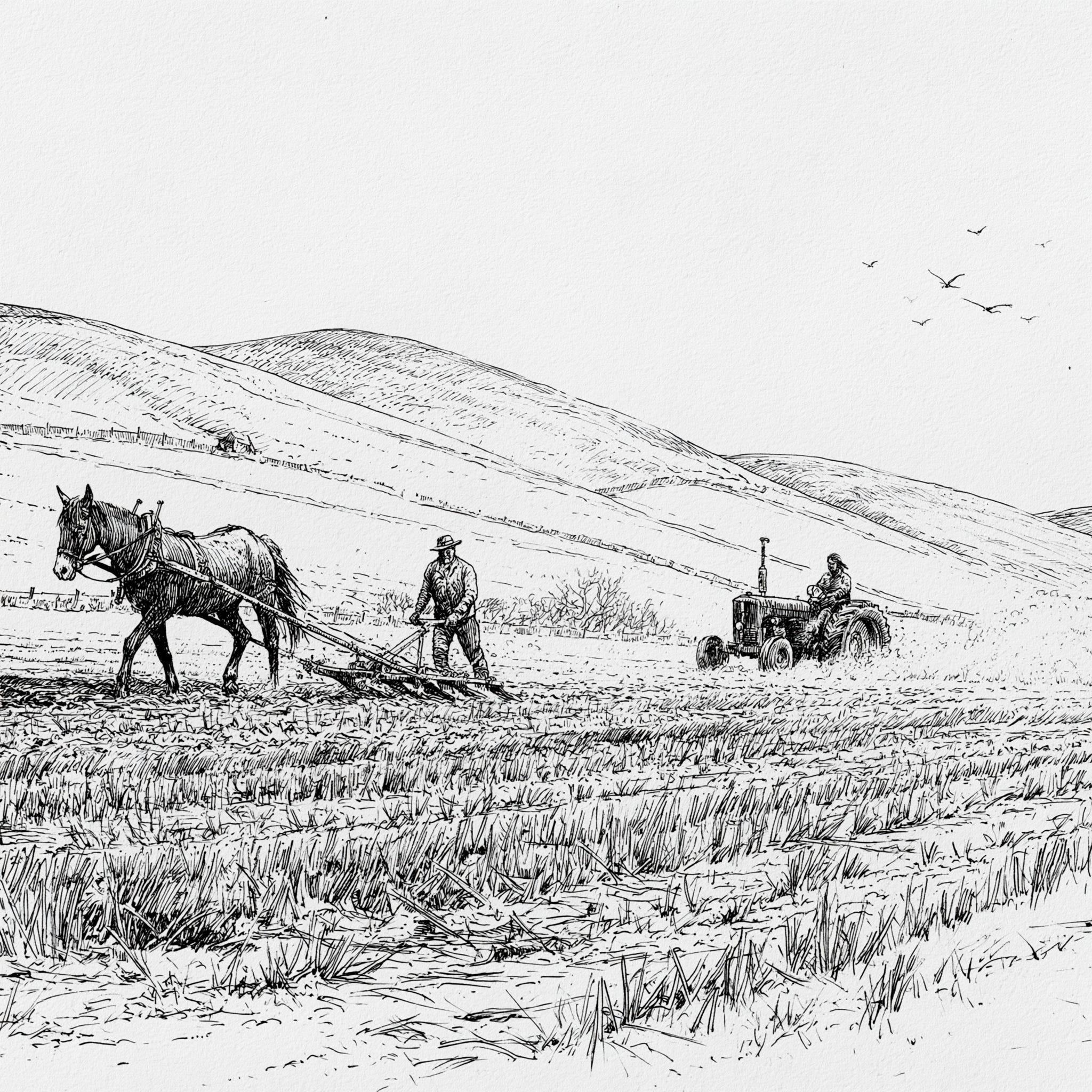
The relationship we have with our work is starting to feel like the relationship horses had with the plough when the tractor arrived. We are putting AI at the centre of the argument about work, much as people put the tractor at the centre of theirs a hundred years ago. I think it is the same mistake. A century ago the thing at the centre was the farm. The thing at the centre now is the way we make and create what we need. What did not change then, and I doubt will change now, is that human life still has to be fed, and housed, and somehow held together. What changed was how we organise to do it.
I have begun to wonder whether our attention is in the wrong place. We watch individuals, when we might do better to watch organisations, because if the analogy holds, organisations are the horses. They are what the new machine acts upon most powerfully.
And as organisations change, we will have little say in it. Capital is the driving force, whilst we are mostly collateral, but that is not the same as helpless. As we come to understand what is happening, and grow familiar with the partial but astonishing power of what has been built, we have to reorient ourselves towards the emerging ways of making things.
The organisation will be reshaped whatever any of us thinks. So set it aside for a moment. The harder question is the smaller one, about ourselves, and it comes down to agency.
✦
Peter Reinhardt, watching the on-demand economy a decade ago, described being above the API or below it: the people who wrote the instructions, and the people who took them from a screen. I borrowed the shape, changed his word from API to algorithm, and added a third position, “beyond”. I found though that the trouble with that is that all three still put the algorithm at the centre of the thinking, and the centre is not the algorithm. Take another step back and it is not even the work. It is the outcomes the work produces.
Seen that way, AI is the latest and most powerful turn of a wheel that began with F. W. Taylor, sped up in the 1980s as we entered the age of the internet, and was refined again through lean six sigma and every other method that made data the sole arbiter of good work. Output, not outcomes became the measure. Impact on what matters beyond measuring slipped quietly out of the frame.
Lisanne Bainbridge named the cost in 1983, as one of the ironies of automation. Automate a process and the human is left to supervise, the task we do worst, while being stripped of the hands-on practice that competent supervision depends on. David Pye would put it similarly; the person who commissions the work buys the workmanship of certainty and gives up the workmanship of risk, and the only known means by which judgement grows. The apprentice once learned that by sweeping the floor of the studio he would one day run; and the executive who never sets foot on the floor has nowhere to serve that apprenticeship. McGilchrist would say the posture trains the wrong attention: outputs are measured, but processes are no longer inhabited, and a chief executive is as caught in the algorithmic thinking of capital as the Uber driver, only better paid. Commissioning the work can look like command, but command without the capacity to own what comes back is just dependency in a smart suit.
✦
So whether we are a boss or a coffee chain barista, the bind is the same. We instruct the work and stand apart from the outcome, whether that is a coffee or a takeover, or we take instructions for we do the work and are kept from knowing why it is done. The process us responsible, but has no accountability.
There is a third place to stand, which we might call witnessing. It commissions nothing and makes nothing; it watches the work, and the larger thing the work belongs to, much as you might watch an abstract painter at work. From there you see differently. You might see a commissioning class doing what has always made it successful, only faster now, to produce nothing different, just more of it. You might see people doing a fragment of something, with no line of sight to the whole, because the work has been broken into pieces too small to feel like work we that belongs to them.
Witnessing lets you see. It does not, by itself, let you act. Acting is a different matter, and it is the thing underneath all of this.
At a time dominated by the term “agentic”, agency is one of those words we just accept, yet it is a term that does heavy work while staying conveniently vague. It helps to take it apart. At its root it is the capacity to act on the world such that the world registers the act; the action begins with you, and the difference it makes can be traced back to you. That already separates it from its near neighbour, autonomy, which is freedom from interference; agency is the power to effect and be changed by the feedback. A hermit (and often a chief executive), has a good deal of the first and little of the second.
Bandura saw it as a loop. Agency is not a trait you possess but a relation between act and response: you do something, the world answers, and from the answer you form a judgement about your own causal power, which then governs what you attempt next.
Self-efficacy is the hinge.
The implication is uncomfortable for most development work. Agency is built almost entirely through mastery, through doing the thing and watching it land, and only faintly through encouragement, outsourcing or insight. Agency is “hands on".
C. Thi Nguyen adds a further thought: agency has texture, and it can be designed. Games are his evidence, sculpted forms of agency we step into for a while, taking on goals and limits for the sake of the kind of acting they allow. It cuts two ways; an environment can be built to enlarge a person’s agency, and can also be built to simulate it, to give the feel of effective action while the real causal power sits somewhere else. Chief executives might note that. Pye is useful here once more: agency lives in the workmanship of risk, where the outcome turns on you. Remove the risk and you remove the agency, whatever the dashboard says at the end of the quarter.
Perhaps much of what executives do is game play? A role they step into temporarily rather than who they are.
And even at its most potent, agency has a short reach. Our first trillionaire was minted this week, when his rocket company went public; he holds the title on paper, tenuously. A falling share price, a failed launch, and the number comes back to earth. His causal power runs through Bandura’s loop like everyone else’s, only with more zeros attached. For the rest of us, trillionaire and barista alike, the reach is much the same. We only directly affect those close to us, in something close to Dunbar’s layered numbers: five, fifteen, fifty, a hundred and fifty. Past that it is social physics and luck.
So as we watch all this happen, set down the technology, the media, the hype, and what is left matters: the question of what we do that the world answers, and consequently whether the next move we make is ours, or determined by someone, or something, else.
Do what others decide you should, and the technology becomes an unreliable assistant and your organisation a horse. Decide for yourself, and the same technology might turn out to be your tractor.
So: who are we useful to?


