Reflections 14th December
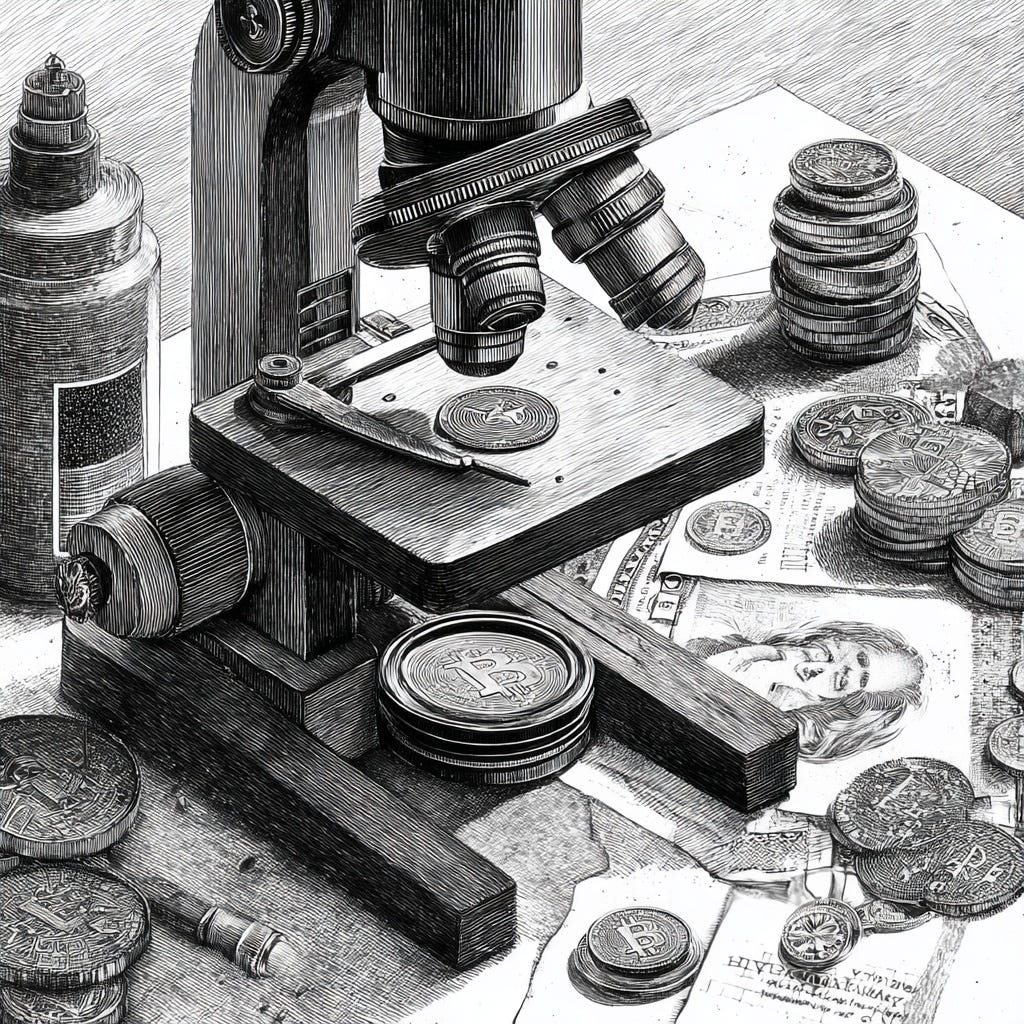
Myths under the Microscope.
Myths create powerful temporary truths. They make the incomprehensible manageable, give shape to uncertainty, and coordinate action across communities. But they are not truth itself; they are signposts towards it, provisional agreements that serve until they don’t.
Max Planck once remarked that new scientific truths don’t replace old ones by convincing established scientists that they were wrong; they do so because proponents of the older theory eventually die, and generations that follow find the new truths and theories to be familiar, obvious even.
We are in a time of new truths and theories, yet we cling to old myths with remarkable tenacity.
Myths Around Metrics
Peter Drucker is alleged to have said that “If you can’t measure it, you can’t manage it” (although, to be fair to the great man, there is no clear evidence that he ever wrote or said it. )
Whether he said it or not, it has become dogma.
There is another view on the record. In “The Tyranny of Metrics”, Jerry Muller shows how a fixation with metrics leads to gaming, goal displacement and the crowding out of judgment, and supports Goodhart’s Law, which predicts that “When a measure becomes a target, it ceases to be a good measure”.
I find something diminishing in the way we have come to worship metrics as arbiters of truth, at the cost of other, less tangible, more visceral signals, as “evidence-based” becomes a shelter we retreat to when faced with uncertainty.
Numbers are such wondrous things. They help us understand mysteries, from music and poetry to deep space, and yet, for the most part, we cage them and make them perform the tedious work of measuring miserable, soulless things like margins, profit, and a very singular definition of growth.
It seems paradoxical that we readily accept 95% of space is dark matter and dark energy - essentially admitting vast cosmic ignorance, and yet expect to measure our economies, our lives, our ‘productivity’ to decimal-point certainty and predictability.
Perhaps, as individuals, we can empathise with numbers; capable of so much more than is asked of us, yet finding ourselves caged within rigid structures that serve narrow, quantified goals. There is violence in this reduction from infinite possibility to single-purpose utility. What violence, exactly? The violence of diminishment. The violence of being asked to perform only one function when you contain multitudes. The violence experienced by the accountant who dreams of purpose, the analyst who sees patterns in chaos, the coder whose contribution is reduced to a performance score that captures nothing of their craft, their judgment, or their humanity.
Where is the human growth in that?
Theodore Porter’s “Trust in Numbers” (1995) offers us a perspective on how quantification became a technology of distance and discipline. Porter shows us that metrics emerged not from mathematical necessity but from administrative needs: to manage at scale, to appear objective, and to avoid the messiness of judgment. According to Porter, metrics are numbers stripped of context and reduced to single dimensions of performance. They are numbers made compliant, domesticated, put to work in the service of control rather than discovery.
This creates a peculiar impoverishment. Philosopher of science Nancy Cartwright distinguishes between “Galilean idealisation” and “minimalist idealisation”. Free numbers participate in Galilean idealisation; they abstract to reveal deeper truths about how the world works. Metrics employ minimalist idealisation; they strip away everything except what serves immediate instrumental purposes. The legibility this creates comes at the cost of the practical wisdom that emerges from engagement with full complexity.
Medieval scholastics understood that number is not just quantity but also quality, not just measurement but also metaphysics. When we reduce everything to quantity alone, we lose the vertical dimension that connects us to transcendence, to meaning, to the patterns that reveal rather than merely record.
Number Liberation
What we need, then, is some form of number liberation, freeing our quantitative imagination from the cage of metrics. This is what Isabelle Stengers calls for in “Another Science is Possible”: a “slow science” that resists the tyranny of productivity metrics and efficiency calculations, that allows numbers to breathe, to surprise, to reveal rather than simply to measure.
Our challenge is not to abandon measurement but to remember that metrics are tools, not truths, and that the wildness of numbers, their capacity to surprise and enchant, must be preserved if mathematics is to remain a living language rather than a dead taxonomy. Metrics may serve management well, but leadership, vision, and genuine growth require us to engage beyond the walls, where the wild things are.
Metrics as Myths
Metrics function today much as myths once did. They reduce uncertainty, legitimise authority, and coordinate behaviour at scale. They are not neutral instruments; they are powerful myth-making devices. They shape what we notice, what we focus on, and what we believe counts. They become fragile, temporary talismans of system health, but they blind us to the deeper failings that their single-minded pursuit engenders.
Metrics do not just describe performance; they assign virtue and blame.
We grant them this power because we ascribe moral weight to them. We ask them to tell us who is productive, who is efficient, who is falling behind, and who deserves reward or sanction. Once we add moral weight, questioning the metric feels like heresy rather than inquiry. The numbers no longer measure reality; they define it.
In our busyness, metrics become containers for deeper myths. The myth of growth: that more is always better, and that expansion is synonymous with progress. The myth of objectivity: that numbers can remove politics, values, and power from decision-making. The myth of meritocracy: that measured outcomes cleanly reflect effort, talent, or worth. The myth of control: that complex systems can be steered reliably through abstraction and optimisation.
And then, perhaps most powerfully, the myth of leadership as something that is a skill set that can be taught, rather than a complex constellation of traits - integrity, intent, character, humility - necessary for it to manifest.
What Leadership Actually Is
One of the best teachers I ever met, David Gilbert Smith, opened a meeting of CEOs with the observation “that leadership is easy, you just have to know what you are prepared to die for. Everything else is management.”
He had a point. Most successful CEOs of established organisations are talented managers, in the right place at the right time. Leadership rarely has much to do with it. Leadership is what happens at the edges, where uncertainty is everywhere and risk is very real. Leadership is contextual; circumstances determine leaders far more than courses, competencies, or carefully constructed development programmes. Putting people on leadership courses is essentially a lottery, an expensive ritual that serves the myth more than it serves the organisation.
This matters because the myth of teachable leadership is intertwined with other myths. It suggests that complex human qualities can be reduced to measurable competencies, that uncertainty can be managed through frameworks, and that the profound questions of purpose and sacrifice can be answered through modules and assessments. It turns leadership into another metric, another cage.
When Myths Fail
The most dangerous myths are not the ones we tell stories about, but the ones we stop noticing altogether, the ones that become the map we mistake for the territory. Like money, borders, or corporations, they persist only because enough of us continue to act as if they are real, even as our lived experience increasingly contradicts them.
A myth endures as long as it helps a society coordinate action, make sense of uncertainty, and justify the distribution of power. It collapses when it can no longer do those things simultaneously. Myths rarely fail because they are proven false; they fail when they stop doing their work, when lived experience drifts too far from the story, belief erodes, even if the rituals continue.
When leadership is seen as self-interest, when what once helped people make sense of uncertainty becomes extractive rather than generative, when metrics justify outcomes that feel increasingly unfair, the myth no longer coexists with doubt; it defends itself. It does so by narrowing what can be said and by crowding out better explanations. Power has often already shifted, but the story that legitimises it has not yet caught up.
For us, the question is straightforward. What do we believe? Who do we want to serve? And how will we shape our talents in pursuit of what we want to see happen - to our families, communities and organisations?
The Choice Before Us
We find ourselves entering 2025 in a long period of hollow performance and quiet cynicism, which will continue until the myths that currently hold power finally lose their moral credibility and can no longer command belief.
Myths are not lies we should expose, but agreements we must periodically renew. The danger is not that myths fail, but that we cling to them after they have ceased to serve life.
The question is not whether the myths we live by are true, but whether they still help us see, act, and grow.
And, quietly, who we allow to tell them to us.
The old myths of limitless growth, of leadership as technique, of metrics as truth, are losing their power to coordinate, to inspire, to justify. What replaces them will not be determined by those who shout loudest or push technology fastest, but by those willing to dwell in uncertainty, ask better questions, and create space for wilder, more authentic stories to emerge.
The question is whether we have the courage to release them, and ourselves, from the cages we have built.


Myths are the residue of generational memory. They resisted becoming irrelevant because deep within them are stories that explained life to past generations that still resonate with us today. There a few numbers that rise to that level of inspiration. I’m thinking of Pi and the Golden Ratio. The failure we’ve created is the belief the past is dead and numbers explain everything.