

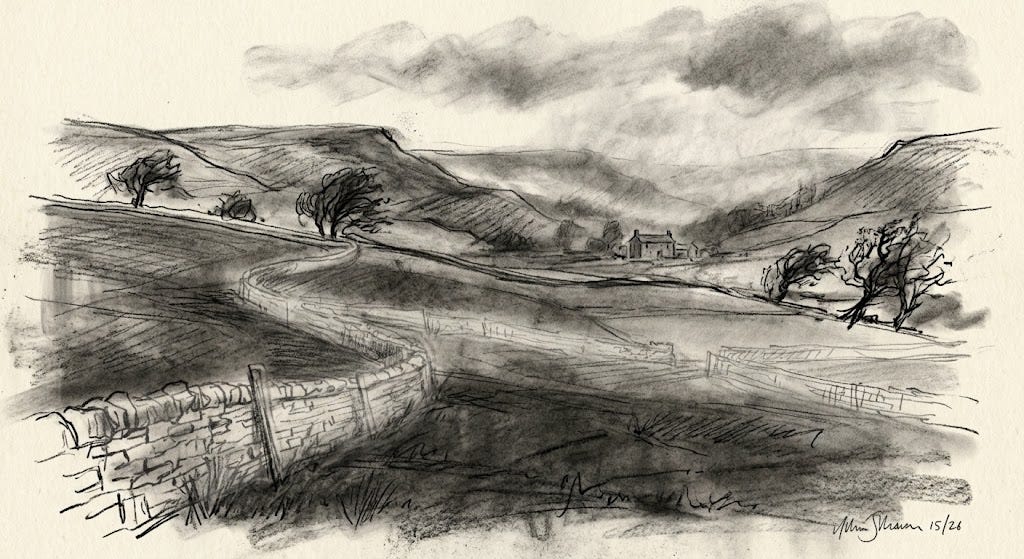
A month ago, I wrote a post “when the walls move”. At the time, it was an observation, but the idea has stayed with me, and grown.
There are times when we think that we are safely inside the walls, only to find somebody has moved them, and we no longer are. Equally, we can convince ourselves we are outside the walls, but then discover we are inside walls we never noticed being built.
I have watched as people in education with progressive views (Michael Gove’s famous “blob”) who nonetheless thought themselves part of the community, find themselves isolated, and in response, the nature of the blob seems to be responding to the pressure by fragmenting into defensive tribes.
There are a lot of people who find themselves with nowhere to belong.
Education is just one example; it seems that just about any sector that has grown at scale, and governed by the bureaucracies they generate, lack the flexibility and resilience to cope with the pressures that the changes we are experiencing require. They have little option other than to retreat to the inner walls, in a way reminiscent of the great castles of the thirteenth and fourteenth centuries that relied on layered, concentric rings of towered walls nested inside one another, until gunpowder and artillery made them irretrievably vulnerable.
It seems a useful metaphor as our fortified corporations and government bureaucracies succumb not so much to evolving technology, as to what those technologies enable. Traditional sources of power, from expensive military arsenals humbled by inexpensive drones, to slow moving corporations eviscerated by private equity special purpose vehicles. They do not surrender easily, requiring the sacrifice of those who work for them as they put up a futile defence.
We find ourselves in a time of remarkable asymmetry, as the walls we shelter behind prove themselves largely illusory, and our assumptions on trust, qualifications, communities and careers are called into question.
AI looks like being the modern gunpowder and artillery.
In Technofeudalism: What Killed Capitalism, Yanis Varoufakis argues that capitalism, as we’ve traditionally understood it, has already given way to something new. Businesses and consumers alike become tenants on privately owned digital territory, as the traditional market mechanism is replaced by platforms that dictate the terms of exchange in a reversion to a feudal-style economic order: a small class of digital landlords with wealth and power flowing from ownership of infrastructure rather than production. It is in many ways a latter day version of the nineteenth century enclosure acts in the UK, as common land to which all had access was replaced by private ownership.
The result then was a landless rural class stripped of its traditional subsistence; no longer able to graze, forage or farm on common ground. With access denied, the dispossessed had three real choices: stay on as tenant farmers under a landlord’s terms, emigrate to the colonies, or pour into the rapidly industrialising cities. Each path carried its own cost. Emigration simply exported Britain’s rural poverty overseas, while the flood into cities like Manchester and London arrived faster than housing or sanitation could absorb it, producing overcrowded slums, cholera outbreaks, and a desperate labour surplus that let employers pay starvation wages. The village’s mutual support networks were not replaced by anything the city offered; people were left atomised, and rural unrest, from rick-burning and machine-breaking to the Swing Riots became the direct expression of that dispossession.
It is not too big a stretch to imagine we face similar forced choices and costs. We can submit as tenants on a platform’s terms, “emigrate” to smaller alternatives with far less reach, or migrate en masse toward whichever platform currently offers the best odds in a move that only concentrates us further onto a handful of walled gardens.
I exaggerate to make a point. The tech backlash we see, and gig-worker strikes are, perhaps, may be early resistance to dispossession before it hardens into whatever the digital equivalent of the Poor Law turns out to be.
The advantage we have, that our predecessors did not, is access to information and connection. We do not have to follow the same path, if we are prepared to think new thoughts:
“Those who do not have power over the story that dominates their lives, power to retell it, power to rethink it, deconstruct it, joke about it, and change it as times change, are truly powerless, because they cannot think new thoughts.”
Salman Rushdie
I have used this quote many times, and do so again here unapologetically because its message to us is central; if we want a different story for ourselves, we must look around us for the material to create a different story. We will have to decide whether to make choices that are not risk free in pursuit of an alternative to the greater risk of following what we are being offered. The stories that have covered the time since the enclosures; of perpetual growth, of corporations as communities, and the pursuit of formulaic education designed for economies that barely include us, have been gradually failing, and are now moving to their “suddenly” phase.
It’s a deeply unsettling thought, and one that is easily avoided, with no clear answer.
If I knew the answer, I might be considering writing this not from a soggy Derbyshire, but somewhere more exotic, but there is no “cheat sheet” answer. Each of us is unique, with different skills, dreams and responsibilities. Nonetheless, I think we can distil our options down to a few essentials.
First, taking charge of our own development and finding our way to work that offers us more than money, and to borrow the earlier metaphor, become freeholders of our lives and careers, rather than tenants on somebody else’s terms. Increasingly, as productivity and efficiency become the drumbeat of corporate progress, our qualities that offer a different tomorrow are submerged beneath short term delivery of what is wanted today, in the knowledge that tomorrow our landlords may find a better way that does not involve us.
Secondly, focusing on the things we can do for the human economy not just the economic version. What do we do that makes us useful to those around us, not just the entity registered at Companies House? When we have made knowledge, and much of technique available on a keyboard tap, what do we understand that cannot be captured as data, and who might be prepared to pay for it?
Third, where is that precious resource most valuable? When we can increasingly automate all that we have converted to process, where does that part that is not process, on which relationships and reputations thrive or fail, exist? All processes have waypoints, where they move from one phase to the next, with each of them a potential inflection point. It is one thing feeling alienated by an automated response to a routine inquiry, another altogether where the response is to someone who can change the weather for us, and yet another when it offers opportunity that it takes the embodied senses of experience and a craft approach to work to notice.
When we find ourselves present at a waypoint, we might find ourselves facing an “accountability sink”, an organisational architecture that emerges naturally from the complexity of modern structures that makes tracing a decision to its origin for its actions almost impossible, or maybe as a “moral crumple zone” within our own organisation, a sacrificial offering for the risks knowingly taken by others. Or, if we make different choices, we might find ourselves with agency and authority, able to act as navigators through new, uncertain territory willingly carrying the risks that entails.
Much of what can be automated is to be welcomed, including the technology that initially frightens us. When it comes to delegation though, and creative thinking, our choices matter: we must be the delegators, not the delegated to.
That. though, is not how most of the organisations we work for see it, and so we find ourselves with a crucial question.
Where is there the most potential for us, as tenants on someone else’s land, or freeholders on our own small plot?. They both carry real risk, and it changes the decisions we must make, today. We cannot avoid the risk, so which ones do we choose? The risks of dependence, or independence?
It is a big subject, and beyond the scope of this blog, so I am going to take it over to The Athanor, along with similar questions from New Artisans and use them as Prima Materia, to see what alchemy might synthesise from them
Sources for the curious,
Madeleine Clare Elish, “Moral Crumple Zones: Cautionary Tales in Human-Robot Interaction”, Engaging Science, Technology, and Society 5 (2019), 40–60. The origin of the term. Responsibility is misattributed to the human nearest an automated system, who had limited control over its behaviour; where a car’s crumple zone protects the driver, this one protects the integrity of the system at the operator’s expense.
Dan Davies, The Unaccountability Machine (Profile Books, 2024). For the accountability sink, and for the argument that it arises from the structure rather than from anyone’s intent.
Ben Green, “The Flaws of Policies Requiring Human Oversight of Government Algorithms”, Computer Law & Security Review 45 (2022). A survey of forty-one policies mandating human oversight, finding that people cannot perform the oversight function asked of them, and that requiring it legitimises the system rather than correcting it.