Reflections 12th July
On Story Debt.
Muriel Rukeyser thought that the universe is made of stories, not of atoms. I suspect the same is true of our economies, as we have moved from economies of tangible goods and services made and sold, to stories: promises of what they will become, rather than what they are today. In a world predicated on perpetual more, the story of enough is a commodity.
Somewhere along this journey, we have adopted the same principles; that our value is in what we might enable and become in the future, rather than who we are today. We value the promise of tomorrow over the reality of today, and the idea of life on Mars over the reality of life today. Elon Musk’s notional wealth would buy two thousand hospitals at five hundred million each; enough good done now to make tomorrow on a distant planet look like the poorer bargain.
And that values drift seeps into every aspect of our work lives. Resumes have become stories about our ability to create stories that we have got others to buy, more than our ability to be useful to them in ways that matter beyond the margins we create for distant shareholders.
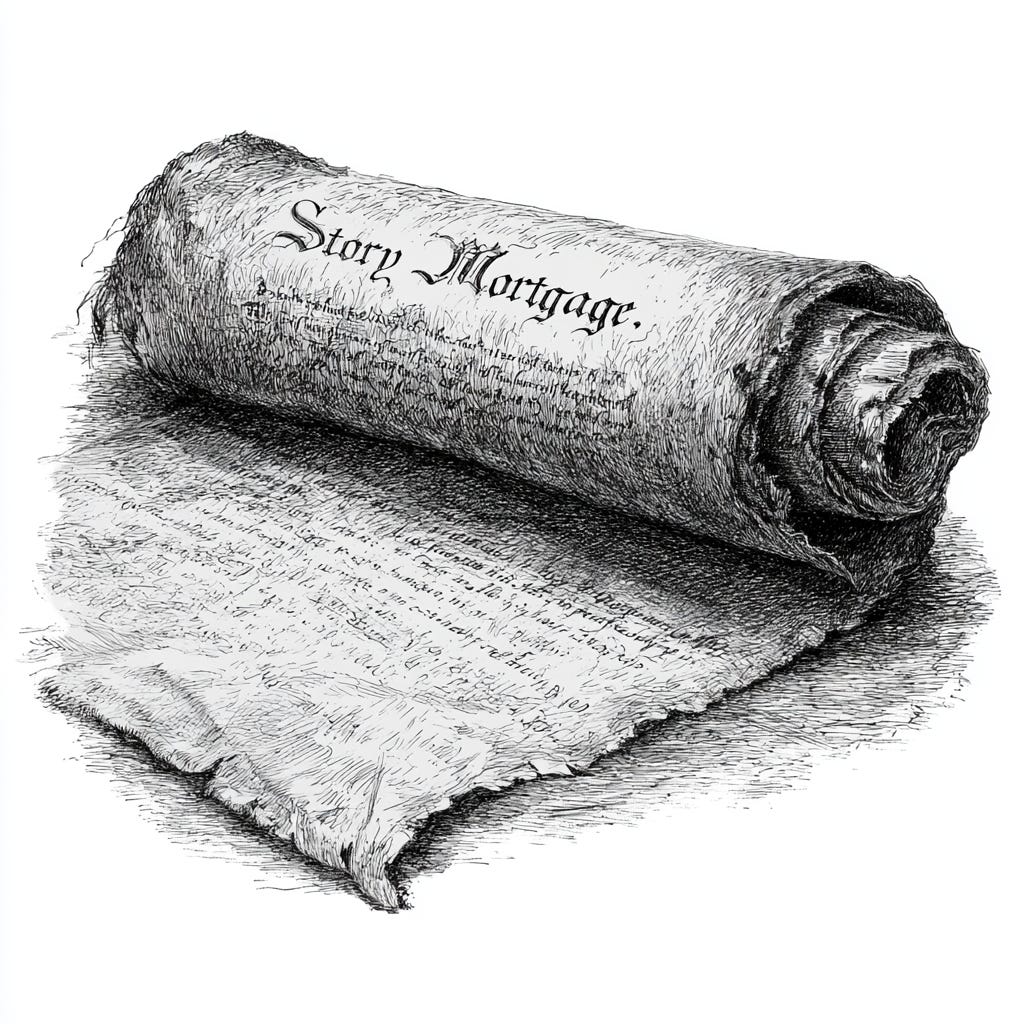
There is a particular tiredness that comes from defending a version of yourself we have privately stopped believing in. We hear it in the way someone recites their title a beat too quickly, protects a network they no longer respect, or keeps a qualification burnished long after the work it once certified has become obsolescent. Nothing is being lied about, exactly; we simply owe more to the story of who we say we are than the story is currently worth, and the interest payments we owe on the mortgage we have taken out on the story of who we are grow larger by the day.
Software people have a phrase for the first half of this. When they take a shortcut to ship something on time, they call the consequence technical debt: the code works, but every later change now costs a little more, and that extra cost is the interest on the corner they cut. It is a phrase that makes an invisible thing legible. The debt can be carried while we have momentum and the means to pay it down; the trouble begins when the debt remains as momentum slows and starts, unnoticed, to take control.
We carry the same kind of debt on ourselves, and it behaves like a mortgage. A mortgage makes a valuable servant. It is how many of us come to live anywhere at all. We borrow against a future based on a set of assumptions of progress so that we can occupy a house we could not otherwise afford, now.
A story about ourselves works the same way. We claim the identity before we have quite earned it, the new title, the place in a group that confers it, and then spend years either growing into it, or finding, gradually (and often, then suddenly), that we will not.
In the early days, almost every payment is interest. The story we have sold demands that we grow into it, on its terms. When things are going well, little of that effort touches the underlying question of whether the thing is yet true. If our story and reality start to align, we build equity, and the story becomes ours to keep.
The difficulty arises when we cannot keep up the payments. Sometimes the ground moves; the profession or trade we trained for thins out, the certificate hanging in the hall gradually becomes a part of history, the story becomes worth less than what we still owe on it, and we find ourselves refinancing.
We move from one job in a slowly failing sector to another in another company that is looking to us for its salvation, and we increase our story mortgage to do it. It used to be we could carry on like this for most of a career, and if all else failed, retire early. I think this is much of what it costs to stay inside the walls of an institution, or a profession, where we have a settled identity, comfortable in proportion to how much of ourselves we have mortgaged in order to belong to them. So we go on defending them for the same reason we keep paying a mortgage we can no longer justify: not because we cannot recognise what is happening, but because the collateral is our story, and we cannot find another buyer.
What happens, though, when we are inside the walls, paying our story mortgage, and find barbarians at the gate?
The barbarians at the gate used to be people with spreadsheets. They came for the asset that was the company we were inside. What they wanted from us was more of the same work we were already doing, harder and for less, so that the debt they had loaded onto the place could be paid down through us. It was extraction, brutal, but it left the story of us intact, if now discounted. Those of us who worked through the closing years of the last century will recognise, and feel, this scenario. They needed the person at the post. Whatever story we had mortgaged to occupy that post, they wanted us to go on servicing it, because our story was one of the cash flows they had bought.
The barbarian at the gate now is a different creature, and it wants something else. It has not come to work us harder. It has come to establish, item by item, which parts of us are now necessary. It is very good at many aspects of the story we sold: the performance measures, the productivity improvements and the other data we promoted in order to belong.
Process, Lean, Agile, Six Sigma; the method turned into procedure, the judgment written down so another could follow it, and the piece of paper that certified we had done this before. These were the very things we mortgaged our story against, and they can do it without us. It does not besiege our position; it dissolves the part of the position that could be written down. And it does this from inside the walls, because the institution itself let it in, to service its own overborrowed story for one or two more years.
And so we arrive somewhere the asset-strippers never took us. They left us our story and took the company; this one takes our story and leaves us standing there holding only whatever the story was wrapped around.
We might ask, why me? I suspect the answer is in the nature of the walls themselves. Most of our large organisations are vehicles built to enable scale, and carry the DNA of scientific management in their structure. The office was born the day we agreed to write the work down. Scientific management took the judgment out of the hand and put it in the file; a file needs a clerk, a clerk needs a procedure, and the procedure needs a tier of people to run it. The corporation is the residue of a single decision to make tacit work legible.
Inside the walls, a person who has mastered words and rules exerts a power out of all proportion to what he could do at the work itself, and the walls exist precisely to grant that leverage. They are made of what can be measured, and reward whoever makes themselves most legible to them.
Until they no longer do. LLMs are native to the file in a way no clerk ever was; all they have to do is internalise the data.
But what, I am wondering, about the new stories? LLMs will parse and rearrange and reinvent all of our existing stories to infinity. In doing so, they will give us valuable perspectives on what we already know. They will extend the franchise of what organisations already know. There is value in that, but it has a shelf life.
New stories need new thinking. LLMs can help us here. They have far greater working memories than we do. They can take what we know, rearrange it, and give it back to us, so that we can interrogate it in ways we could not before. But I am not sure that LLMs will step over the threshold. I suspect they will be happiest inside the walls.
Outside the walls asks for a different set of skills altogether. And that is the question we are left with: what those skills are, and where a person goes to learn them, once the our file has been handed to the better clerk.


