Reflections 12th April
Technology, Creativity and Dark Matter...
There is something deeply unsettling about discovering that the walls we trusted were never quite solid. Those around us believe in them, so we believe in them too. That particular conspiracy holds together perfectly well until the walls are tested, and they are now being tested to destruction.
What we might be facing is less rearrangement, more revolution.
Last week, I wondered about what we might do as the walls were being rearranged. This week I find myself wondering whether they will not so much be rearranged as disappear entirely and new ones replace them. We have become so preoccupied with artificial intelligence that human intelligence is not getting much of a look-in, and I think we need to change that.
“If we were going to define a revolution? - It’s the replacement of elites.”
Jimmy Carr on the TRIGGERnometry podcast. (recommended watch)
Ideas have their own elites, and create their own self-serving dogma. Elites won’t disappear, but they will change as the old order can no longer cope with the changes they are experiencing. As I write this, Anthropic’s Mythos threatens to enable consequential change much faster than the organisations (and management elites) can adapt.
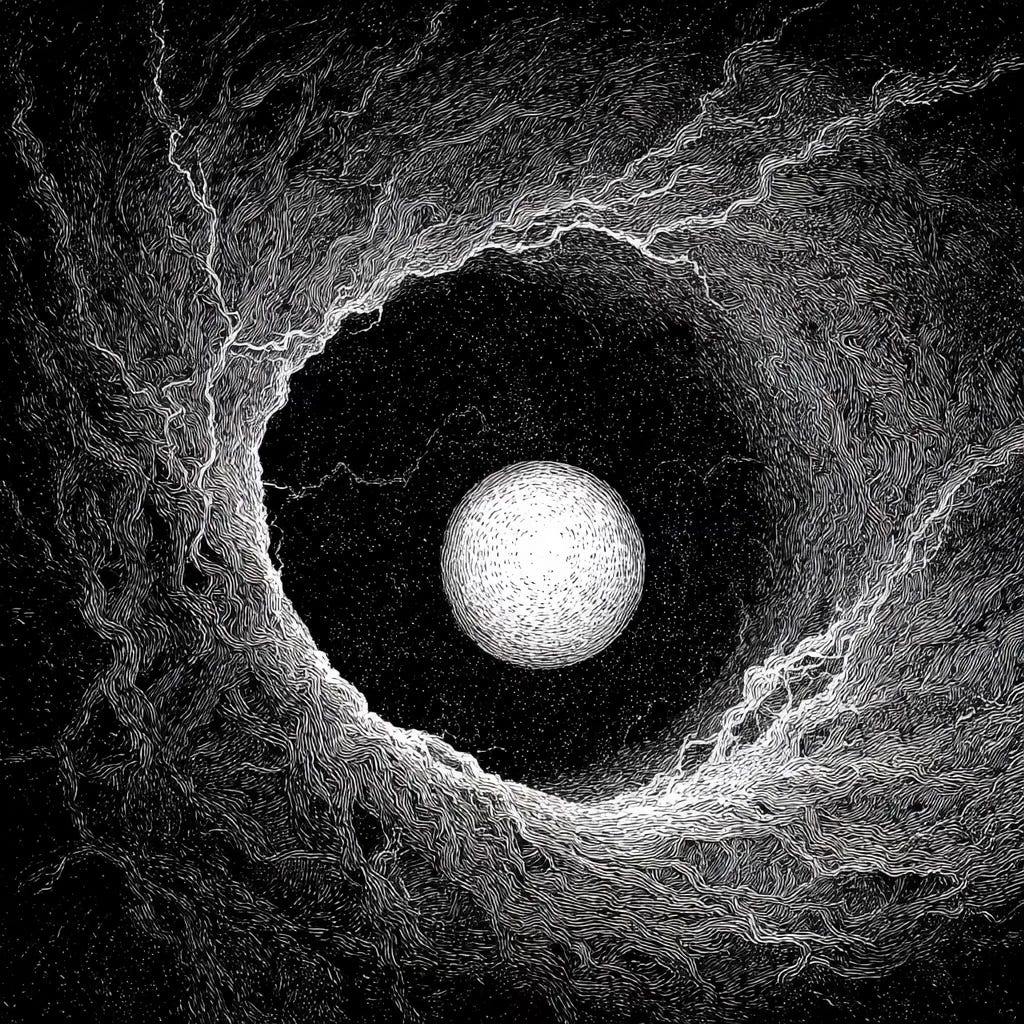
Which brings me to dark matter.
Cosmologists think the universe is roughly five per cent ordinary matter, twenty-seven per cent dark matter, and sixty-eight per cent dark energy. We can observe the effects of what we cannot see, but we still have only a partial, indirect understanding of what most of the universe actually is. The instruments we have built are very good at measuring the five per cent, but largely silent about everything else.
I think the same is true of us. We know more than we can tell.
We have arrived at a convoluted understanding of human potential, shaped at every turn by whatever partial view of wealth happened to be building the walls at the time. Our instruments, our institutions, our measures of productivity and value, are exquisitely calibrated for the five per cent they were designed to capture. The rest of what makes us individually unique, the curiosity, the judgment, the care, and the capacity for wonder, registers mostly as noise, or not at all.
It is not that we have forgotten how to wonder; our organisations have simply made it something to be done in the scarcity of our own time.
Mark Fisher (1968–2017) was an English writer, cultural and political theorist who argued that contemporary neoliberal capitalism has produced a pervasive sense that no coherent alternative to it can be imagined, with profound effects on culture, education and mental health. He also popularised the use of “hauntology” to describe how contemporary culture is haunted by “lost futures” that late capitalism has foreclosed. It is an evocative description of what I think many of us feel, and offered us the simple truth that to live in the twenty-first century is to have twentieth-century culture on high-definition screens. Better technology, static imagination.
He was pointing at something real: that despite the acceleration of our tools, we have been largely recycling the forms and assumptions of the previous era rather than generating genuinely new ones. The evidence is not just cultural. Measures of financial intermediation suggest that, over the course of the last century, finance grew from roughly two per cent of economic output to around six per cent before the 2008 crisis. We have, in other words, progressively shifted from economies that make things to economies that make money from the stories we tell about things.
Extraction masquerading as growth.
The instruments that drive this are very good at what they do, but they cannot track what is lost in the process: the civic capacity, the craft knowledge, the accumulated mētis of people who knew how to make things work in ways that resisted quantification.
That knowledge did not disappear; it became part of our economic dark matter.
Across history, the source of political power has tracked closely with whatever was scarce and therefore valuable. First land, then trade and industrial capital, then the ownership of information and the channels through which it moved. When digital networks collapsed the cost of producing and distributing information, it stopped being the primary scarcity.
Herbert Simon anticipated this: in a world rich in information, the truly scarce resource is human attention.
That insight became the architecture of the last two decades.
But attention is not the final resting place. As AI systems increasingly filter, summarise, and prioritise on our behalf, the bottleneck shifts again. The question is no longer who controls what you see, but who shapes how you think about what you see. In a world flooded with synthetic content, genuinely novel human experience, verified identity, the capacity to make considered judgments in conditions of uncertainty becomes valuable in ways that visibility alone never can. The next scarcity is not attention. It is cognition and the integrity of the processes by which we form it. Judgement, discretion, experience other qualities that are metric resistant.
It is where the five per cent problem becomes urgent.
The organisations we have built are not designed for this. The majority were designed to be as efficient and fast as possible at turning money into more money. Along the way, remarkable technologies emerged, but money has always been in the driving seat, and the instruments on the dashboard measure what money can see.
Much of our organisational inheritance makes sense when you understand where it came from. For a long time, the central problem was reducing the friction of transaction costs and pooling capital. AI is now taking care of much of what we have conventionally understood as transaction costs, but in doing so, it is not eliminating friction; it is replacing one kind with another.
The friction that remains is not logistical. It is cognitive and emotional. It is the work of not knowing, of sitting with uncertainty long enough to find something genuinely new in it, of making judgments that cannot be validated in advance and for which no algorithm will take responsibility.
That is not a problem technology can solve. It can help us think, structure, surface, and connect, but it cannot do the wondering or the caring. It can write poetry, but not feel its impact on our souls. These qualities remain stubbornly, irreducibly human. And there is a paradox worth sitting with: the technology we are perhaps most afraid of may also be the one most likely to free us from the narrowness of the measuring systems that have kept the other ninety-five per cent invisible.
Capital is agnostic. It has no loyalty to the organisational forms we have built, only to the potential for returns. As AI takes care of the frictions that made those forms necessary, the case for the old structures weakens. What that frees up, if we are paying attention, is space for a different kind of work. Capital does not lead; it is the ultimate, submissive follower.
I have written at New Artisans about the idea of mētis and of craft, about how the nature of human curiosity grasps and shapes what it doesn’t understand in ways that are not clinical, efficient or immediately productive, but which evoke the human power of curiosity, courage, and love of the unknown.
It is these very human, joyous qualities we are going to need.
Science, and the technology it enables, follow human curiosity and wonder, not the other way round. The capacity to embrace a mystery, hold it long enough to turn it into a heuristic, and eventually into something testable is a sequence that begins in a human being who cares enough to stay with something they did not understand. No model generates that from first principles. It has to be given something to work with.
The emerging work ahead is not technological. It is the harder, slower work of recovering our capability to explore the other ninety-five per cent: wonder, curiosity, courage, the willingness to sit with what we do not know, and the patience to find our way toward what only we can do. Not instead of the technology, but alongside it, and in the places where it can only follow.
The walls are rearranging themselves.
Whether we find that a threat to hide from or an opportunity to shape what we might do differently is a choice we all have to make.
The question of what that practice actually looks like, and what it demands of those willing to do it, is one I explore over at New Artisans.
The question of what practice looks like as we embrace the unknown is something we are working on in The Athanor.


