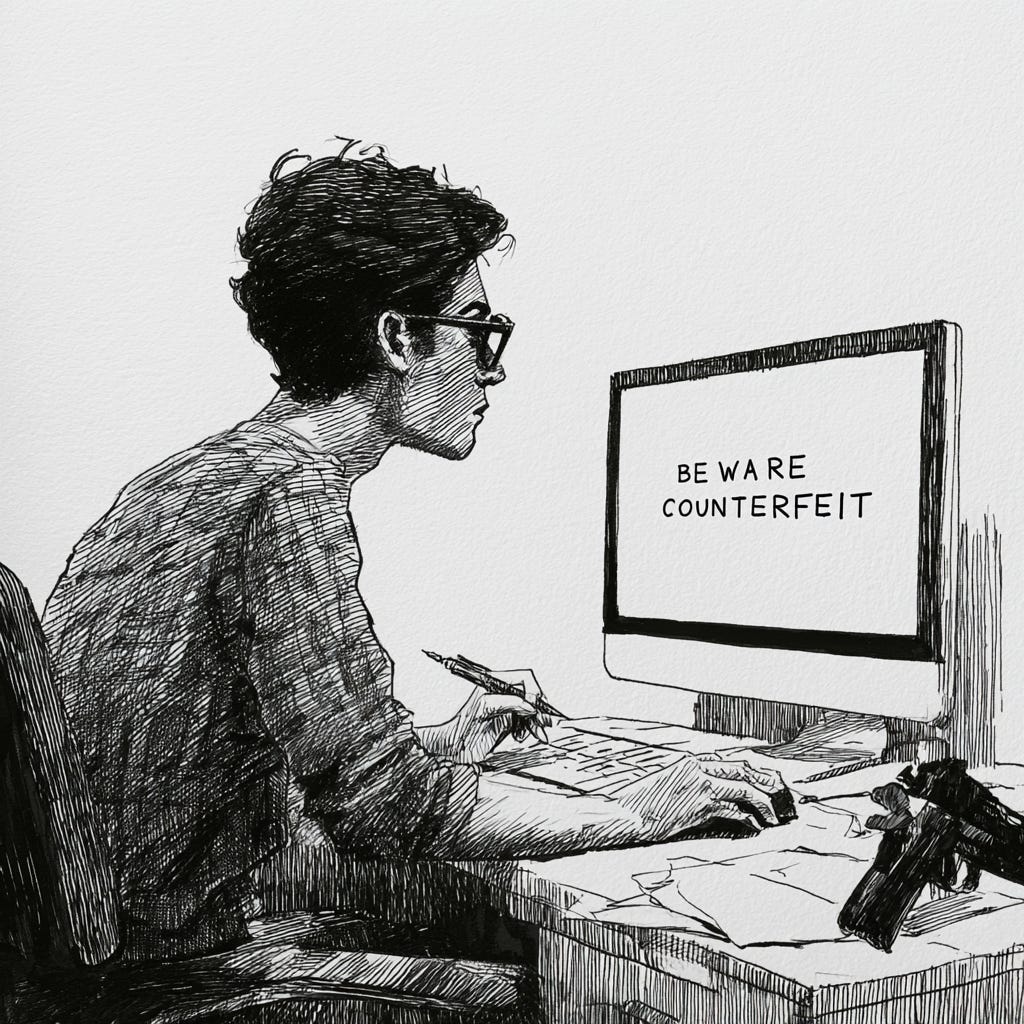
AI as Counterfeit?
Owning the work we do
AI appeared like a stranger newly arrived in town, fluent in many languages, full of bravado and promises, and throwing money around. The long term residents are still working out what she is really here for.
Google published a study in July drawn from about fifteen million interactions with its own models, and the numbers underneath the headlines are, for me, the interesting part. Workplace use spans two thirds of occupations, covering close to ninety per cent of American employment. Within any one job, AI is used for about a fifth of the tasks, although fewer than one in ten of those interactions automates a task outright. What people mostly bring to it is ideation, strategy, information retrieval and learning. Broad, then, but shallow. The stranger is everywhere, makes a lot of noise, but does not yet do very much.
Despite that, she is affecting how we work, because the tasks we are giving her are the ones through which we have historically learned judgement: Framing the problem, taking the first pass at it, forming the hypothesis, sketching the design, and working out what kind of question this is before anyone can answer it. This is the apprentice’s work, the necessary work through which an apprentice stops being one.
I was told last week about people qualifying in accountancy who have never kept a set of books, such that they are using AI to process data they have never had to generate. The output is correct, or correct enough, and that is the vulnerability. What is missing is the felt sense of when it is wrong, which arrives only from having learned the boring basics, making the entries by hand.
In the workmanship of risk the result is determined by a person the whole way through, and is open to being spoilt at any moment; in the workmanship of certainty the automation determines the outcome before the work begins; the operation just runs it out without a sense of what it feels like. What is being produced has no provenance. All process, no ownership.
It reminds me of counterfeits. A counterfeiter knows what the real thing is; it is the knowledge that makes the copy possible, and the good counterfeiters know the original better than most of its owners. I spent years understanding how counterfeit economies operate, and in my experience, the difference between a good counterfeiter and a brand is an advertising budget.
The position we are facing is worse. The vocabulary of the work has been acquired by AI without the workmanship, and there is no original held in mind against which the copy could be tested.
The obvious challenge is that every technology tool has faced this challenge. Calculators, CAD, the compiler, the spreadsheet. Each of these drew a similar complaint, yet mostly the complaint was misplaced. The sky did not fall. However, the earlier tools only took the process work; they left the context with the author. This one starts with the context, and becomes the author. I suspect that is an important difference.
Brands hate counterfeiters for good reason. They often expose the fundamental weakness of the brand story. Strong brands, with genuine credentials, thrive. Those with credentials manufactured by marketers rarely do.
It’s a question that applies to us. Would the client miss us for who we are if technology counterfeited what we do?
Sources
Google, AI & Economy ATLAS v1.0: Mapping Gemini Usage in the Economy


